Small manufacturers buy machinery and expect an uptick in orders
Small businesses that make machines and components for other manufacturers are experiencing an upswing that could be a sign of things to come for the broader economy.
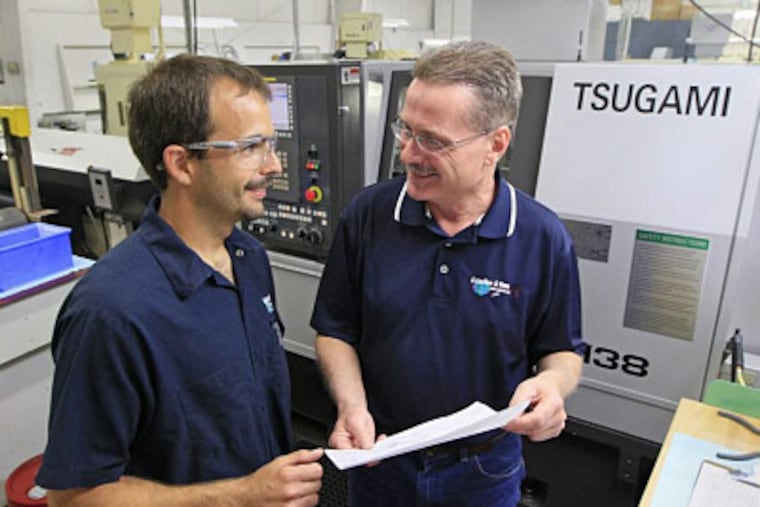
NEW YORK — Small businesses that make machines and components for other manufacturers are experiencing an upswing that could be a sign of things to come for the broader economy.
The industries fueling the demand vary. In some cases, business is coming from medical device makers, which are expected to see increasing growth as baby boomers age and need more medical care. An uptick in orders is coming from oil and gas producers supplying energy to growing economies in countries such as China and India. And then some are getting a pop in sales from aerospace manufacturers that are busy building fuel-efficient aircraft and engines and need special parts to get the job done.
As different as these manufacturers may be, they have two things in common: Their industries are expected to see continued growth and they're investing in expensive machinery that can cost millions of dollars.
This small manufacturer machinery boom may seem at odds with an economy that is suffering from slow job growth following the worst recession many can remember. But the increase in demand for gear that businesses use to make a variety of machines, parts, tools and devices is a sign that companies are more confident and are willing to spend. They're also getting loans from banks to buy the equipment — evidence that lenders are feeling more secure.
Last year, industrial and materials manufacturers had a 37 percent increase in big equipment purchases, according to PayNet, a company that tracks lending to small businesses. That compares to an average of 17 percent for all the industries PayNet follows.
"We're positioning ourselves now to have the capacity to respond quickly," said Pat Pastoors, general manager of Dynamic Sealing Technologies, which last month spent $450,000 on new equipment after spending $800,000 last year. In 2011, Dynamic Sealing paid $3.2 million to expand its Andover, Minn., factory. The company makes manufacturing equipment for companies, including food packagers and oil and gas producers. Pastoors said the company sees good potential growth in the industries it serves. The company's revenue rose 20 percent last year after doubling in 2010.
Skeptics should talk to the bankers who grant loans to companies that make gear and parts for other manufacturers, like Anthony Cracchiolo, president of U.S. Bank's equipment finance unit. U.S Bank's lending through its Manufacturing Vendor Services division, part of the equipment finance unit, is up 15 percent this year from the same period of 2011. And last year's lending level was up 26 percent from 2010. Equipment sales had fallen 70 percent during the recession. More recently, the bank, which is based in Minneapolis and has branches in 25 states, has seen an increase in demand for big machines like lasers, molding equipment and plastic injection machines.
By the end of this year, U.S. Bank expects this type of lending to be at 90 percent of pre-recession levels. It expects the recovery among these manufacturers to reach other parts of the economy.
Sales for privately held industrial machinery manufacturers, including companies of all sizes, are up nearly 23 percent in the last 12 months, according to Sageworks, a financial research firm.
Wells Fargo & Co. also is seeing an increase in lending to companies that manufacture products for other companies, said Hugh Long, head of business banking and based in the Philadelphia area. The bank would not provide a breakdown of how much lending to companies that make machinery and components has gone up, but "that particular subset of the manufacturing business is quite active," Long said.
Generous tax breaks that small businesses got during the recession were also an incentive for these manufacturers to buy big equipment. Morris said the laws that allowed him to speed up depreciation of new equipment were a factor in his decision to buy. However, those breaks have been scaled back dramatically this year. For example, what was a $500,000 deduction last year is now down to $125,000. It's not certain that Congress will increase them before Dec. 31.
Many of these small manufacturers spend months on design and development to customize parts for their customers. The complexities involved have given U.S. manufacturers an edge. That's helped some small companies in the U.S. take business away from manufacturers in China.
"For specialty manufacturing products, the end users are concluding it's better to have production close by, here in the U.S.," said William Phelan, the president of PayNet. "If there's a problem, they can get the parts shipped overnight, and transportation costs are less."
Wells Fargo also sees the trend in its lending to small manufacturers. "We're seeing this reverse offshoring — some call it onshoring," Long said.