QuestBridge program helps talented, low-income students attend top colleges
The phone call sent Carla Cain-Walther into shock: The Media teen, from a large, single-parent family of adopted children, was getting a free ride worth nearly $50,000 a year to a small liberal-arts college in Massachusetts.
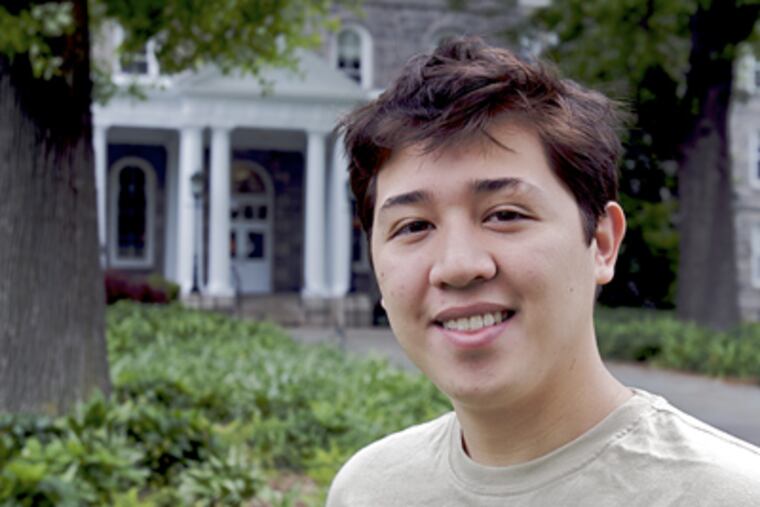
The phone call sent Carla Cain-Walther into shock: The Media teen, from a large, single-parent family of adopted children, was getting a free ride worth nearly $50,000 a year to a small liberal-arts college in Massachusetts.
For Cain-Walther, known simply as Baby Girl until adopted at 9 months old, it was a pleasant turn of fate.
"It was like one of the most amazing feelings. I just started sobbing," recalled Cain-Walther, 20, now a sophomore English major and poet at Williams College. "I thought maybe there is such a thing as fate, or maybe things do fall in place the way they're supposed to."
She is among 3,000 high-achieving, low-income students nationally who have attended high-end private colleges through the nonprofit QuestBridge program. The group includes more than 650 who were directly matched with 25 partner colleges and got all expenses paid, and others who got substantial aid or a free ride because of their low income.
Started by a California emergency-medicine doctor in 2004, the program has run for several years at Princeton University and Swarthmore College and is expanding this year to the University of Pennsylvania and Haverford College.
Palo Alto-based QuestBridge aims to identify students previously underrepresented on the campuses of America's most selective colleges: Those of modest financial means.
Its higher mission: "To reinvigorate America with more thoughtful and sincere leaders, drawn from the lowest economic quartile," said Michael McCullough, founder and president.
A 2004 report by the Century Foundation in New York found that only 3 percent of students at the nation's 146 most selective colleges came from families whose incomes were in the bottom 25 percent.
QuestBridge isn't the only program that recruits low-income students for colleges, and some schools do extensive recruiting of their own.
But it has been gaining respect for helping schools diversify faster. The average income of a QuestBridge family is $32,000, with few coming from families with incomes greater than $60,000.
"We were seeing those students in our pool, but not as many as Quest was able to identify," said Jim Bock, admissions dean at Swarthmore, which has taken 30 QuestBridge scholars and will add 15 in the fall among its 395 freshmen.
Penn is pleased with its 64 incoming QuestBridge scholars, who include a number of first-generation college students, many of them from public schools. Among them are two from Central High, an academic magnet in Philadelphia.
Haverford accepted 17 QuestBridge students. Princeton took 32.
QuestBridge schools cover tuition, room, and board. Many also pay for books, supplies, and travel, and offer work-study jobs to help with other expenses.
Participating colleges contribute 70 percent of QuestBridge's budget. The rest is from donations.
Candidates come from poor rural areas, urban centers, and even affluent suburban and private schools. One of Penn's scholars is from Friends Select in Center City.
"We're able to reach into areas of the country which are hard for individual colleges to get into," McCullough said.
QuestBridge e-mails honors and Advanced Placement teachers nationally, and networks with local groups to recruit students.
In a way similar to medical school selection, students make their top choices, and so do the colleges. Then students are matched with the top choice that wants them.
Dante L. Benson, a junior Asian-studies major at Pomona College in California, couldn't believe the program plucked him from Camden.
"I told myself, 'This looks too good to be true,' " said Benson, who was raised by a grandmother and graduated from Camden Academy Charter High School.
Fast-forward three years: Benson, who had just pulled an all-nighter for a final, said: "I've got not a care in the world, except for my studies."
He has maintained a 3.0 average and most enjoyed studying for a semester in Beijing, where he learned Mandarin.
"That's all coming from Camden, N.J.," he said.
Limited knowledge about financial aid most often is to blame for a shortage of lower-income applicants to high-end colleges, McCullough said.
"So QuestBridge not only serves as a recruiter but also as a mentor and teacher in trying to relay this information," he said.
Raymundo Alsaro-Aco's family moved from Mexico to the United States in 2005, with the intent of finding better educational opportunities for him and his brother. Alsaro-Aco knew little English when he arrived, but persisted, and racked up a 4.6 GPA at a Lancaster public high school.
But he didn't know how he'd pay for college. A teacher told him about QuestBridge, and he will begin his sophomore year at Swarthmore in the fall.
"I was really, really excited," he recalled. "After three years of being in high school, struggling with language and culture in general, I was finally completing the goal of going to college here."
Alsaro-Aco belongs to a campus Latino organization and writes for the Spanish literary-arts magazine. Interested in biochemical research, he likes the close student-professor relationships at Swarthmore.
QuestBridge students must be high academic performers, McCullough said. The average GPA is 3.9, with a combined reading and math SAT score of 1,337.
Williams College, in the program for five years, has seen its percentage of first-generation college students grow from 13 percent to 20 percent, said Richard Nesbitt, director of admissions.
Williams has enrolled between 30 and 50 QuestBridge students each year, he said. Their retention rate is the same as that of the student body as a whole, he added.
Nationally, QuestBridge retention rates are equal or superior to the schools' overall averages, McCullough said.
Cain-Walther came from an unusual family: Eight adopted children, all unrelated, several with HIV, a single mother at the helm. (Cain-Walther is not HIV-positive, but her birth mother, whom she does not know, was.) One sibling was Italian, one was biracial, one was Hispanic, and the rest were black.
In 1989 her mother, Nadine Walther, waged a public battle after one of Cain-Walther's HIV-positive siblings was booted out of a New Jersey nursery school. Two siblings with the disease died.
"Growing up with so many kids was difficult, especially with two kids who were sick with HIV/AIDS," Cain-Walther said of her early years in Lebanon, N.J. "Our family suffered discrimination and prejudice."
At Strath Haven High School in Wallingford, she thrived: She took AP classes, read incessantly, was inducted into the National Honor Society, and ran track.
But she was stressed about college. How would her mother, a teaching assistant, afford a good one?
Then she learned about QuestBridge.
"I feel like I fit perfectly here, and it's exactly what I wanted out of a college," said Cain-Walther, who has a B average at Williams. "I love all the professors, and the class sizes are really small."
Next year, she plans to study in London.
Someday, she hopes to write her family's memoir.
"Knowing I was given a second chance, I definitely have singled out the great things in my life - my family - and have tried to preserve them," she said. "I've also done that with my chance through QuestBridge."