Two years in, Temple's president getting 'A's
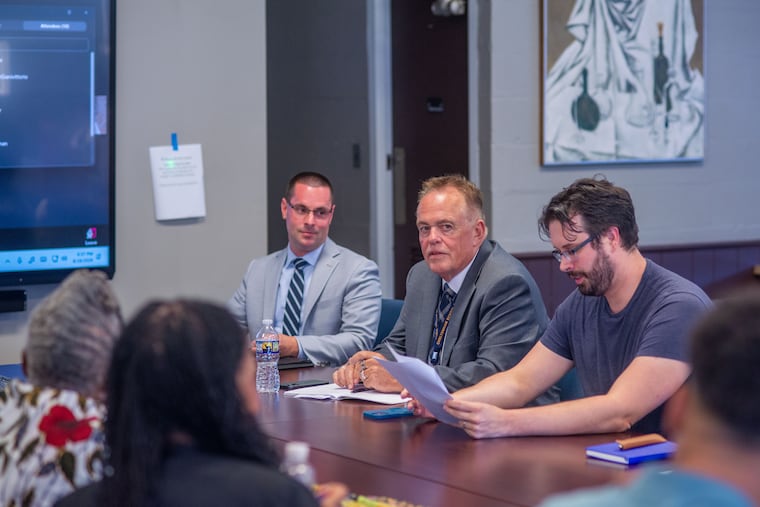
Sitting around a Temple University conference table, Ameena Soliman and her classmates laid out the problem: Commuter students have no place to store books or keep warm while they wait for a train.
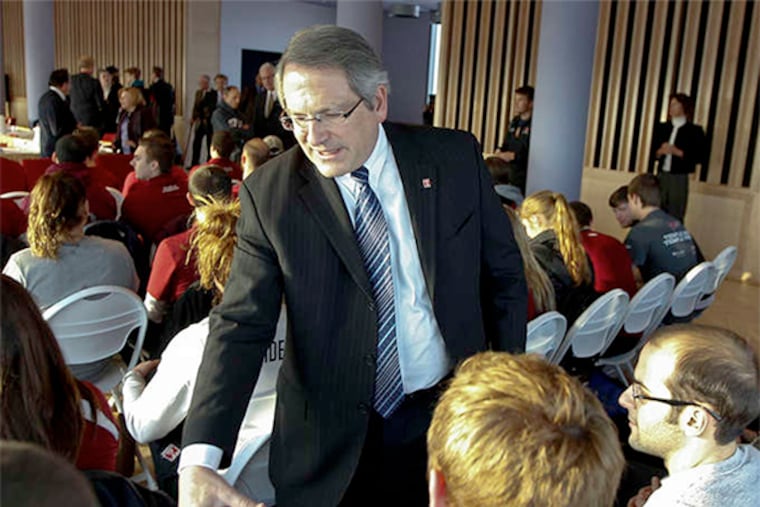
Sitting around a Temple University conference table, Ameena Soliman and her classmates laid out the problem: Commuter students have no place to store books or keep warm while they wait for a train.
"If you have four classes and four textbooks, you have to carry them all day," noted Soliman, a finance and marketing major from Yardley who was a freshman in the fall of 2013 when she lodged her complaint.
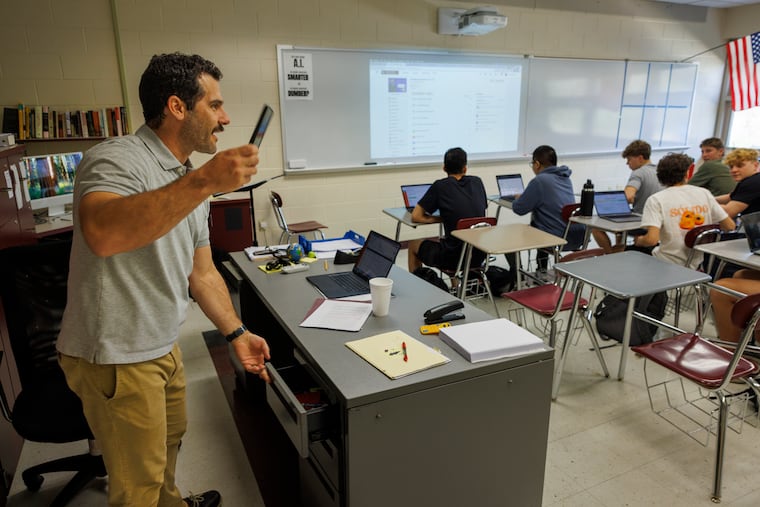
The professors - Neil D. Theobald and his wife, Sheona - listened intently. This wasn't something that had been brought to his attention before, Theobald told his organizational change class, but one worth resolving.
He put students in touch with James Creedon, Temple's facilities' head, so they could find a solution. On Monday, a new commuters lounge, with lockers, chairs, and TV monitors, opened at the Montgomery Garage on Berks Street, next to campus and a block from the train platform.
Quite an impact for a group of first-year students, but then again Theobald, 58, isn't your ordinary professor. He's also president of the 39,000-student university in North Philadelphia, which he has headed since January 2013.
For Theobald, it has been two years of discernible progress, some major successes and a misstep or two, with formidable challenges ahead.
The expert in education finance has implemented what could be considered his signature program, designed to have more students graduate in four years and avoid additional debt. Nearly nine of every 10 freshmen have agreed to participate.
The university in October settled a contract with faculty after what union president Arthur Hochner called "the most cooperative negotiation we've ever had." Theobald weathered a bruising battle over the decision to eliminate some sports last year, unveiled a master plan with a new library and huge green space, made SAT scores optional to broaden access to more applicants, and has begun to forge relationships in the city's and state's complicated political worlds, with a former mayor as his tutor.
Those on campus and off describe him with words like open, honest, and candid, an energetic leader who has set out a transparent blueprint for his tenure and has pretty much stuck to it. He's almost so humble, said one observer, that it's easy to underestimate him.
"The difference with Neil is he won't be in the box, he'll be in the seats at games," said Patrick O'Connor, chair of the board of trustees. "He won't be at the executive dining room. He'll be at the student cafeteria."
Overall, O'Connor said he would give Theobald an A.
"He's innovative, not reactive," O'Connor said. "He sees what the issues are and he quietly goes about making Temple a better place."
Under his five-year contract, Theobald earns $450,000 in base pay and lives in Temple's presidential condo on Rittenhouse Square, with his wife of 32 years.
So far, he says, he has thought his time at Temple has gone extremely well. "What we need to do next," he says, "is really monitor how successful we're being."
The challenges facing Theobald are significant: Students increasingly are living on or near campus in neighborhoods affected by crime, resulting in friction over parking, parties, and trash. The university's health system, which serves predominantly low-income and elderly patients, is running a $6.6 million deficit, and board leaders have charged him with solving that problem in the next year.
At the same time, Temple has seen flat state funding for the last several years and growing expenses as pressure mounts to keep tuition increases low. Alumni giving has waned, with 6.9 percent, or 18,000, donating last year - a drop from 11 percent, or 21,135, five years ago, though overall, Temple raised a record $67.9 million last year.
Theobald, a Midwesterner with no previous ties to Philadelphia, is an outsider, which can be difficult in a city where politics are decidedly insular.
But he's undaunted: "I think the potential here is immense. I'm extremely optimistic."
'Fly in Four'
A first-generation college student, Theobald knows how important it is to keep education affordable. The son of a blue-collar worker for a Peoria, Ill., tractor company, Theobald was headed for factory work until he scored high enough on his SATs that a guidance counselor told him he could probably not have to pay to go to college. He went to Trinity College in Hartford, Conn., on a full scholarship then started teaching high school math in Washington state. He later became a professor at the University of Washington before heading to Indiana University, where he worked for two decades, most recently as senior vice president and chief financial officer.
When he arrived at Temple, Theobald set reducing student debt as a major goal. The university unveiled "Fly in Four," a program that doles out $4,000 grants to the neediest 500 students if they agree to meet with advisers, register early, and stay on track to graduate in four years. The university modified its academic calendar to allow for a third semester in the summer so that students have extra opportunity to fit in their required course work.
It also added online courses, retooled class offerings, and beefed up academic advising.
"We're signaling very clearly, if you want to hold down debt, the best thing you can do is graduate in four years," Theobald said, "and here's this path that's very clear on how to get from here to there."
Forty-four percent of Temple's Class of 2014 graduated in four years - an increase from 39 percent three years before. Theobald would like to hit 60 percent by 2020, he said, which should lower student debt. On average, students graduate owing $34,000.
The plan, which Theobald recently talked about at a White House summit, has excited city officials trying to boost the number of residents with college degrees.
"This model has received national attention and is certainly having an impact on our local colleges and universities who are now seriously considering similar types of programs," said Lori Shorr, Mayor Nutter's chief education officer.
Labor peace
It took less than a month to reach the faculty's new four-year agreement, and 96 percent voted in favor.
Hochner, who is a business professor in addition to union president, credited Theobald with setting the tone for such positive negotiations.
"He made it clear that our priorities aren't all that different, which is a very refreshing thing to hear," Hochner said.
Hochner also likes that the university has committed to a $50 million, five-year boost for new research aimed at improving the city and region.
But he has some concerns. Some faculty and administrators also are wary of a new budgeting model Theobald brought, which will cause departments with dropping enrollment to operate on less money and could force cuts. The college of liberal arts - the university's largest - could be particularly hard hit.
Overall, Hochner, who has been at Temple for more than three decades spanning four presidencies, said he would give Theobald an A-minus - higher than he rated the previous two presidents.
"Temple's moving in a positive direction, . . . could do some things better," Hochner said. "The jury's still out on some things."
Street scenes
Theobald has been learning about the city in part by walking it. His partner often is former Mayor John F. Street.
Sometimes they walk an hour, other times three or four. They have been to the Navy Yard, through Strawberry Mansion, and around campus and Center City, talking Philadelphia history, politics, and people.
"He's helping me get the context," said Theobald.
One day, he shared a problem, and Street told him to talk to Joyce Wilkerson, his former chief of staff. "Who's Joyce Wilkerson?" Theobald asked. "And he looked at me like: 'You don't know?' "
Theobald has since hired Wilkerson as senior adviser for community relations and development.
Street finds Theobald more community-oriented than his predecessors and was struck by his genuine desire to learn how the city works.
"He was dedicated to the proposition of really trying to figure it out," said Street, an adjunct professor at Temple.
His prominence is key in a region where one in seven college graduates hails from Temple.
City Council President Darrell L. Clarke, whose district includes Temple, said Theobald had been "extremely accessible" and willing to work on neighborhood issues. "We affectionately call him Dr. T up in the neighborhood. That's a badge of honor," Clarke said.
Theobald also has garnered praise for his recent testimony before the state's Basic Education Commission on K-through-12 school funding.
"He has become a tremendous asset to this city in a very short period of time," said Shorr, Nutter's education adviser.
Still, board chair O'Connor would like to see Theobald emerge as a bigger figure in the community, akin to Drexel president John A. Fry, a former University of Pennsylvania administrator who heads incoming Gov. Tom Wolf's transition team.
"I would like to see him adopt a more public persona," said O'Connor, "for his sake, the sake of Temple, and the sake of the community."
Toughest decision
No question, the cutting of sports teams has proven to be Theobald's toughest test.
"I'd rather hang myself before I do that again," he said.
He points out that the $2.4 million saved was pumped back into doctors, better dining options, upgraded sports facilities, and academic help for remaining athletes, excluding football and basketball.
But some still fault him for how Temple sprang the elimination of seven sports with virtually no notice. Temple eventually restored men's crew and women's rowing after philanthropist and Inquirer owner H.F. "Gerry" Lenfest and the city agreed to fund the renovation of a canoe house. Hard feelings have persisted.
"My hope is that the president and the board learned some important lessons from that," said Mark C. Rahdert, a longtime law professor, who generally gives Theobald good marks for his tenure.
Theobald said he's not sure he could have done it any better.
"This is just impossible news to break," he said. But, "I have no doubt it was the right decision."
A teacher too
In Theobald's class, students spend the first semester identifying problems and the second semester working in teams to solve them. They use Temple as their practice field, and their ideas have taken hold: University police squared off and expanded their patrol zone. A new dining center with healthy options and longer hours opened at Morgan Hall, and all incoming freshmen now have lessons in financial literacy.
"They give you ideas you would never have thought of, just because it's real to them," Theobald said.
For Soliman, now a sophomore, it was thrilling to see the commuter lounge become a reality.
"A lot of times you do projects or assignments in class and they're in theory," she said.
She also gives high marks to her professor.
"When you think of someone in power, you think of someone distant, someone you really can't talk to," she said. "He's very personable, very approachable."
215-854-4693 @ssnyderinq