CLASSICAL NOTES
Rachmaninoff's Symphony No. 2 will get you to the Philadelphia Orchestra concert . . . but the Mark Anthony Turnage Piano Concerto will expand your ears. Turnage, 54, has long been England's brilliant renegade composer, his first operatic success being Gr
Rachmaninoff's Symphony No. 2 will get you to the Philadelphia Orchestra concert . . . but the Mark Anthony Turnage Piano Concerto will expand your ears. Turnage, 54, has long been England's brilliant renegade composer, his first operatic success being Greek (Oedipus with a surprisingly happy ending). More recently, Anna Nicole (yes, Anna Nicole Smith) was the great last hurrah of the New York City Opera. Now, the 2013 concerto, featuring Marc-Andre Hamelin, Thursday through Saturday at the Kimmel Center, is what music director Yannick Nézet-Séguin describes as jazz-inflected with "an immediacy of rhythm that makes you want to dance." Radio recordings of the Rotterdam premiere suggest that's an understatement. Information: 215-893-1999 or www.philorch.org. - David Patrick Stearns
It is to laugh. There's an eerie, never-spoken- of soundtrack to Duchamp's Étant donnés, the endlessly enigmatic work in residence since 1969 at the Philadelphia Museum of Art. The low, constant wind-whistling E-flat draws a creepy aural scrim around the walk-in experience, a room with a door through which a diorama is spied via two peep holes. I've always accepted the sound element as an intentional part of the piece. But no, a museum spokesman says, it is just ambient sound. The pitch is apparently an unplanned consequence of air pressure in the room around the installation. Which, in this context, makes it the most ecstatic of accidents. Duchamp was the father of the "ready-made" - an everyday object becoming art by the act of declaring it so, making this perhaps a musical ready-made. - R. Mutt
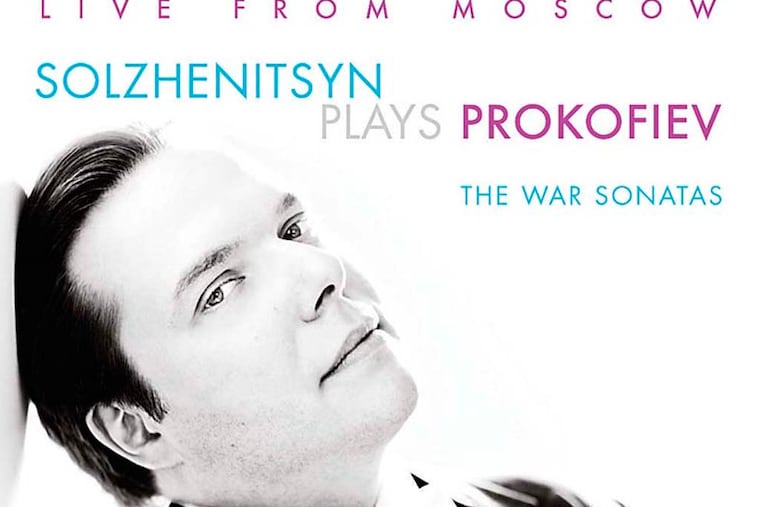
The war in perspective. Pianist/conductor Ignat Solzhenitsyn is at his best with music that gives him plenty to do - emotionally, intellectually, and technically. So Live from Moscow: Solzhenitsyn Plays Prokofiev is, not surprising, core repertoire. The composer's Piano Sonatas Nos. 6, 7, and 8, the so-called War Sonatas written in the 1940s, often come off like pianistic assaults. In Solzhenitsyn's hands, they are varied and nuanced, with influences from Chopin to Poulenc contributing to some of Prokofiev's most compelling moments. The live-recording circumstances are mostly an advantage: In-concert energy keeps Solzhenitsyn away from the interpretive microscope he sometimes uses in studio recordings. The Illuvium-label release is digital only, but available from the usual places (Amazon, etc.). - D.P.S.
Find out for sure. Walk upstairs to your attic. Find the violin Uncle Herman left you. Or was it a viola? It's probably worth only the hundred or so dollars he paid for it. But what if it's not? What if it turns out to be a rare Italian instrument? So many questions. Answers might be within reach if you bring your stringed instrument down to the free valuation event being held Jan. 28 by online auctioneer Amati at the Philadelphia Airport Sheraton. Information: amati.com. - Peter Dobrin