A writer who steered life toward poetry
In her brief life, Flannery O'Connor produced short stories of Southern Gothic strangeness. A biographer draws on a wide trove of letters.
A Life of Flannery O'Connor
By Brad Gooch
Little, Brown. 464 pp. $30
nolead ends nolead begins
Reviewed by Bob Hoover
In his book
God and the American Writer
, Alfred Kazin starts with Nathaniel Hawthorne to examine the struggles with the angel that occupied so many American writers.
Using the dark, Puritan moral absolutism of his New England ancestors, Hawthorne wrote of guilt, shame, and punishment, resulting finally in his powerful novel The Scarlet Letter.
One hundred years later, grounding her strange fiction in her homeland, the South, Flannery O'Connor felt a kinship with the Yankee writer.
Speaking on "Some Aspects of the Grotesque in Southern Fiction" in 1960, O'Connor cited Hawthorne for his ability to raise fiction from the ordinariness of life and "steer it in the direction of poetry."
For both writers, the poetry came from God, but different ones. Hawthorne's was a Calvinist creation, O'Connor's a Roman Catholic one.
In his new biography, Brad Gooch focuses on O'Connor's deep-seated faith as the mainspring of her emotional and intellectual life. Writing on novelists of the 1950s, John Updike described O'Connor's fiction as "Christian orthodoxy eminently, provocatively represented." Her life was cut short by lupus: O'Connor died at 39 in 1964 after a 14-year battle with the same disease that killed her father when he was 45.
A member of an extended Georgia family, Mary Flannery O'Connor was well cared for all her life, mostly by her mother Regina and other relatives, all of whom had little understanding of her work, Gooch writes. "She don't read any of it," O'Connor told a friend about her mother's relationship with her fiction. "Does it have any symbolisms in it?" was the only question Regina asked about her daughter's second and final novel, The Violent Bear It Away.
A shy and awkward young woman who described herself as "of the 13th century" and insisted that her real age was 12, O'Connor found her way to the Iowa Writers' Workshop in 1945 as that fabled program got off the ground. There she found the confidence and guidance to write fiction seriously.
A stint at the Yaddo writers' retreat in Saratoga Springs, N.Y., deepened her resolve, as she matured in the presence of people like Robert Lowell, Elizabeth Hardwick, and Malcolm Cowley. Other key relationships with publisher Robert Giroux and editor Caroline Gordon introduced her to New York publishing.
(A commentary on the world of book reviewing in the New York press of the 1950s: Gordon reviewed O'Connor's remarkable collection A Good Man Is Hard to Find for the New York Times in 1955, after editing the manuscript. The review was a rave, of course.)
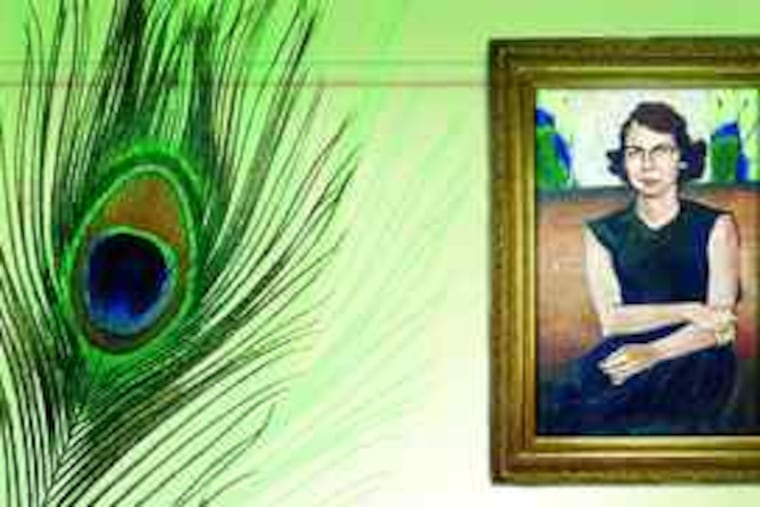
O'Connor's illness ended any hope of an independent life, and she returned to her mother's dairy farm in Milledgeville, Ga., at 25, attended by a flock of peacocks.
Her first novel, Wise Blood, was published in 1950. Its original, oddly stylized and violent story of Hazel Motes, an ex-serviceman who starts his own religion, the Church of Christ Without Christ, in a ruined Southern landscape, baffled reviewers and readers alike.
It also stamped O'Connor at first as a curiosity piece of Southern Gothic.
Isolated in Milledgeville, O'Connor was still able to grow as a writer, particularly of short stories based on the local folk and news items she found in the papers.
It was not a life of excitement, adventure, or full-blooded romance, leaving Gooch - also a biographer of poet Frank O'Hara - little more to work with than the uninteresting details of comings and goings, meals, daily attendance at Mass, and medical reports.
Fortunately, he had a wide range of correspondence and personal accounts on which to draw. Those were the days of letter-writing, and O'Connor and friends were engaged in lively and revealing correspondence.
These sources fill many pages, but what his book lacks are fuller discussions of O'Connor's works. Only occasionally, as in his commentary on the background of the story "Good Country People," do we get serious insight into O'Connor's process.
We are left, however, with her 32 strange and compelling stories, such as "A Good Man Is Hard to Find," "Revelation," and "Everything That Rises Must Converge," - too few, to be sure, but enduring and important.