Burrowing into bias
We all have it innately, psychologists say - it's our way of making sense of the world. Empathy can broaden biased perceptions.
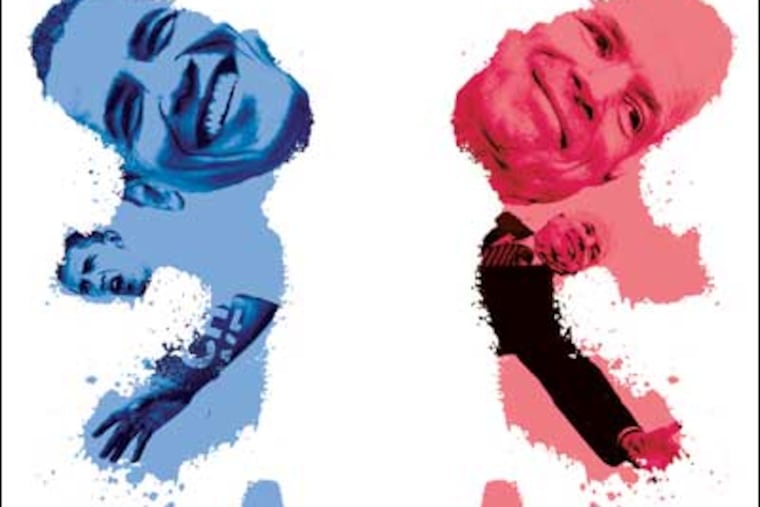
If you saw any of the political debates between Biden and Palin or McCain and Obama, you know who won. It was obvious.
Isn't it odd, though, that so many people in the media and elsewhere saw the same debate and thought the other side won? How could they see the world so differently? Are they stupid or just biased?
To further muddy the waters, the journalists trying to explain the world are injecting bias into their reporting - or so says former CBS journalist Bernard Goldberg, author of the book Bias.
"When you live and work in a liberal bubble, you can go a week or a month or maybe a lifetime and never run into anybody who has a different point of view," he said of his former colleagues.
Eric Alterman describes the reverse situation in his book What Liberal Media? He calls the concept of a liberal media a myth comparable to the story of George Washington and the cherry tree. "If it were true, we might have a more human, open-minded and ultimately effective public debate on the issues facing the nation," he wrote. "Alas, if pigs could fly . . . "
Which one is right?
Possibly both, say psychologists, but viewers and readers may bring just as much bias to the table as the reporters and writers.
The tendency to see the world through distorted lenses may have helped people for eons to make quick sense of the world, and even, by exaggerating their own self-worth, to win friends and influence people.
But in many instances, this human tendency to skew reality can cloud our vision and judgment, and so some psychologists are exploring ways to get around bias.
Psychologists say we're biased toward the perception that other people are more biased than we are.
Scott Plous, a psychologist at Wesleyan University, says it has been known for some time that people tend to attribute base motives more often to other people's actions than to their own. And those tendencies matter.
If you attribute poor performance on a test to insufficient studying, you might work harder next time, for example. But if you attribute the problem to an unfair test, you might not bother.
Plous said that when we explain the behavior of others we think of fixed traits - he or she is greedy or stupid or lazy. But we usually attribute our own behavior to circumstances: I was late because the traffic was bad, not because I'm inconsiderate.
Some of the problem comes from the fact that we can see into our own thoughts and motives but have to approximate those of others, said Emily Pronin, a Princeton University psychologist who has done experiments to show how bias works.
In one, Pronin asked student volunteers to read what they thought were statements about the views of the new university president.
But the president's "view" on affirmative action was manipulated so that it would agree or disagree with the students' views to varying extents.
What Pronin found was that the more the students' opinions diverged from what they thought was that of the university president, the more biased they found her.
When the volunteers agreed with her, they attributed her perspective on affirmative action to careful consideration, rational thought and insight. When they disagreed, they attributed her view to emotion, self-interest, or her own situation as a white female.
The perceptions of bias, in other words, had as much to do with the students' views as with those of the president.
Stanford psychologist Lee Ross said most of us live with the illusion that we see reality clearly while those who disagree with us are biased. And when we try to set them straight and tell them how things really are, he said, "we're even surer they're biased."
In some recent experiments, Ross and colleagues showed the same newscasts on the Arab-Israeli conflict to volunteers.
Those with strong views on both sides saw the news coverage as dangerously biased in favor of the other side. Both worried it would mislead ordinary people.
Ross said the perceptions of bias came not from what was covered but from what was seen as omitted. "Pro-Israeli and pro-Palestinian viewers both felt the media had not given critical background that would have revealed the real story," he said.
He has seen the same effect with the way McCain and Obama supporters reacted to news articles about Obama's association with William Ayers and other former radicals, or "terrorists," depending on your point of view.
"Liberals would say they're leaving out the fact that Ayers won the citizen of the year award and has a big grant from the Annenberg Foundation," Ross said. "Conservatives say they're leaving out how Obama not only sat on the same board with these guys but went to their houses."
Some of these differences come down to what Ross calls confirmation bias - the tendency to take information and evidence that confirm our beliefs at face value and subject information that challenges us to more critical scrutiny.
"We see the world through the prism of our own needs and expectations," he said.
Luckily, Ross said, our biases are not always set in stone.
In another experiment, Ross and colleagues asked students at Stanford a series of questions about their political views, but first, one group was asked to write an essay about how hard work and good decision making helped them gain admission to the elite university.
Students in another group were told to write about how luck and help from others influenced their ability to get into Stanford.
Those who were asked to write on the role of luck and help from others expressed consistently more liberal political views, he said.
"We carry in our minds these kinds of schemas," Ross said. "One says life is tough and there's a lot of luck involved and we should help each other," he said. "But we also know to some extent we get out of life what we put into it."
University of Pennsylvania evolutionary psychologist Rob Kurzban says an internal spin doctor might have given our ancestors an edge in life.
Most people see themselves as somewhat nicer, better-looking, smarter and more skilled at driving than most other people. And yet someone has to be below average.
In subjective realms such as beauty, a positive spin can improve your image: If you walk and dress and act as if you're great-looking, other people will think you're great-looking.
Kurzban suggests that a brutally honest self-image may make a person come across as depressive or pessimistic. Some psychologists have even considered the term "depressive realism" to describe those who see themselves clearly.
In our modern world, however, there are some pitfalls to inflated self-esteem. Hal Arkes, a psychologist at Ohio State University, said physicians tended to become biased toward their diagnoses in a way that might blind them to contradictory evidence.
Once doctors make a diagnosis, he said, they often remember suspecting this all along. That sense of "I knew it all along" is called hindsight bias.
To help doctors and others think more critically, Arkes has done some work in what he called "debiasing." It doesn't work just to tell people "don't be biased," he said, since people tend to be biased about their own relative lack of bias.
What works in the case of doctors is to ask them to think of the other possible diagnoses and the reasons each of those might be correct. Scientists often do something similar by trying to prove themselves wrong, even when their hopes and aspirations hinge on their ideas' being right.
Bias author Goldberg said it hadn't escaped him that, being human and a member of the media to boot, he is not above being biased himself. How does he avoid it?
"I go out of my way to see the other guy's position," he said - a tactic similar to the debiasing that Arkes suggests for doctors.
Think how much better we could all communicate if we tried to really listen to people on the other side - even if they are morons.