Report: Beach quality slipping
A New Jersey environmental group says developers are fouling the waters at the Jersey shore with feces and trash, but officials there say the group is full of crap.
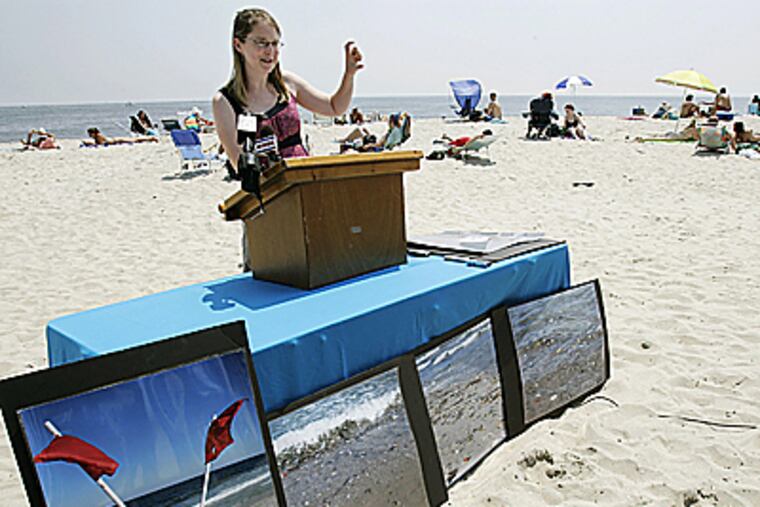
A New Jersey environmental group says developers are fouling the waters at the Jersey shore with feces and trash, but officials there say the group is full of crap.
Doug O'Malley, of the advocacy group Environment New Jersey, said additional stormwater drains that accompany new development give feces and trash a free ride to foul up the water.
"Developers are literally loving the Shore to death," O'Malley said yesterday.
"And if we don't do something about it, we're all going to be standing in deep doo-doo."
The Natural Resources Defense Council released a report yesterday that found that New Jersey beaches had closed 142 times in 2007, eight more than in 2006.
The report cited stormwater - which is excess rainwater funneled to waterways via street drains and pipes - as the source of the contamination 72 percent of the time when bacteria is found.
Shore officials interviewed yesterday pointed out that the beaches that exceeded bacteria levels in the report were all in rivers, bays, or lakes.
There's nothing murky about New Jersey's ocean beaches, they claimed.
"You can see your feet in waist-deep water in Wildwood," said Diane Wieland, Cape May County's director of tourism. "The water is cleaner than it's ever been."
But O'Malley said it's just a matter of time before ocean beaches are impacted as well.
"We're changing the entire ecology of the Shore," he said. "Barnegat Bay [Ocean County] is becoming the state's largest stormwater-retention basin."
If stormwater drains are the culprit, O'Malley said, he wants to make sure no more are built at the Shore.
"We need Governor Corzine to put a halt on development at the Shore," O'Malley said. "He's the one who can stop it."
Elaine Makatura, a spokeswoman for the New Jersey Department of Environmental Protection, said she was skeptical of the report's tone. She pointed out that 72 percent of the beach closings in 2007 were pre-emptive.
"There were also no ocean- beach closings because of high bacteria," she said.
O'Malley and Shore officials agreed that the public needs to be more mindful of what gets washed into drains during a storm: dog feces, fertilizer, cigarette butts, and anything else discarded on the street.
The proliferation of Canada geese, specifically their feces, has been a particular problem in lakes, said Robert Ingenito, Ocean County's environmental-health coordinator.
"We have Canada geese in the lakes, seagulls in the bays. It all adds up," he said.
For the third straight year, the NRDC looked at the percent of monitoring samples that exceeded the state's minimum bacteria standards.
According to the report, Ocean County had the most beaches that exceeded acceptable bacterial levels in 2007, and the highest overall excess rate of all counties in the state, at 10 percent.
O'Malley said the high bacterial levels are no coincidence, given that Ocean County lost about 10,000 acres to development, which he said is the most of the four Shore counties from 1995 through 2000.
Barbara Steele, Ocean County's public-information director, sees it another way.
"New Jersey is the most populated state in the Union," she said. "It's a modern-day miracle our waters are as clean as they are."
Ocean County's 10% bacteria-exceedance level for 2007 was followed in the report by Monmouth (5%), Atlantic (2%) and Cape May (1%) counties.
In Cape May County, Ocean City spokesman Mark Soifer said the days of hypodermic needles and trash washing up on New Jersey beaches are long gone.
"Most of that came from New York," he said. "The water is clean here."
To view the report, visit www.nrdc.org/water/oceans