Traffic down locally and nationally
Highway traffic is down across the region, gas is around $4 a gallon, and authorities say people are making fewer trips, nationally and locally.
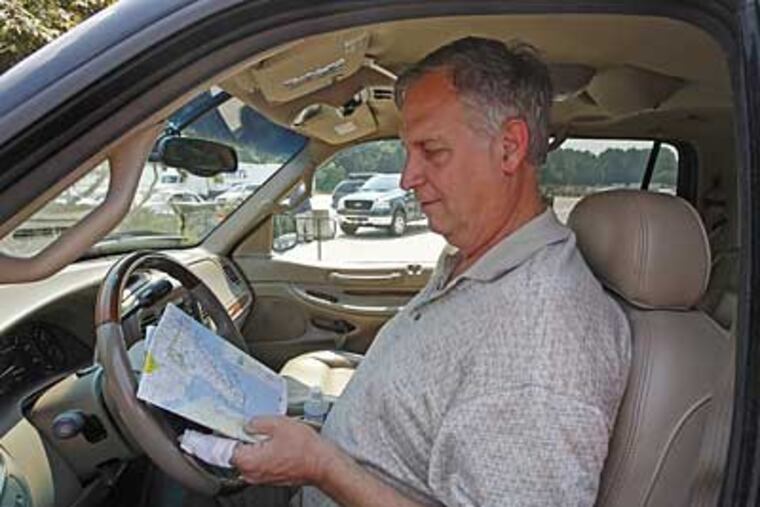
Highway traffic is down across the region, gas is around $4 a gallon, and authorities say people are making fewer trips, nationally and locally.
But has anyone behind the wheel actually noticed?
Not the state police, who issued a record number of citations this year and say the number of crashes every month averages between 550 and 650 crashes on highways in Philadelphia and Montgomery Counties. Not the truck drivers, who say the Schuylkill Expressway is as it always has been: a nightmare.
"The drivers are still running into traffic on the Schuylkill, getting over the bridges, and the turnpike's been just as bad," said Bob Dalfonso, terminal manager for A&R Transport Inc., a trucking company in Philadelphia.
On the other hand, if the downward trend continues, rush hour could shrink, reversing a 20-year trend of increasing peak traffic times, said Scott Brady, who manages the office of travel monitoring for the Delaware Valley Regional Planning Commission.
In other words, the traffic jam is here to stay, but maybe it will shorten up a bit.
"What used to be rush 'hour' has grown from 6 a.m. to 9 a.m.," Brady said. "If you have fewer cars on the road, you might have that peak shrinking, and you'll have a contraction of that peak hour."
It could be a long way off, though, since motorists aren't feeling the drop in traffic flow that's been documented.
For seven consecutive months, motorists across the country have driven fewer miles, according to data compiled, in part, from 4,000 electronic sensors operated by the Federal Highway Administration. The agency reported a 4.3 percent drop in miles driven by Pennsylvania motorists in May 2008 compared with last May. In New Jersey, drivers drove 5.2 percent fewer miles.
Traffic flow around the Philadelphia area is down an average of 3 to 5 percent, according to the Delaware Valley Regional Planning Commission. Traffic on Route 23 in western Chester County dropped 10.3 percent in June compared with last year, said Gene Blaum, assistant press secretary for PennDot.
But for drivers who take I-95 or the Schuylkill, the reduction hasn't meant much. Tens of thousands of vehicles use the highways each day.
"It's pretty much the same every day," said Kevin Miskiewicz, 37, a truck driver who makes short trips around Philadelphia on I-95. "You kind of know the peak times and what to expect: 95 South at Girard Avenue in the morning is always backlogged right there."
Miskiewicz has been driving for a living for 14 years, and he doesn't believe a few months of higher gas prices can reverse trends that took decades to establish.
"Everybody always seems to be going in opposite directions," he said. "Nobody seems to live and work in the same place."
When oil prices spiked in the 1970s, transit authorities noticed a drop in traffic right away, Brady said.
"I-95 became basically empty in the peak hour," Brady said.
But back then, more drivers paid cash for gas. Credit cards may help people delay their decisions to cut back or change their habits, Brady said.
And while urban planners speculated that the oil shock in the '70s would cause people to move closer to the cities to cut down commuting times to their jobs, they didn't anticipate jobs would move to the suburbs, complicating traffic patterns, Brady said.
"There are a lot of very complicated forces here," he said. "Theoretically, yes, less traffic means less congestion, means people can get there faster. But it's not always that simple."
The changes are small, but any downward trend in car use in America is worth noting, said Blaum, who has worked for PennDot for 21 years.
Drivers do offer anecdotal evidence suggesting that while local commutes remain a headache, changes are occurring elsewhere.
Bill Sudall, 57, who drives cars back and forth across the region for the Enterprise car-rental company, said he and other drivers were slowing down to get better gas mileage.
"I just came back from a 1,000-mile trip and I didn't see any less traffic," he said. "But people are slowing down."
Frank Leo of Atlantic City said he had not noticed any changes in traffic in the Aston area, where he is living while doing graduate work at Neumann College. However, Leo, 24, said he had seen dramatic differences around Atlantic City.
"I think people are making fewer trips," he said. "There's been less traffic - on the roads and the Boardwalk."
Delaware Memorial Bridge traffic was down 5.6 percent on Memorial Day, and 34,500 fewer vehicles crossed the Delaware toll plaza on I-95, according to AAA.
Steve Guy, who drives for a limousine company and traveled to Nashville on the July Fourth weekend, said holiday traffic was a breeze this year.
"People are not traveling nearly as much as they used to," said Guy, 57, of Harrisburg. "I expected traffic to be really jammed up. It was nothing. It was really easy to travel."
For folks like Guy, however, there was some possible bad news yesterday.
Crude oil prices sank $2.54 to $122.19 a barrel, continuing a two-week long drop from the $147 record.