Ceremony at Mother Bethel will complete a healing circle
Symbolically ending a centuries-old racial rift, St. George's congregants will visit.
"I was born in the year of our Lord 1760, on February 14th, a slave to Benjamin Chew, of Philadelphia," Richard Allen wrote in his terse autobiography, published in 1833. "My mother and father and four children of us were then sold into Delaware state, near Dover."
So begins the remarkable story of an American Founding Father, a man who bought his freedom; helped start the first African self-help organization in America, the Free African Society; began his own religious denomination; brought moral force to the fledgling struggles against slavery and racial discrimination; and created a bustling business in Philadelphia, to boot.
Allen, best known as bishop and founder of the African Methodist Episcopal Church - and purchaser of the site at Sixth and Lombard Streets where his Mother Bethel A.M.E. Church still stands - was born 250 years ago today.
Events and exhibits celebrating his life and achievement began last week, but one of the most potent is to take place today at Mother Bethel at 11 a.m., when the congregation of St. George's United Methodist Church in Old City will join the congregation at Mother Bethel for worship, salving a fissure that wrenched black from white in the late 18th century.
Allen and his friend and colleague Absalom Jones led African congregants out of St. George's more than 200 years ago in a famous and dramatic response to the church's efforts to segregate black worshipers, confining them to a newly built balcony.
Jones went on to found the African Episcopal Church of St. Thomas, and Allen forged Mother Bethel and, eventually, the A.M.E. church - a wholly new denomination.
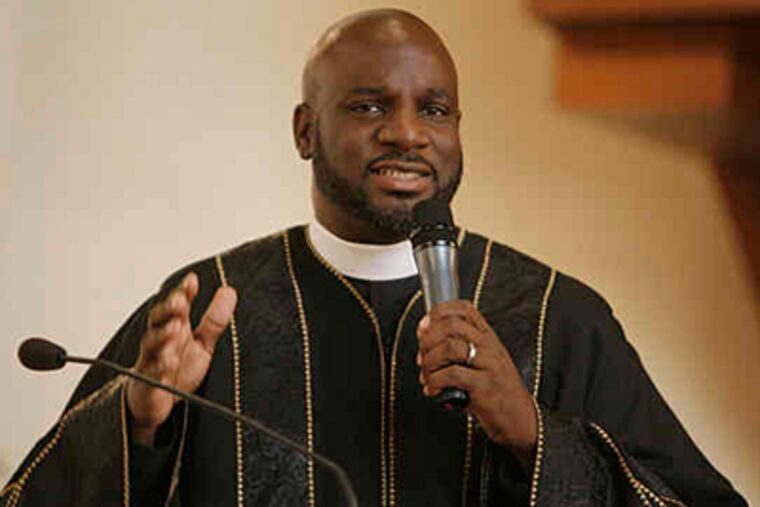
"Richard Allen was not a person who waited for things to happen to him," said the Rev. Mark Kelly Tyler, pastor of Mother Bethel. "When he wanted something, he found ways. What Allen says to us today - not just black people, everyone - is you don't have to let anything stop you. . . .
" 'Walk out of St. George's? Where would we go? What would we do? Wow! Build a church? They won't let us.' None of that mattered to Allen."
For the Rev. Alfred T. Day III, pastor of St. George's, the joint worship echoes the seminal one held in the fall, when Mother Bethel congregants returned to St. George's for the first time since the walkout. Today completes the circle, when St. George congregants visit Bethel.
As black and white parishioners looked on in October, Day presented Tyler with a cross made of nails taken from the balcony built in 1792 - the place of prospective exile for Allen, Jones, and other African worshipers.
"We did not begin to comprehend - I still get chills - how meaningful it would be," Day recalled. "When I gave him that cross, the gasp in the congregation was audible. The tears that welled up in his eyes were visible. We thought of it as a symbol, but it was received more powerfully than we even thought."
Allen, Jones, and, a bit later, the founders of Mother Zoar United Methodist Episcopal Church departed St. George's because of the growing environment of racial hostility there.
Over the subsequent decades, Allen found the struggle of Africans in America increasingly multifaceted and consuming. He fought off the efforts of St. George's to take control of Mother Bethel. He founded schools for black children. With Jones and other people of color, he tended the dying and the dead during the great yellow fever epidemic of 1793.
He wrote pamphlets denouncing slavery and petitions demanding its end. With his second wife, Sarah, he became a primal force in assisting Africans fleeing bondage.
In 1794, the year after yellow fever swept Philadelphia and sent President George Washington scurrying to a country house in Germantown (with several enslaved servants in tow), Allen published his "Address to Those Who Keep Slaves and Approve the Practice."
It was the first antislavery pamphlet published by an African since the birth of the nation. And it spoke with tremendous biblical and moral force.
"We do not wish to make you angry," Allen wrote in addressing Congress, which had passed the harsh Fugitive Slave Act the previous year, "but excite your attention to consider, how hateful slavery is in the sight of that God, who hath destroyed kings and princes, for their oppression of the poor slaves."
Congress was unmoved, and Allen responded over the rest of his life (he died in 1831) by providing a moral, political, and practical launching pad for the abolitionist movement. He denounced white schemes for African repatriation, viewing them as an effort to strip the enslaved of all outside support, then despaired and reconsidered as calls for equality and justice elicited harsher and harsher white responses.
"He was really a divided soul," said Richard S. Newman, professor of history at the Rochester Institute of Technology and author of Freedom's Prophet: Bishop Richard Allen, the AME Church, and the Black Founding Fathers, a biography published in 2008.
"That's really an African American story. He pushed right up against the question: Would America ever become hospitable to African American equality?"
Yet Allen, who was an entrepreneurial businessman, running a chimney-sweep business among other things, remained in Philadelphia. One of his customers was the nation's first president.
In 1796 and '97, Allen even visited the President's House at Sixth and Market Streets to collect money from Washington for work he had done. Whether he conducted that transaction with the president personally is unclear.
"He's an entrepreneur, as one gentleman to another, who goes to George Washington to collect his debt," said Newman. "Think about that image! He infused moral principles into the debate. It is much more difficult to say [slaveholders] didn't know anything or had no idea about the immorality of their acts when we define Allen into the equation."
Perhaps Allen's ideas and moral suasion had some impact on the president, even if the two men did not meet: Washington's will, written a year or so before his death in 1799, called for the freeing of his slaves after the death of his wife, Martha.
"It's a classic American story," Newman said. "Allen belongs in the conversation about important Founding Fathers. He's not just a church father. He's an abolitionist before the abolition movement. He's a civil-rights leader in Washington's day. He injects a moral argument that resonates down into the civil-rights movement of the 1950s and 1960s. He never rests. He was always, always moving."