Lessons of Amish siege
First responders need more tools, trooper said.
NICKEL MINES, Pa. - From the moment a gunman began shooting 10 girls in an Amish schoolhouse last year, 21/2 agonizing minutes ticked by before state police were able to force their way into the barricaded building, according to newly revealed details about the siege.
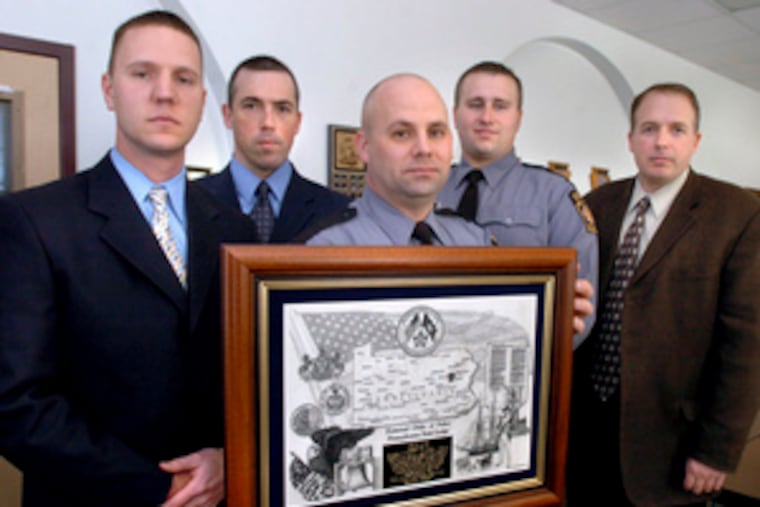
The Pennsylvania state trooper in command at the West Nickel Mines Amish School standoff Oct. 2 says an important lesson was learned by that delayed entry and reinforced in April by the Virginia Tech massacre: The nation's front-line police officers need better training and more equipment, including battering rams and forced-entry tools, to deal with barricaded gunmen holding hostages.
In the attack on the Amish schoolgirls, gunman Charles C. Roberts IV acted so suddenly and quickly - he shot his 10 victims, killing five, in about eight seconds - that even quick entry into the building might not have prevented the tragedy, said State Police Sgt. Douglas Burig, who carried two of the victims out of the school that day.
"It just highlights the need for equipment like this [to be] available for the first responders," Burig told the Associated Press this week.
Nearly a year after the West Nickel Mines tragedy, Pennsylvania state troopers who were on the front lines have said little publicly about the shootings. But in talks to police agencies across the country, Burig and other state police officials have been sharing what they learned.
In an interview this month with KTLO Radio in Mountain Home, Ark., where he was attending a conference, Burig provided new details about the shooting timeline and the assault on the schoolhouse. He also spoke of the need for getting more equipment into the hands of officers other than SWAT teams.
Police tactical units have the tools necessary to cope with a barricaded hostage taker, but sometimes it falls to the first officers on a scene to handle such a scenario, he said.
"Both the incident with West Nickel Mines and Virginia Tech [have] shown that the police may have to defeat barricades to get inside," he said in the radio interview.
Roberts, a 32-year-old father of three who made his living driving a milk tanker truck, used lumber, flexible plastic ties, and furniture to secure the building, apparently intending to sexually assault the children. He lined up the 10 girls before the blackboard and lashed their feet with wire and flex-ties.
After insisting that police back off, he systematically shot them at close range.
"When he shot the girls, he shot them a total of 13 times, and he did that in about eight seconds," Burig said in a portion of the radio interview that was not broadcast. ". . . It took the troopers about 21/2 minutes to fight through the barricades."
Police used shields, the butts of rifles, and batons to beat their way through the doors and windows. Roberts shot himself fatally in the head as the first troopers entered.
"Those troopers assaulted the school without any thought of their own safety," Burig told KTLO. "They were shot at, but they continued to move towards the school - they dove through windows and ripped off doors while being shot at - and they saved the lives of five of the 10 girls that were inside there.
"It's something I'll never personally forget, and their bravery's directly responsible for why five of those girls are alive today."
Three of the survivors are recovering well, but a fourth may need additional surgery for a shoulder wound, said Holmes Morton, a physician at the Clinic for Special Children in Strasburg, Pa., who is familiar with their conditions. The most seriously injured girl remains in what doctors fear will be a permanent vegetative state, he said.
"The families in general are still trying to come to grips with that tragedy, but I think as a community they're doing as well as can be expected," Morton said.
A statement from the Amish community's leaders about the girls' conditions is expected in the coming weeks.
The investigation remains open - just last week police returned some clothing to the victims' families - but Burig said no additional information had surfaced that might help explain Roberts' actions.
In suicide notes and brief phone conversations on the day of the shooting, Roberts expressed anger over the memory of having molested two very young female relatives two decades earlier. Investigators later tracked down the girls, who had no memory of it.
Roberts also expressed pain over the 1997 death of a newborn daughter, Elise. He was buried beside her in a grave that, nearly a year later, remains unmarked.
"We certainly believe that's part of the motive," Burig told the AP.
Roberts' widow, Marie, remarried in May and moved several miles away. Roberts' father, a former police officer, participated in the wedding ceremony, said Terry L. Blessing, the minister who performed it.
"From all indications as I observed her, she was doing quite well," Blessing said.
Neither the Amish nor the surrounding community plans to mark the first anniversary of the shooting.