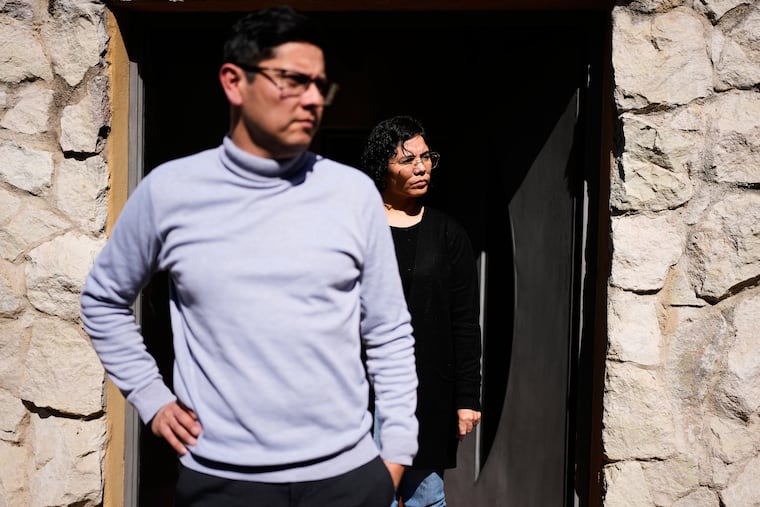
Last resort and the letter of the law
A Pa. doctor and his wife are fighting deportation to the Philippines after more than 20 years here.

America has always prided itself as "a nation of laws, not men," where the rules that bind society matter more than a person's title, economic standing, or who knows whom.
What recourse is there, then, when the scales of justice seem out of whack? Should another test of what is right and fair apply? Should the system make exceptions for specific people in cases that an outraged public considers egregious?
Attorneys for Pedro and Salvacion Servano, Filipino immigrants facing imminent deportation, think it should. In a last-ditch effort to prevent their clients' expulsion, they have filed papers seeking "deferred action" while also looking to Congress to provide a remedy through "private immigration legislation," a rare maneuver designed to redress grievances in deserving cases. That process begins when a member of Congress files a special bill.
But time is short for the Servanos, who are under orders to report to the Immigration and Customs Enforcement office in Philadelphia today to be processed for removal. An immigration spokesman said the couple would not be immediately arrested.
For scores of Americans who have begun speaking out after recent news stories about the Servanos, even the idea of jail seems absurd.
"I cannot fathom how our justice system could be so blind, stupid and callous," Vincent J. Gregory, a retired surgeon of Philadelphia and Ocean City, N.J., wrote in an e-mail to The Inquirer. "Have we lost our minds?"
Adds Andrew Wetzel, a Havertown Realtor, in another message: "The Servano family is . . . a model for why we should allow legal immigration and fairly enforce our existing laws while remaining compassionate and weighing all of the facts."
Pedro Servano, 54, is a family physician with a 2,000-patient practice in rural Hummel's Wharf, Pa. Salvacion, 51, a trained nurse, runs a bakery and Asian-specialty market in nearby Sunbury. For nearly 25 years, since their separate, visa-authorized entries into the United States in the 1980s, they have lived exemplary lives. They have four U.S.-born children, ages 13 to 24.
But because of misstatements about their marital status on their visa applications, immigration officials accused them of lying and want to exclude them from the United States.
The Servanos contend they did not purposely misrepresent their status. They were single when they filed applications in 1978. They wed in the Philippines in 1980, primarily to satisfy Salvacion's strict father. They didn't know they needed to update the paperwork years later when the applications were granted. Salvacion entered the U.S. in 1982; Pedro entered in 1984.
The discrepancies were discovered in 1990 by an immigration-hearing examiner after the couple applied for naturalized citizenship. Deportation proceedings commenced immediately, but have been stalled by legal appeals.
Private legislation, though a long shot, would give the Servanos a fresh start.
Their lawyers recently brought the case to the attention of Pennsylvania Sens. Arlen Specter and Robert Casey, and Rep. Chris Carney, whose district includes Selinsgrove, the town on the Susquehanna River where the Servanos live.
Specter spokesman Scott Hoeflich said the senator received a letter about the matter on Nov. 12 "and promptly contacted Immigration and Customs Enforcement to inquire about the case." Without specifying what, if any, further action Specter might take, Hoeflich added: "The office will continue to work with the Servanos and ICE to see what resolution can be obtained."
Post-Thanksgiving messages for the constituent services offices of Casey and Carney were not immediately returned.
Generally, a private bill grants legal permanent residency - short of full citizenship - to deserving parties, according to a 2005 report from the Congressional Research Service.
Under House and Senate rules, "no private bill shall be considered . . . until all avenues for administrative and judicial relief have been exhausted."
Though 7,321 private immigration bills have been enacted since the first such law in 1839, it is a rarely used - and rarely successful - maneuver.
Of 451 such bills introduced in the last six sessions of Congress, just 36 became law.
In practice, the Congressional Research Service notes, Congress considers only "those cases that are of such an extraordinary nature that an exception to the law is needed."
Lawyers Ann Ruben and Gregg Cotler of Philadelphia and Gregory Craig of Washington - the Servanos' new legal team - say that is precisely their clients' situation.