N.J. basks in election attention
Ads, phone calls, rallies - seems the primary matters this time.
It's the kind of intense political activity New Jersey residents usually see only as the leaves are turning.
But on the eve of this first early Feb. 5 primary, voters have seen television ads, received automated calls from campaigns, been buttonholed at Ponzio's Diner in Cherry Hill, and opened campaign mail. Some have had strangers knocking on their doors to pump up candidates.
Because the state moved up its presidential primary to Feb. 5, Garden Staters suddenly matter in the outcomes of both the Republican and Democratic races. And the campaigns still standing are doing all they can to get their attention.
U.S. Sen. John McCain (R., Ariz.) plans to appear at a rally today in Hamilton Township, Mercer County.
U.S. Sen. Barack Obama (D., Ill.) planned a rally in vote-rich North Jersey at the Meadowlands in Rutherford this morning.
Tonight, U.S. Sen. Hillary Rodham Clinton (D., N.Y.) planned an 8 p.m. video town-hall meeting, where New Jersey voters can ask questions at Burlington Community College's Enterprise Center. There was talk that her daughter, Chelsea Clinton, would pass through the state as well today.
Craig Romney, son of Republican candidate Mitt Romney, former Massachusetts governor, planned to stump today with Joseph Kyrillos, a Republican state senator from Monmouth County who is state cochairman of the Romney campaign.
"We're just going to move around the state and make some noise," Kyrillos said.
Not even unaffiliated voters could escape the wave of enthusiasm sweeping New Jersey in the days and hours before it joins more than 20 other states in a primary that experts say will significantly shape the Democratic and Republican fields.
U.S. Rep. Steve Rothman (D., N.J.) pulled $80,000 out of his campaign war chest to finance "robocalls" to the state's unaffiliated voters.
Of the state's 4.8 million registered voters, 2.8 million are unaffiliated. Rothman said they live in 1.3 million households and the plan was to call all of them - whether they live in Republican- or Democratic-leaning areas.
"People are just not aware that even though they're registered to vote but unaffiliated with either party they can vote in the primary," said Rothman, an Obama supporter. Rothman's message is that unaffiliated voters need only bring identification and proof of residency to the polls so they can affiliate with a party to vote in its primary on Election Day.
Those unaffiliated voters are especially important for Obama and McCain.
"In general, these candidates have had stronger appeal to independents," said political scientist David Rohde, a national politics expert at Duke University.
The big money was spent by Democratic candidates Clinton and Obama, who started running ads last week on broadcast television in the Philadelphia and New York markets to reach voters in New Jersey, Delaware, New York and Connecticut who will cast ballots tomorrow.
Clinton's forces took a campaign bus around the state, stopping at diners such as Ponzio's and attending rallies such as one in Glassboro.
Obama supporters, led by State Sen. John Adler (D., Camden), knocked on doors in retirement communities in Ocean County on Saturday and in Haddonfield yesterday.
Recent academic polls showed that Clinton had a comfortable lead over Obama but that the race was tightening. The Monmouth University poll of 1,273 likely voters conducted between Jan. 30 and Feb. 1 showed Clinton still in the lead with 50 percent to Obama's 36 percent.
Because Democrats apportion delegates, both Clinton and Obama have a lot to gain from New Jersey, where all but 20 of the state's 127 delegates are awarded based on a candidate's share of the vote.
New Jersey is a winner-take-all state for Republicans, so the victor in the primary will get 52 delegates.
There used to be a tight Republican race in the state between McCain and former New York Mayor Rudy Giuliani, but on Thursday the McCain forces took in much of what was left of the collapsed Giuliani campaign.
They promised that their combined forces meant 20 phone rooms buzzing voters around the state until Election Day.
Ocean County GOP chairman George Gilmore, who headed the Giuliani campaign in New Jersey, said: "We were prepared for a massive phone get-out-the-vote operation to every Republican in Ocean County. We were prepared to do that for Mayor Giuliani, and we're prepared to do it for Sen. McCain."
McCain's state chairman, State Sen. Bill Baroni (R., Mercer), kicked the campaign into an around-the-clock operation for the weekend, which meant thousands of volunteers were making calls and knocking on doors "through every day and every night in all corners of the state."
Besides going after Republicans, Baroni's forces have been working on independent voters, especially students and "all families touched by the military."
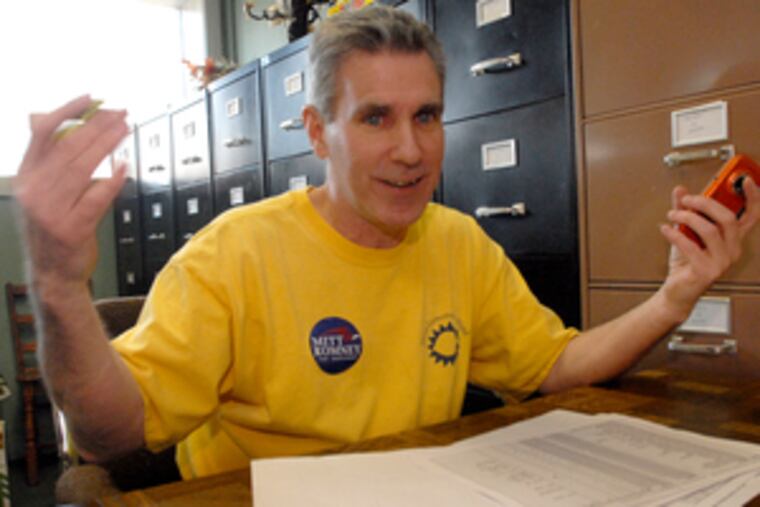
In Woodbury, volunteers made calls from Morris Graphics on Broad Street on Saturday to get the vote out for Romney.
Beyond the campaigns themselves, Emily's List, which supports female Democratic candidates, targeted female voters for Clinton with mail and robocalls. It focused on South Jersey, where voters may not know as much about Clinton as North Jersey residents who read New York papers and see its television news, said communications director Roberta Oliver.
No matter what happens tomorrow in New Jersey, it is certain to start a new chapter in the state's political history. New Jersey Democrats haven't had a voice in a presidential primary cycle since 1984, when the race between Walter F. Mondale and Gary Hart was still undecided in June, the traditional Jersey primary month. For Republicans, the last blast was in 1976, when the race between Ronald Regan and Gerald Ford was still in play in June.
Before that, the voters' voices weren't the last word in a New Jersey primary.
In 1972, the primaries became binding on delegates to the party conventions where presidential nominees are formally chosen.
That's why state GOP chairman Tom Wilson said no one could accurately predict turnout in New Jersey's first early primary that matters.
When it comes to voter turnout in such an early primary, Wilson said, "we have no experience. We can't base it on anything."
Primary Facts
Who can vote: Registered Democrats and Republicans may vote in their party races. People who are registered but unaffiliated must choose a party at the polls.
Poll times: Polls will be open Tuesday from 6 a.m. to 8 p.m.
At stake: The winner of the GOP primary will receive all of the party's 52 delegates. Of the state's 127 Democratic delegates, 70 will be distributed based on the candidates' shares of the vote. The state party selects most of the rest.
Problems at the polls: The U.S. Attorney's Office has set up a hotline at 973-645-2924 for election irregularities, intimidation, or any activities that would interfere with a citizen's right to vote.
For more information: Visit www.nj.gov/oag/elections/electionshome.html.
- Associated Press
EndText