Hospital: Fumo had erratic heartbeat, not heart attack
The federal corruption trial of former Sen. Vincent J. Fumo was abruptly suspended today after Fumo became dizzy and nauseated during court. He was lifted onto to a gurney and taken to a hospital for evaluation overnight.
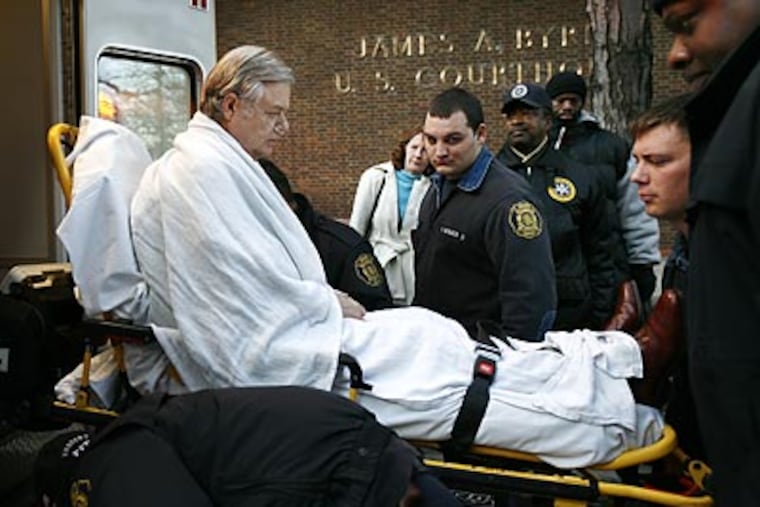
The federal corruption trial of former Sen. Vincent J. Fumo was abruptly suspended today after Fumo became dizzy and nauseated during court. He was lifted onto to a gurney and taken to a hospital for evaluation overnight.
A spokeswoman for Hahnemann University Hospital said that Fumo had an erratic heart beat, but did not have a heart attack. The former legislator, who was listed in fair condition, will spend at least one night in the cardiac unit, said the spokeswoman, Coleen Cannon.
The 65-year-old Fumo, who had a heart attack last March, had experienced chest pain, a racing heart and other symptoms, the hospial said.
In court, he had said that he was anxious, light-headed and short of breath.
U.S. District Judge Ronald L. Buckwalter adjourned the trial early, about 3:20 p.m. If Fumo's health permits, the trial resumes Monday. Fridays have normally been off-days during the marathon trial, which began 14 weeks ago and perhaps has a month to go.
In an interview with The Inquirer during an afternoon break in the trial last week, Fumo complained of the pressure of the case. "It takes a phenomenal toll emotionally and physically, day in and day out," he said.
Fumo, long a Democratic power in Philadelphia and state politics, is charged with 139 counts of conspiracy, fraud, tax charges and obstruction of justice. A federal grand jury said he illegally turned his Senate staff into personal servants and political operatives, and unlawfully extracted free benefits from a pair of nonprofit organizations.
Nothing especially dramatic or adverse for Fumo was taking place when his medical drama unfolded.
Fumo's lead lawyer, Dennis J. Cogan, was trying to score points in cross-examining one of the lead FBI agents in the Fumo investigation.
Among other things, Cogan showed the jury an e-mail from a former Fumo aide, who testified earlier in the trial, complaining that the "feds" had a "habit of putting words in people's mouths."
As Cogan proceeded with his questioning of FBI Agent Vicki Humphreys, his client suddenly lost all color in his face.
Cogan was standing in front of Fumo and couldn't see him.
Defense lawyer Edwin J. Jacobs Jr., who represents Fumo co-defendant Ruth Arnao, stood suddenly to signal to the judge that the trial needed to pause.
Once the jury had filed from the the courtroom, it became clear to those left behind that Fumo was ill.
Within minutes, a nurse arrived to evaluate him, checking his vital signs as he sat slumped in his chair at the defense table, his jacket off, his blue Oxford shirt open.
Arnao patted Fumo in support. Prosecutors and members of the defense team stood around awkwardly.
Judge Buckwalter swiftly said he thought it best to break entirely for the day.
"We agree, your honor," said Assistant U.S. Attorney Robert Zauzmer, one of two lead prosecutors.
Said Fumo: "I apologize . . . I don't want to mess up the court."
Soon, firefighters from the Snorkel 2 ladder unit at Fourth and Arch Streets, and paramedics from Medic 15, at Fourth and Girard Streets, had crowded into the 17th floor courtroom.
Initially, Fumo said he didn't want to go the hospital, for fear he would have to stay overnight. But he finally agreed to ride in Fire Department ambulance to Hahnemann.
In court, a medical responder called out Fumo's blood pressure and blood-sugar levels.
When told the readings by a reporter, Robert McNamara, chairman of the Department of Emergency Medicine at Temple University School of Medicine, said Fumo's blood pressure was normal and his blood-sugar level was elevated, but not dangerously so.
Emphasizing that he had no personal knowledge of Fumo's condition, McNamara said that the primary focus of any hospital evaluation would naturally be Fumo's heart, especially since the former senator had said he was short of breath.
McNamara said that stress can cause anxiety, but can also trigger heart problems.
Last June, Fumo had a previous spell of dizziness and collapsed on the floor of the Senate in Harrisbug. He spent a night at Harrisburg Hospital.
A Fumo spokesman said at the time that hospital doctors attributed the collapse to a combination of factors, including slight anemia, low blood sugar, dehydration, and the toll of long hours and erratic eating habits during a week of budget negotiations.
Fumo has long suffered form heart problems and has been hospitalized for angina, chest pain caused by a lack of blood and oxygen to the heart.
He suffered his first heart attack in 1977, the year before he was first election to the Senate.
Then last year, he had his second heart attack. He was rushed to Hahnemann, where doctors discovered that his right artery was 100 percent blocked. Cardiologists did a coronary angioplasty remove the blockage, and a metal stent inserted to restore normal blood flow.
Fumo spent a week at Hahnemann.
Soon after, Fumo announced that he would not run again for his Senate seat. His last day in office was Nov. 30, six weeks into the start of his trial.