Dogfighting complaints up, but penalties aren't
The complaint was routine: a stray running loose near Adams Avenue in Frankford. But that dog led investigators from the Pennsylvania SPCA to a major discovery. The pit bull had escaped from a nearby warehouse that had been rented under a fake name and converted into a thriving dogfighting operation.
The complaint was routine: a stray running loose near Adams Avenue in Frankford.
But that dog led investigators from the Pennsylvania SPCA to a major discovery. The pit bull had escaped from a nearby warehouse that had been rented under a fake name and converted into a thriving dogfighting operation.
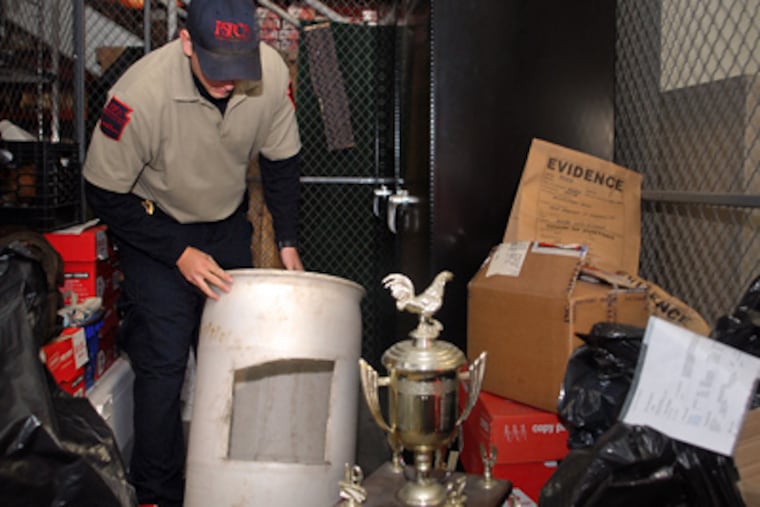
Inside the warehouse, officers uncovered equipment for training dogs, a ring for fighting them, and even bleachers for spectators.
"It was a perfect setup," said George Bengal, the PSPCA's director of law enforcement.
That was nearly two years ago, well before the Eagles signed quarterback Michael Vick, released from federal prison this summer after serving 18 months for operating a dogfighting ring.
The furor over the Eagles' decision brought the issue of dogfighting to the forefront, but chances are only a handful of the city's dogfighters will ever face the same penalties as Vick.
For example, the man accused of running the operation on Adams Avenue, Marcus Miller, 34, of Kensington, pleaded guilty to animal fighting earlier this year and was given house arrest. Officers seized dozens of dogs from the warehouse and near Miller's home.
The nonprofit PSPCA, the lone law enforcement agency dedicated to investigating dogfighting, has a mere 14 officers. Two of them are assigned solely to the city's animal fighting, which includes cockfighting.
Meanwhile, the agency receives an average of 1,000 calls a month about animal cruelty. Although dogfighting complaints are way up this year - topping 400 - they are still a small percentage of the officers' duties.
Busting the bigger, more complex dogfighting operations can take weeks of surveillance and investigation, and occasionally requires the kind of break that led officers to Adams Avenue.
"I just don't have the bodies and the resources to address all of these the way they should be," Bengal said. "You pick and choose out of these the ones that we need to address first. . . . I could have a full-time police force working 24 hours a day and still have calls waiting."
Dogfighting, which is illegal in all 50 states, is a third-degree felony in Pennsylvania, punishable by 31/2 to 7 years in prison. But sentencing guidelines take into account prior records, which often means no jail time.
"First-time offenders, it's just going to be a slap on the wrist," Bengal said. "You're looking at nickels and dimes."
Barbara Paul, an assistant district attorney for the city, said that in the past, some judges did not see animal fighting as a big deal.
"I'm hoping that with more awareness and the Michael Vick case, that lets judges and everyone know that people take these cases very seriously," she said.
The blood sport of dogfighting operates like any other criminal enterprise - underground and with varying levels of sophistication.
The lowest level - essentially dog owners getting together for impromptu fights in parks, yards, or alleys - happens all over Philadelphia.
The highest level, a category in which Bengal placed Vick's operation, involves an interstate network of big-money fights, promoted and discussed in underground magazines. It is not unusual for tens of thousands of dollars to be wagered in such bouts. Philadelphia, at least so far, has not seen an operation of that size, he said.
But locally based, mid-level rings like the one on Adams Avenue are common and invariably linked to the drug trade.
"Almost every time we go in on a search warrant, we come out with guns and drugs," Bengal said. "That's a given."
Dogfighters employ some of the same safeguards used in the drug game. Just as drug dealers employ "stash houses" to store their product, dogfighters typically house and train their animals in locations apart from where they fight.
"These things are done in secret, obviously, and the people who do them are not stupid about being caught," said Paul, who handles all animal-cruelty prosecutions.
This summer, humane officers found a home in East Germantown being used as a kind of stash house for dogs. Owners would leave their animals there for training and amateur veterinary care, officials said.
Although many losing dogs are simply executed and dumped, some injured dogs are deemed worthy of nursing back to health.
The PSPCA rescued four dogs in the East Germantown raid and dubbed them John, Paul, George, and Ringo. Paul, an emaciated, light brown pit bull with deep scars on his face, was a "cur," explained Nicole Larocco, the PSPCA's director of animal training and behavior.
Curs are passive dogs pitted against top fighters to build up confidence. Paul's owner didn't even consider him worth feeding, she said.
"He probably gained 10 pounds since he's been here," she said.
While the animal-cruelty laws include a host of misdemeanor charges, animal fighting is the only one deemed a felony offense. Dogfighters need not be caught in the act to face that charge.
Cases can be built on the paraphernalia used to train the dogs: retrofitted treadmills for running, dip tanks that force dogs to swim, and heavy chains worn as leashes to strengthen the animals. In a recent case here, humane officers found dogs leashed with 60-pound chains secured with truck axles driven into the ground.
That paraphernalia also can include "injectables," such as steroids and antibiotics, or "rape stands" to restrain females and prevent them from fighting during mating.
"They're very well organized," Paul, the prosecutor, said of dogfighters. "They all use the same accoutrements. They all train the dogs the same way."
Discovering dogfighting rings often relies on tips from neighbors, though one man was arrested last year when he advertised a fighting dog for sale on Craigslist. To show off the dog to an undercover officer, posing as a buyer, the owner had the animal carry a 15-pound dumbbell in his mouth.
The two officers dedicated to animal fighting - they asked not to be named because they work undercover - often spend days in their car, checking out tips, looking for signs of dogfighting operations, and trying to attract the attention of dogfighters.
"I brought my dog a few times, because I have a pit bull," one officer said. "We'll throw a chain collar on him and see who comes up and talks to us."
Finding fighting dogs isn't hard. Larocco said the PSPCA rescues about 50 to 75 of them a year, and Bengal said the numbers would be significantly higher this year.
The hard part, they say, is penetrating the underground world and arresting the people involved in it.
"It's like with drugs. Someone can tell me you're selling drugs out of your house, but that doesn't make it so," Bengal said. "I still have to catch you."
Paul has three cases pending, encompassing 11 defendants, and at least two other dogfighting cases are being handled by other prosecutors because they stemmed from drug investigations.
This August, a judge gave defendant Anthony Clark, 37, of West Philadelphia, a rare prison term - one to two years - for animal fighting, on top of a sentence for drugs.
"The legislature made animal fighting a felony for a reason," Paul said. "All I can do is keep trying them and keep arguing them."