Developing new medicine to treat a rare, but deadly condition
Here's how Dr. Dan Rader has had to treat his patients with very high cholesterol: Every week or two about 30 of them come to the clinic to lie on a table with an intravenous line in their arms, and have their blood drawn, filtered and replaced.
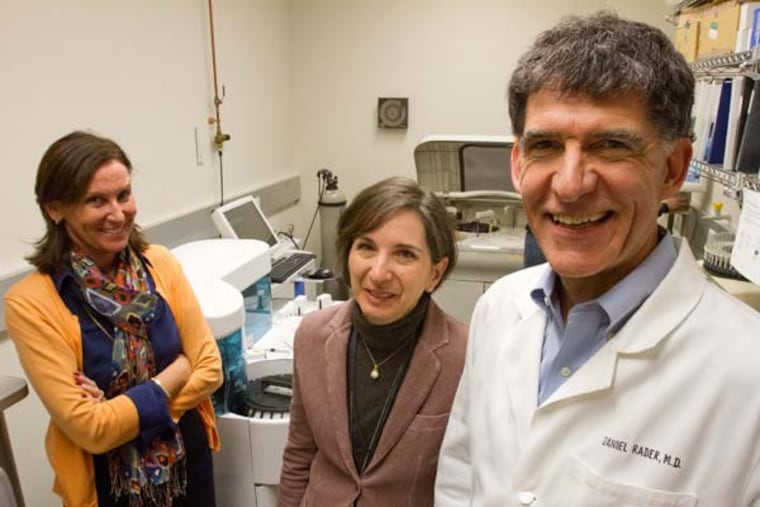
Here's how Dr. Dan Rader has had to treat his patients with very high cholesterol: Every week or two about 30 of them come to the clinic to lie on a table with an intravenous line in their arms, and have their blood drawn, filtered and replaced.
"It sounds primordial," Rader said, "but this is what we had to offer people."
Soon, that will change.
A new pill now exists to treat the rare condition, Homozygous Familial Hypercholesterolemia (HoFH), which affects 2,000 to 3,000 people in the United States and can lead to heart attacks and death, even in young adults.
The U.S. Food and Drug Administration approved lomitapide (brand name Juxtapid) in December, marking a big victory for Rader, the University of Pennsylvania's Center for Technology Transfer, and Aegerion Pharmaceuticals, the Cambridge, Mass.-based firm that Rader helped form in 2005.
This marks the third FDA approval in a year for a Penn-related product. "This is something to celebrate," said John Swartley, associate executive director of Penn's transfer center. The two others are the demential test Amyvid, made by the Avid subsidiary of Eli Lilly, and the Perjeta/Pertuzamab combination, made by Genentech to treat breast cancer.
The new cholesterol drug still faces many challenges, including its high cost and the fact that it comes with a black box warning for liver toxicity. Patients will have to be monitored closely.
High-priced drug
Some employers, insurers and patients may be less enthused about the drug because of its cost. Aegerion is planning to charge a yearly rate of $235,000 for the initiation doses of the drug and then a yearly rate of $295,000 for maintenance doses of the once-a-day capsule.
Rader defends the cost, saying the current care can cost as much as $364,000 a year.
Rader, who owns stock in Aegerion, said he will have colleagues in his group talk to candidates for the drug and write any prescriptions.
Insurers say they will pay for the drug but aren't sure how much of a co-pay patients will bear. People without a job or health insurance might have difficulty getting the drug, though Aegerion said it will help some needy patients.
Experts say it is unlikely that lomitapide will become a blockbuster drug like Lipitor and other cholesterol-fighting statins because of its small core of patients and the potential toxicity.
"We estimate peak combined US/EU sales for lomitapide in adult HoFH of about $500 million," J.P. Morgan analyst Cory Kasimov wrote to clients.
"From a general, public-health standpoint, this drug will not have a huge impact," said Richard Gregg, who worked on the compound with Rader years before it was approved. "But for individuals, it will have significant impact. It can be a life-changing therapy."
Tinkering with molecules
Rader, 50, is married with three children. He grew up in the city of Lancaster, graduated from Lehigh University, and got his medical degree from the Medical College of Pennsylvania, now part of Drexel University. After medical school, Rader went to work for the National Institutes of Health in suburban Washington in the early 1990s.
While at NIH, Rader and colleagues focused on low-density lipoproteins (LDL), the bad cholesterol. HoFH had been shown to cause blockage of a receptor that helped rid the body of LDL. On the other end of the spectrum, Rader and colleagues found that patients missing a microsomal transfer protein (MTP) had almost no LDL. That was the a-ha moment. If somebody could create a drug to block MTP, it might help lower cholesterol, especially for HoFH patients.
One of Rader's research buddies at NIH, Gregg, left for Bristol-Myers Squibb and set about trying to accomplish just that, albeit aiming for a larger population than just HoFH patients
But after several trials, BMS abandoned the effort. One reason was gastrointestinal side effects (diarrhea, nausea), but more troubling were alarming levels of toxic enzymes and fat in the liver.
The company's strategy then was to go after blockbusters, sales more than $1 billion to $2 billion a year, recalled Gregg, now chief scientific officer at Vitae Pharmaceuticals in Fort Washington. "I was very disappointed that we found fat accumulation in the livers of patients in our early studies and that this would not be a drug for large numbers of people with elevated cholesterol levels, but I supported the decision for BMS to stop development. BMS has subsequently changed strategies, and is now much more open to more targeted drugs like lomitapide."
Rader moved to Penn in 1994. After BMS stopped its lomitapide work, Gregg and Rader spoke about Rader's acquiring the patent that BMS had earned. Eighteen months of talks between lawyers and staff for BMS and Penn ended in the drug company donating a portion of the patent to Penn in 2003.
Gregg said BMS did not want to release the whole patent partly because it feared that a company would sell lomitapide to a wider group of patients who would not be closely monitored and that BMS would be blamed for people getting liver damage.
Rader, meanwhile, was working with self-described serial health-care investor David Scheer and two other men to form Aegerion. Scheer said they were concerned that the license from Penn would be too narrow.
The Penn-Aegerion deal included an initial payment of $56,250 to Penn and development milestone payments that could amount to a total of $150,000 for the two main uses, corporate records show. If Aegerion ever develops the drug for other uses within the patent range, Penn could get as much as $2.6 million. Penn also gets a cut of sales royalties and sublicenses from lomitapide.
Back in the lab, Rader, with help from assistants and fellow doctors Marina Cuchel and Emma Meagher, took a different path from BMS', by slowly raising the dose to allow the body to adjust to the medicine. The FDA approved the drug with the understanding that doctors and pharmacists would have to be trained in monitoring patients for liver toxicity.
With $1 million from the FDA's orphan drug program, which is meant to help develop drugs for diseases affecting 200,000 patients or less, Rader conducted a phase I trial, proving it could be taken safely. The Doris Duke Foundation helped pay for phase II. Aegerion contributed money for the pivotal phase III studies in 2009-10.
Those earlier contributions were key because Aegerion was "technically insolvent," said Scheer. The company had an accumulated deficit of $170.9 million in September, a recent filing showed.
Yet FDA approval helped push up Aegerion's stock price last week to an all time high of $29.81.
"As a physician engaged in biomedical research, we have the hope of doing work that actually makes a difference in people's lives," Rader said. "By resurrecting this medication from the dustbin and championing its development for over 12 years, I feel I did something that will tangibly help patients."