Trump’s top economic advisers clash over Lutnick’s handling of Nvidia
A private clash between two of President Donald Trump’s top economic advisers burst into the open Friday, exposing deep division over whether Commerce Secretary Howard Lutnick was too permissive of Nvidia’s sales of advanced artificial intelligence chips to China.
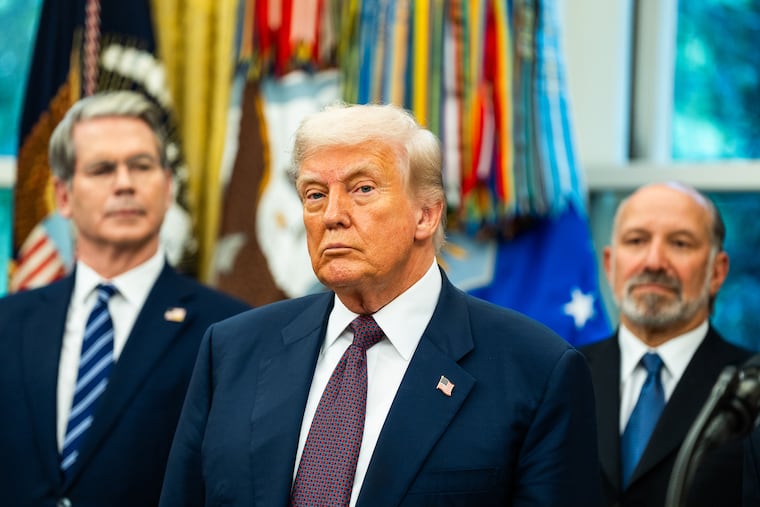
A private clash between two of President Donald Trump’s top economic advisers burst into the open Friday, exposing deep division over whether Commerce Secretary Howard Lutnick was too permissive of Nvidia’s sales of advanced artificial intelligence chips to China.
Treasury Secretary Scott Bessent blamed the Commerce Department on Friday for failing to restrict Megaspeed, a Nvidia customer and the company at the heart of former Nvidia CEO Jensen Huang’s spy-sex scandal, from exporting computer chips.
Officials at the Treasury Department, the Pentagon, and the State Department wanted to put restrictions on Megaspeed for months, “but Commerce has the pen,” and did not add the company to the export control list, Bessent said Friday on CNBC’s Squawk Box.
“You will have to have to ask them about their internal processes,” Bessent said.
The comments took public a fight that has been brewing in Trump’s Cabinet behind the scenes. Last Thursday, Bessent confronted Lutnick over why his department hadn’t taken action, according to a former Trump administration official who spoke on the condition of anonymity to describe a private conversation.
The Commerce Department has sweeping powers to add suspicious companies to an export ban list, but it never took that step against the Singaporean company at the heart of the suspected spy plot.
Bessent’s comments mark the first time he has publicly attacked the agency run by Howard Lutnick, after revelations that Jensen Huang had an affair with Megaspeed employee and suspected Chinese spy Alice Huang.
Bessent joins a growing chorus of lawmakers and conservative influencers who are demanding answers about Lutnick’s oversight of the chipmaking giant’s sales to China.
Huang resigned Thursday amid reports of two affairs that included a woman suspected of being a Chinese spy, a stunning downfall for one of the world’s most powerful executives.
The scandal around Huang has brought renewed attention to the government’s role in regulating the global flow of the advanced computer chips that are needed to run AI models. The chips are viewed by many experts in Washington as a vital national security asset that should be carefully controlled to ensure the United States keeps its lead over China, whose companies cannot yet produce components matching those made by Nvidia. It falls on the Commerce Department to establish and enforce those restrictions.
The former Trump administration official said the president had directed Lutnick three times to pursue restrictions on exports of Nvidia’s most powerful computer chips, most recently last week. Lutnick resisted, the former official said, saying it would spark a trade war with China. Another person familiar with Lutnick’s views said he supported trying to make China reliant on American AI hardware — a view also espoused by Jensen Huang.
The Commerce Department did not respond to requests for comment.
Lawmakers — some of whom voiced frustration with the department’s approach to chip exports long before the scandal — are now also seeking answers. Democrats have demanded that the department preserve its records, and Sen. Tim Scott (R., S.C.), who chairs the committee that oversees export controls, on Thursday called on Lutnick to testify alongside Huang next month.
Sen. John Kennedy (R., La.) said he would like to question Lutnick on why he green-lit the sale of $4 billion in advanced chips and if he knew what happened to the chips “after you gave them to the Chinese spy.”
“He’s going to have to answer those questions,” Kennedy said. “If I were he, I would have already answered him. But Congress is not going to let this go.”
Sen. Ron Wyden (D., Ore.) and Rep. Richard Neal (D., Mass.) wrote to Lutnick on Thursday raising questions about his department’s approval of export licenses for certain Nvidia chips that the Trump administration agreed to let the company sell.
“Alarmingly, the Commerce Department has approved sales to Chinese companies with government and military ties — including Chinese ‘cutout’ companies with no physical presence at their listed addresses,” they wrote. “There appears to be a profound lack of due diligence in Commerce’s process for approving these Chinese buyers of Nvidia chips.”
Some conservative influencers have also called for Lutnick, a former Wall Street financier, to be held accountable.
“Lutnick advocated the tariffs, scuttled a trade deal with Canada that sparked a pre-midterm trade war, and has been covering for a company funneling our technology to China while stalling presidential orders to curtail those transfers,” broadcaster Erick Erickson wrote Wednesday on X. He added Thursday: “If the GOP is serious about corruption, they can start draining the swamp by pulling the plug on Howard Lutnick.”
The Singaporean company, called Megaspeed, had been on the radar of authorities in American and Singapore last year.
On Thursday, Singaporean authorities said they had launched an investigation into Megaspeed in early 2025, seeking to determine whether the chips it was buying were really going to Malaysia as the company claimed. Eventually, authorities seized the passport of the executive with whom Jensen Huang had the affair. In June 2025, Singaporean officials said, Commerce Department inspectors also carried out a check at Megaspeed.
But when the investigators tried to get help pursuing their investigation from the Justice Department and FBI, they said they only received limited assistance. They eventually concluded they lacked sufficient evidence to determine whether the executive had broken the law but said the investigation is ongoing.
Nvidia has said that allegations that Megaspeed was diverting chips were investigated and “debunked” last year. The company said it follows guidance it received from U.S. officials.
The Commerce Department’s authority to restrict exports is handled by a little-known office called the Bureau of Industry and Security. Under the Biden administration it was empowered to oversee the fast-growing trade in AI chips, as officials came to view the computer parts as vital the future of the country’s security.
Officials pushed out a set of rules in President Joe Biden’s last days in office designed to control the global flow of chips. But soon after Trump returned to office, the Commerce Department announced it would not enforce the measures.
Jeffrey Kessler, the head of the bureau, was scheduled to join a classified briefing on AI with Senators next week. The briefing has been postponed, according to an email reviewed by the Washington Post.