Immigration debate lands before U.S. Supreme Court
WASHINGTON - With thousands of demonstrators rallying outside, a divided U.S. Supreme Court listened Monday as advocates argued over whether President Obama overstepped his authority when he issued orders to let millions of undocumented immigrants stay in the country.
WASHINGTON - With thousands of demonstrators rallying outside, a divided U.S. Supreme Court listened Monday as advocates argued over whether President Obama overstepped his authority when he issued orders to let millions of undocumented immigrants stay in the country.
For 90 minutes, the justices pressed the lawyers and considered whether the administration policy amounts to simply "tolerating" the surge of immigrants, or grants them benefits they deserve because of their "legal presence" in the country.
"What we're doing is defining the limits of discretion. And it seems to me that that is a legislative, not an executive, act," said Justice Anthony M. Kennedy, often seen as a swing vote on the bench. "It's as if . . . the president is setting the policy and the Congress is executing it. That's just upside down."
The case dates back a year, but the arguments in Texas v. U.S. come as illegal immigration has shaped the presidential race - and as the death of Justice Antonin Scalia raised the odds of a deadlock.
One of Obama's executive actions would give limited protection from deportation to undocumented immigrants whose children are American citizens or legal permanent residents. The other would increase the number of undocumented youths, initially one million, protected under a 2012 order.
Between the two - called Deferred Actions for Parents of Americans (DAPA) and the Deferred Action for Childhood Arrivals (DACA) - about 4.9 million of the nation's 11.3 million undocumented immigrants would be shielded from deportation.
In issuing DAPA and DACA, the federal government said the affected immigrants are a low priority for removal.
Justice Ruth Bader Ginsburg noted the "basic problem" that the government lacks the resources to deport 11 million people, meaning it must prioritize such decisions. "There are these people who are here to stay no matter what," Ginsburg said.
Last year, 26 states filed a lawsuit challenging the orders and won a federal injunction that was later upheld by the U.S. Court of Appeals for the Fifth Circuit. The Justice Department petitioned the Supreme Court to review the case, setting the stage for Monday's arguments.
Opponents contend the presidential orders confer legal rights, such as work authorization, that go beyond what can be granted by executive action.
Texas Solicitor General Scott Keller called Obama's actions "an unprecedented unlawful assertion of executive power." He conceded the federal government has the power to defer action on deportations to large groups of people, but said it cannot grant them work permits or other benefits.
He also called the orders one of the largest changes in immigration policy, prompting Justice Sonia Sotomayor to note that a 1990 policy affected even more.
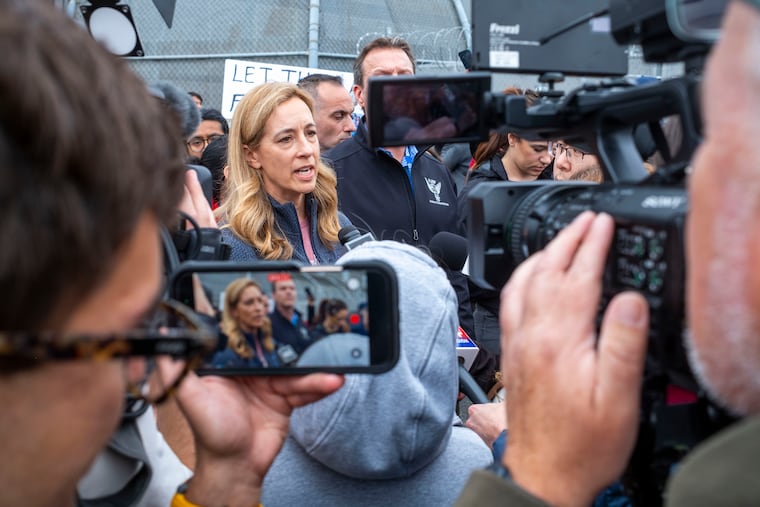
As the court prepared to hear the arguments, throngs on both sides gathered outside carrying signs and joining voices. Among them were members of the Pennsylvania Immigration and Citizenship Coalition, and the New Sanctuary Movement of Philadelphia.
Minutes into the session, Chief Justice John G. Roberts Jr. pivoted away from the underlying merits to an issue that could loom just as large: whether Texas, which led the challenge, has the standing to sue.
The state claimed the executive orders amount to a financial burden because they could force Texas to provide driver's licenses for an estimated 500,000 immigrants who would otherwise face deportation.
Solicitor General Donald B. Verrilli Jr. said that to allow Texas' theory of legal standing "would invite exactly the same kind of flood of litigation" that the Constitution is designed to prevent.
"Texas is already using this theory to sue the United States based on the resettlement of Syrian refugees in Texas," he said, "and that will just be the beginning."
Defending the plan, Verrilli said the federal government had regularly launched programs aimed at giving large groups of immigrants temporary legal status as part of its role in establishing enforcement priorities because of limited resources. Asked if the government has the power to allow all immigrants who are in the country illegally to stay, Verrilli said: "Definitely not."
Erin Murphy, representing the House of Representatives, told the justices the problem with the president's action is that "Congress has not created a legal status for the category of individuals covered."
Arguing for the administration, Verrilli told the court the phrase "lawful presence" had created "a terrible amount of confusion in this case."
What it means in the immigration world, said Verrilli, "is not that you have a legal right to be in the United States, that your status has changed in any way, that you have any defense to removal. It doesn't mean any of those things and it never has." In essence, it simply means that the government is not going to act immediately to deport a person.
With a bit of incredulity in his voice, the chief justice asked: "Lawfully present does not mean you're legally present in the United States?"
That's right, said Verrilli.
Justice Samuel A. Alito Jr. took it further by adding the wrinkle of "work authorization," which can be granted to immigrants waiting to obtain legal residency. "How is it possible to lawfully work in the United States without lawfully being in the United States?" he asked.
Verrilli said that was the case for millions of people currently applying for adjustment of their immigration status.
A ruling is expected before the end of June.
215-854-2541 @MichaelMatza1
This article includes material from Reuters.