The new worst-case scenario for election officials: Federal interference
Much of the preparations for Nov. 3 can be distilled into one overarching concern — that the Trump administration will somehow attempt to meddle with the voting process or the results.
State and local elections officials regularly plan for floods, fires, and computer glitches.
This year, they are teaching poll workers what to do if immigration enforcement officers show up. They are drilling them about the statute that bars federal agents from voting places. They are running through the limits of what federal monitors may and may not do on Election Day.
Much of the preparations for Nov. 3 can be distilled into one overarching concern — that the Trump administration will somehow attempt to meddle with the voting process or the results. The tricky part, officials said, is predicting what shape that interference might take while also recognizing that it might not materialize at all.
“This is the first time ever that we have had to engage in scenario planning to safeguard against potential federal interference in elections,” said Shenna Bellows, the secretary of state in Maine. “It seems like the federal government is now adversarial to the states.”
It remains to be seen whether any of these scenarios will play out. Many federal officials have dismissed the idea that agents or soldiers could be sent to the polls, and the courts have blocked most of President Donald Trump’s efforts to insert the federal government into state and local election administration.
And some of the country’s most prominent voting advocates have sought to assure the public that election administrators are well-prepared to protect the vote. David Becker, a former voting rights lawyer for the Justice Department, said the most chilling possibilities are unlikely to come to pass because the courts would likely block them.
“But election officials feel more comfortable to know they’ve thought about this, and discussed it,” said Becker, who runs the Center for Election Innovation and Research, a nonpartisan group that works to support election officials in both parties.
Even so, the Trump administration has already taken significant steps to try to shape the voting process this year. Trump has sought to sow doubt about the security of elections. His administration has demanded that states turn over voter lists, and has tried unsuccessfully to change mail voting rules. Last week, the Justice Department filed a lawsuit in Alaska seeking to preemptively block the certification of the Senate race there if the Republican candidate loses by a narrow margin.
With one week until Election Day, officials around the country say they are bracing for even more unwanted and potentially undemocratic federal intervention — even as they can’t be sure what, if anything, the Trump administration might do. To prepare, secretaries of state and other state and local officials have met with lawyers and local law enforcement agencies, trained poll workers, and held meetings to consider what could come next.
Among their top concerns: that Trump’s attacks on the integrity of American voting systems could form the basis for challenging the legitimacy of the results. Along with that unease comes the worry that any federal intervention could further undermine public confidence in elections and cause voters to stay home.
The next step is a guessing game, they said.
Could federal officials try to seize ballots, as they did earlier this year in Fulton County, Ga., as part of a criminal investigation that thus far hasn’t resulted in any charges?
Could Trump deploy Immigration and Customs Enforcement personnel or other federal agents to polling sites, even though his Homeland Security chief has said ICE will not patrol polling stations and would be deployed to such an area only to investigate “specific threats”?
Might he invoke the Insurrection Act and somehow summon the military in connection with the election? Trump has refused to rule out the possibility.
“We really are shadowboxing here, because we don’t know when or if the blow is going to land,” said Steve Simon, the Minnesota secretary of state. “We don’t know the character of, or content of, what might be headed our way.”
Trump, who has long claimed without proof that U.S. elections are rigged, sought to overturn his 2020 election loss. Earlier this year, he said the federal government should “get involved” in elections, even though the Constitution empowers the states and Congress — not the executive branch — to govern elections.
Bellows and Simon are Democrats. But Republican election officials have also planned for the possibility of federal intervention. Deidre Henderson, the lieutenant governor of Utah and a Republican, recently said that while she did not “necessarily expect” such interference, officials in her state were still planning for it.
In a statement, Lauren Bis, a White House spokesperson, said the bipartisan concerns about election interference were unfounded.
“The only ‘worries’ about election security are caused by radical Democrats who refuse to enact basic election security measures, supported by the majority of Americans, including voter ID and citizenship verification to ensure only Americans are electing America’s leaders,” Bis said. “President Trump has done more than any other president to ensure we have free and fair elections.”
Several voting advocacy groups have offered training and advice to election officials to help them get ready. One organization, the Government Counsel and Election Officials Network, explains to election administrators the legal basics that could be helpful in the case of federal action, whether civil or criminal, such as the seizure of machines or documents.
The group’s website provides samples of what federal grand jury subpoenas and search warrants look like. It also advises how to respond to a federal investigation, including what to do when agents show up with a search warrant.
“Step 1,” the site says: “Stay calm.”
Tina Barton, the co-chair of the Committee for Safe and Secure Elections, said her team has helped run about 140 training sessions for officials with local government and law enforcement this year, up from 67 such sessions in 2024.
Some of those officials, including law enforcement leaders in northern Virginia, said they were concerned about how immigration enforcement might affect the election process. Although Trump’s homeland security chief has said ICE will not patrol polling stations, Barton said that some congressional officials nonetheless expressed concern about the possibility. She said she helped lead a training scenario in which ICE enforcement was near a polling location.
Bellows said her team introduced a new slide this year into its training presentation for law enforcement. It provides the text of the federal statute that bars armed federal agents from polling places.
“It’s sad that we’re in this posture,” Bellows said in a phone interview. “But it’s just the way it is in 2026, given the administration’s rhetoric, and their actions.”
Barb Byrum, the clerk of Ingham County, Mich., said she was already concerned by some actions of the Trump administration, including the Justice Department’s deployment of federal election monitors to her county during the August primary. She said it was the first such deployment of federal monitors to her county in her nearly 14 years as clerk.
“The feds suggested that there were long lines, voters were not offered provisional ballots, and clerks and precinct workers failed to use the qualified voter file to check voters,” she said. “All of which is simply not true.”
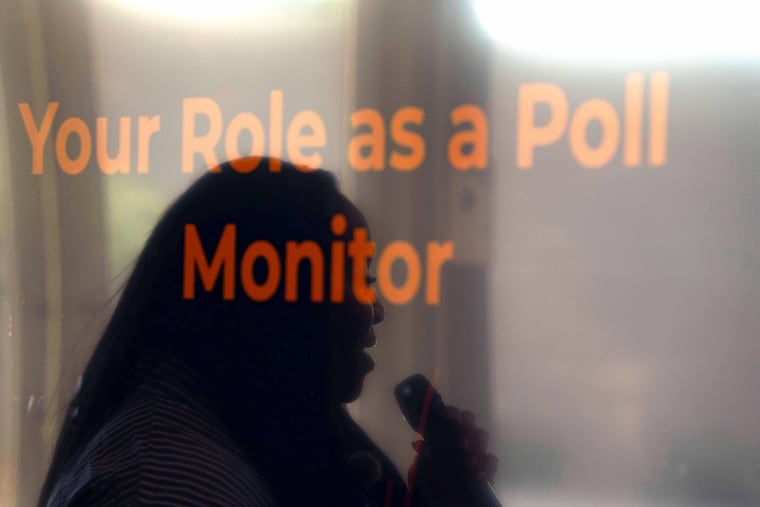
After the primary, Byrum put her election workers through additional training on what federal monitors were and were not permitted to do under state law.
“They can watch the process,” Byrum said. “They can’t touch anything, they can’t ask any questions. They can literally just watch — monitor.”
Byrum said she found it disheartening that she now considered the federal government a potential threat to the election.
Justin Levitt, a law professor at Loyola Marymount University, formerly worked on voting rights for the Biden administration. He said nearly everywhere across the country, Justice Department observers must adhere to the same rules of behavior at polling places as any other member of the public.
Earlier this week, Dana Nessel, the Michigan attorney general, said the Justice Department’s civil rights division had sent notices to seven Michigan municipalities that election monitors from the department would come to their polling places on Election Day. In a statement, Nessel, a Democrat, sought to quell anxiety about the plans.
“It’s important for residents know that DOJ monitors are a standard part of our election process, and we anticipate they will comport with state and federal law,” she said.
Some officials are hesitant to share granular details of their preparations, for fear of giving the federal government a tactical advantage if legal skirmishes arise.
For Democrats, the politics of discussing preparations are also complicated. By having an open discussion about preelection planning, they said, they show their constituents that they are taking the threats seriously. But they also recognize that such discussions could intimidate voters from going to the polls.
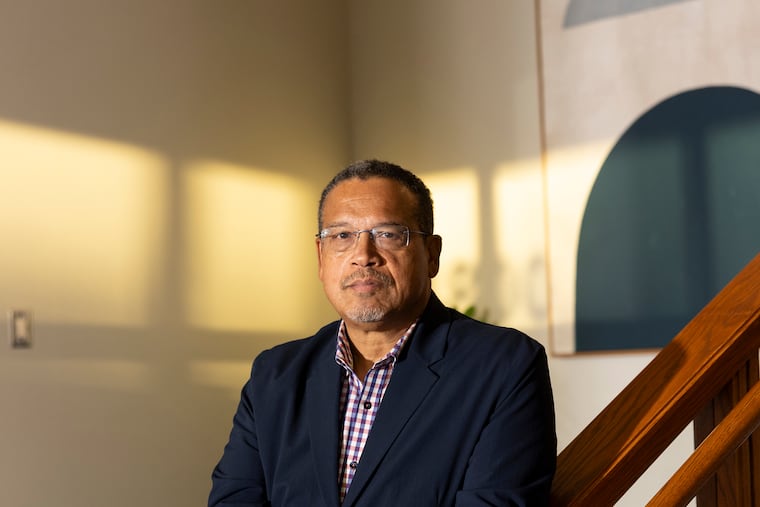
In an interview, Keith Ellison, Minnesota’s attorney general and a Democrat, said he and Simon, the secretary of state, have been working in tandem to prepare for election threats.
Asked how concerned he was about the threats to the Nov. 3 election on a scale of 1 to 10, Ellison said: “I’m at a seven.” He added: “It’s as high as it’s ever been for me.”
During a recent online forum, Lisa Lyons, the clerk and registrar of deeds in Kent County, Michigan, said her staff regularly communicated with her government’s legal team about potential troubles.
“We’re going to follow the law,” she said. “We’re going to follow the Constitution. We’re going to protect our election equipment.”
This article originally appeared in the New York Times.