In historic first, voters in five states will decide transgender youth rights
Washington’s ballot question 638 is particularly troubling to opponents because they say it would require all girls participating in sports to undergo a genital exam to verify their biological sex.

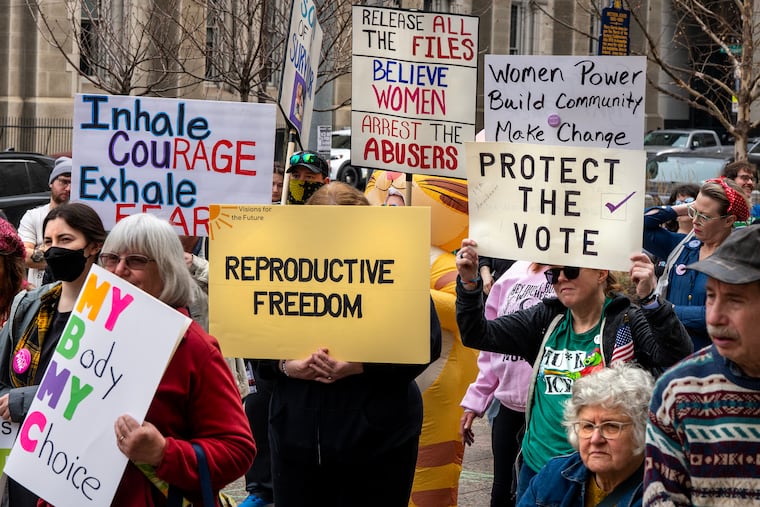
CAMAS, Wash. — Under heavy security, a transgender girl stretched for a high school race as supporters of a new anti-trans ballot measure chanted “enough is enough,” and others in rainbow garb cheered her on.
In an election cycle where Republicans have leaned heavily into anti-transgender advertising, deep blue Washington state has become ground zero in the debate over transgender rights.
Two ballot initiatives, heavily funded by a conservative private equity mogul, would ban participation of trans athletes in girls’ school sports and bolster parents’ access to curriculum and confidential mental health and medical records at school.
Similar questions are on the ballot in four other states — Colorado, Nebraska, Arizona, and Missouri — making this the first general election where such a wide pool of voters, almost 20 million, will be asked to weigh in directly on issues affecting transgender youth.
Polls show that a majority of Americans oppose transgender athletes competing in girls’ sports — with a Gallup poll last year finding that 69% of U.S. adults continue to think transgender athletes should be allowed to play only on teams that match their birth sex.
More than two dozen Republican-led states have adopted bans on female transgender athletes, which were upheld by the Supreme Court in June.
LGBTQ advocates say conservative groups have turned to ballot questions in blue states after failing to persuade Democratic-controlled legislatures to pass similar laws.
“They’re trying to do an end run around legislators that voters elected,” said Vivian Topping, the senior director for advocacy at the Equality Federation, a national advocacy group that supports a network of state-based LGBTQ rights groups.
Washington’s ballot question 638 is particularly troubling to opponents because they say it would require all girls participating in sports to undergo a genital exam to verify their biological sex. Supporters brush this off as a routine physical exam while detractors say it would be far more intrusive and discourage many girls from participating in sports.
“I am concerned we are villainizing transgender children, creating a bogeyman out of them when there are far greater issues we should face to keep our children safe,” said Kelsey Gellner, a pediatric nurse and board member of the state’s nurses association, which opposes the measure. “It’s a small minority who just want to belong.”
Supporters of the sports-related ballot initiative say transgender athletes have an unfair physical advantage when they compete on girls’ teams. And they also say it’s unfair that young people who oppose allowing trans athletes to compete have been accused of bigotry.
At a pro-638 rally before the district championship track meet on Wednesday, Frances Staudt, a senior at an Oregon high school about two hours away, told the crowd she was vilified and accused of harassment when she spoke out about a transgender player at a basketball game her sophomore year.
“This has never been about hate,” Staudt said. “It’s about fairness, it’s about privacy and making sure the next generation of girls don’t have to fight the battles we’re fighting today.”
After the protest, attendees walked to the course to watch the meet. Guards lined the route and teams gathered behind a cordon along the course littered with fall leaves.
For the varsity girls race, elite runners from four high schools lined up at the starting line. The transgender runner shook out leg muscles and ignored the protesters on the sidelines. The runner has been a focus of controversy since switching from the boys team to the girls’ team midseason; on Oct. 13, about a dozen girls walked off the course rather than compete against her.
A spokesperson for the family of the runner said at the meet they were not interested in being interviewed.
The starting gun sounded, and the runners were off.
“Let’s go girls,” called out Claudia Opri, a parent and former professional distance runner. “And shame on the boy.”
Brian Heywood, 59, a Trump inaugural donor and wealthy investor from the Seattle suburbs, is chief backer of Washington state’s anti-trans efforts, spending $2.2 million of his own money as of this month on the two initiatives as well as a third, a repeal of the state’s “millionaire tax.”
Heywood has pushed conservative ballot initiatives in the blue state since he founded his political action committee, Let’s Go Washington, in 2022, spending more than $11 million of his own money on a range of issues with mixed success.
Let’s Go Washington has raised a total of $12 million for the three initiatives on this year’s ballot, while the opposition group, No Hate in Washington State, has raised $4.5 million, records show.
Supporters of the initiative requiring parents to know about medical treatments at school say parents deserve to know what’s going on with their child, particularly one who might be struggling with gender issues. Opponents worry it will have a negative effect on LGBTQ youth and survivors of abuse who might feel safer confiding in a teacher or a counselor than a parent.
Heywood said at the rally he was inspired to take on transgender participation in sports after hearing the stories of Staudt and other female athletes.
“The girls have all been told, ‘If you say anything, you’re a bigot,’” he said in an interview. “They were making excuses for it, saying it’s OK because they didn’t want to get canceled.”
He ended up hiring paid signature gatherers for more than half of the 308,911 signatures required to get the initiative on the ballot.
“I’m not buying anything,” he said. “I’m getting people out there who can put it in front of people who can sign it or not sign it. That’s all I’m doing.”
A smaller grass roots movement supported by evangelical churches is behind two anti-trans ballot questions in blue-state Colorado, one which prohibits sex reassignment surgeries for minors and another that also limits sports participation to biological sex identified at birth.
Led by President Donald Trump, Republicans have embraced the anti-trans message with fervor this campaign season, spending at least $196 million on ads highlighting transgender issues in competitive races, according to a Washington Post analysis of data from the ad tracking firm AdImpact. Democrats spent far less, about $14 million, on ads about transgender issues, and candidates who did run ads appeared to be distancing themselves from their party.
Conservatives are moving forward with court challenges in the remaining states that allow transgender participation in sports. A female high school wrestler from Washington state filed an emergency petition to the Supreme Court on the matter this month.
“I can definitely see how it’s unfair,” Holly Burns, 16, one of the runners who joined the walk-off on Oct. 13, said about competing against a transgender runner. “We shouldn’t have to deal with this, honestly, we’re all just still kids. We should be able to run and have fun and hang out with our girls.”
There is no official tally of how many transgender athletes compete in sports in Washington state, which has allowed students to compete on teams matching the gender with which they identify since 2007. The state’s interscholastic sports association estimates the number is about 10 out of 101,000 female athletes.
Verónica Garcia, a transgender runner from Spokane, won the 400-meter dash at the state championships in 2024 and 2025, becoming a major flash point in the debate over transgender athletes.
This year the prospect of a ballot question that could mandate a genital exam for teens has caused the most uproar — although it is a matter of debate.
Sports physicals are usually conducted while the athlete is in street clothes, where doctors do a routine check of lung capacity and bone structure.
The ballot initiative requires verification of an athlete’s sex by a healthcare provider based on “reproductive anatomy, genetic makeup, or normal endogenously produced testosterone levels.”
Gellner said that the measure’s wording — and the potential that a physical inspection of anatomy might be required — makes it the most restrictive, and potentially invasive, in the country.
Heywood dismisses that idea.
“There’s nowhere in the bill that says they have to get unclothed,” he said. “That’s a ridiculous interpretation of what this is.”
At the district finals, Karen Wood, 56, a local small-business owner, said she was inspired to come out after reading coverage that called the female runners who walked off the field “brave,” when she felt the reverse was true.
“It’s the trans athlete who decided to be who they are, they’re the brave one,” Wood said.
Her older children had run cross-country at Camas, she said, and there have always been inequities between athletes. Some have bodies that develop faster than others, some have parents that pay for elite coaches.
“At this stage, it doesn’t really matter,” she said. She said she was disappointed in the Oct. 13 protesters, who could have chosen to embrace the runner as she transitioned, but instead walked off the field and refused to participate.
At the championship meet last week, the trans runner eventually placed second, helping her team win the district trophy.