Eagles not banking on this secondary just yet
Give Cary Williams points for honesty. Asked recently why he signed with the Eagles, the cornerback gave the answer most free agents would give if force-fed truth serum.
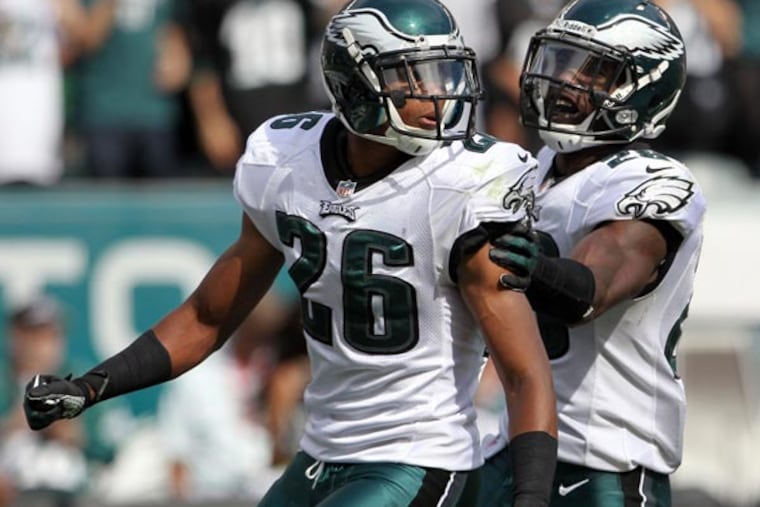
Give Cary Williams points for honesty.
Asked recently why he signed with the Eagles, the cornerback gave the answer most free agents would give if force-fed truth serum.
"No. 1 was money, no doubt," said Williams, who listed the history of the Eagles organization as a close No. 2. "This is the NFL. We only get a few opportunities to make the most money and they were offering the most money."
The Eagles signed Williams to a three-year, $17 million deal, but only about $6 million is guaranteed. The six-year veteran said that $10.5 million was in the bag, but the remaining $4.5 million or so isn't guaranteed until the fifth day of the next league year.
In other words, if the Eagles don't want to bring Williams back for 2014, it wouldn't cost them a dime to release the tenacious but sometimes controversial cornerback before March 16.
In essence, the same holds true for all of the free agents signed this offseason, minus outside linebacker Connor Barwin. With one swift stroke of a pen, the Eagles could wipe out their entire starting secondary - three-fourths of which was acquired through free agency - this coming offseason without putting a ding in their salary cap.
Safety Patrick Chung was signed for three years, $10 million with $4 million guaranteed, but only $1 million is guaranteed beyond 2013. Cornerback Bradley Fletcher inked a two-year, $5.25 million contract, but the $3.3 million guaranteed comes only in the first year. And safety Nate Allen, now in the final year of his rookie deal, may not even make it through this season.
The Eagles would certainly prefer that Williams, Fletcher, and Chung be back next season. It would indicate they performed well enough to stick around, and it wouldn't cost them very much, comparatively speaking.
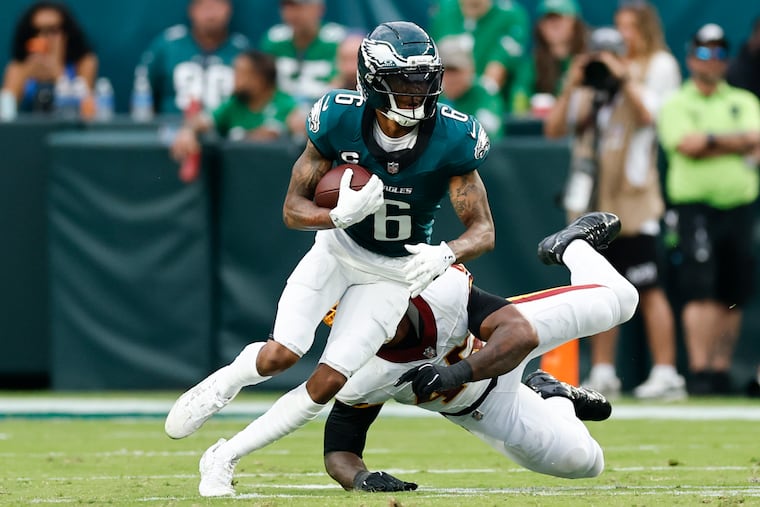
After three games, it's difficult to come to any conclusions on the three defensive backs. Williams, after a turbulent offseason start with his new team, had a strong first game against the Redskins, a complete reversal the following week against the Chargers, and a steady rebound vs. the Chiefs.
Fletcher, who missed the Chargers game with a concussion, has been solid if unspectacular in the two games he has played. And Chung looked decent enough in Weeks 1-2, if only because he wasn't anywhere near as bad as Allen, but was abysmal against Kansas City. Chung is doubtful for Sunday's game against the Broncos with a shoulder injury.
Any assessment of the Eagles secondary on the day it is to face Peyton Manning isn't exactly fair. The Denver quarterback can make the soundest secondary look unsound. But even an optimist would say the prospects for the season are dubious.
It would be easier to digest if the Eagles had young talent developing or to develop. The cupboard isn't exactly bare, but coach Chip Kelly and general manager Howie Roseman did relatively little to address the future in the secondary.
They drafted safety Earl Wolff, who is slated to start for the injured Chung, in the fifth round, and cornerback Jordan Poyer in the seventh. The Eagles are happy with the progress Wolff has made, Kelly said. The rookie has already chipped into Allen's playing time, but that isn't exactly a ringing endorsement.
Poyer was pushed into action in the opener, struggled, and was inactive against the Chiefs. Since the final preseason game the Eagles have scrounged up young cornerbacks Shaun Prater and Roc Carmichael. The odds are long that either will ever make a significant contribution.
Cornerback Brandon Boykin has the greatest upside, but the Eagles have relegated him to the slot for the second straight season. There is always the chance he has a future outside, but Kelly has made it clear he prefers bigger and rangier at those spots.
Four prospects were drafted ahead of Wolff, seven ahead of Poyer. Three of the first four players selected - tackle Lane Johnson, tight end Zach Ertz, and quarterback Matt Barkley - addressed the offense. Roseman has said the Eagles had no set plan for which players to take, only that they would choose the best available.
In his words, it was drafting by position that got the Eagles into their secondary bind in the first place. Allen and Jaiquawn Jarrett were supposed to project as starting safeties alongside cornerback Curtis Marsh and possibly Trevard Lindley, but the latter are gone with Allen not far behind.
The Eagles did load up on defensive linemen, drafting three big bodies, but only Bennie Logan is on the active roster. Many teams like to build from front to back, and the Eagles' move to a 3-4 compounded the need, but they are nearly barren in the secondary.
The Seahawks have shown that teams can have the secondary as a strength and be a dominating defense. But they evaluated, drafted, and developed three-fourths of their starters, including all-pro cornerback Richard Sherman and safety Earl Thomas.
The Eagles tried to compensate for poor drafts by adding big-name cornerbacks such as Nnamdi Asomugha and Dominique Rodgers-Cromartie. But they learned their lesson and went after mid-tier talents they aren't beholden to beyond one season.
"I try not to think about those things," Williams said about returning. "I just try to play my game and hopefully at the end of the year I can come back. But I don't see myself anywhere else next year."
With the Eagles still a ways off from having their "secondary of the future," it's possible Williams is right.