WHEN THE national reporters begin making mysteriously authoritative proclamations about your bosses' feelings concerning your job performance, you needn't possess a persecution complex to sense the skids being greased.
Yesterday, Ryne Sandberg did what many proud, financially ambivalent men would have done in his situation. He left before the inevitability of his leaving became awkwardly obvious.
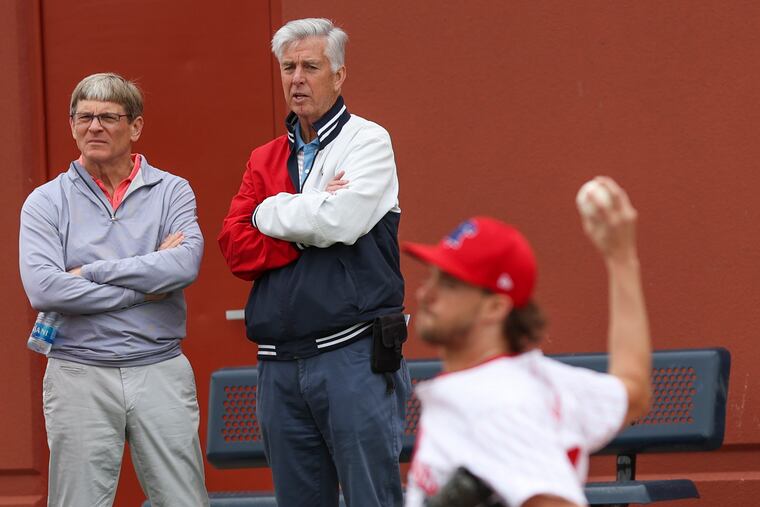
The result was a remarkable press conference that featured a stunned general manager, a silent president, and a gigantic elephant invited by the outgoing manager and ignored by the other two men. The Phillies might be the worst team in the major leagues, but man, do they make it interesting. How strange are these times? When asked one of the most basic questions regarding situations like these - who will be in charge of hiring Sandberg's replacement - the president of the organization could not answer.
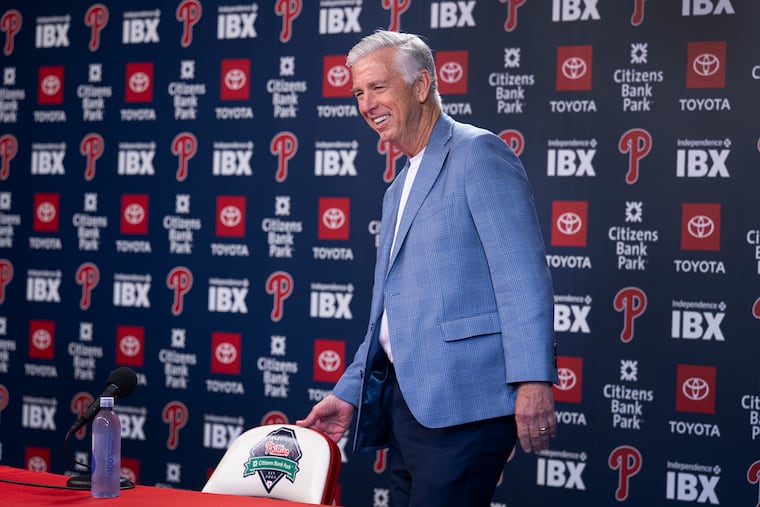
"I can't really comment on that," Pat Gillick said.
After a few moments of silence, the press conference ended. Those six words were the only ones Gillick spoke.
The silence wasn't deafening as much as it was baffling. Who, exactly, is making the decisions these days? Who, exactly, is Gillick answering to? Is the Phillies' reportedly imminent hiring of Andy MacPhail a Gillick endeavor, or an ownership endeavor, or an ownership-mandated Gillick endeavor? And what does ownership mean, anyway? Who is the voice of the ownership? Is John Middleton leading and the rest of the partnership rubber-stamping?
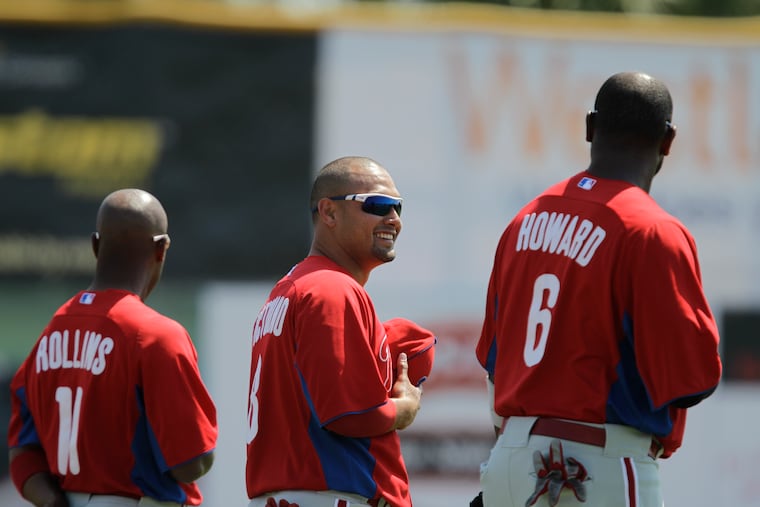
And why is all of this happening now, in the middle of a season that was Dead On Arrival, as if the dreck that we have witnessed is a surprise that somebody is just now realizing must be dealt with, instead of in the offseason, when the Phillies had yet to trade Jimmy Rollins and Marlon Byrd and had yet to field another series of offers for Cole Hamels and were yet again trying to drum up interest in Ryan Howard and Jonathan Papelbon?
These are all questions that would be great to ask whoever speaks for the ownership group these days, but it really isn't clear who that person is. If it is Gillick, then he should have been able to offer something a little more reassuring/constructive/diplomatic/whatever than "I can't really comment on that."
Otherwise, it appears to this outside observer, and, apparently, to Ryne Sandberg, that a bizarre vacuum has opened up in the chain of command, and the only thing keeping everybody going about their business is the off chance that the bosses will show up for a surprise inspection.
Perhaps, then, yesterday's announcement should not have come as the shock that it did. The Phillies, in their current state, are a dysfunctional organization, and functional people tend to tire easily when dealing with dysfunction. For all his flaws, Sandberg is a functional person. No doubt, there were serious questions about his aptitude for managing in the majors. At heart, he is a teacher and a doer, but a big-league manager needs most of all to be a communicator, both with his players, and with his bosses.
There have been way too many instances over the last 2-plus years in which all three levels of the organization appeared to be on different pages. The workload he placed on some of his pitchers, particularly the young ones, was alarming. The rotation of his hitters at times lacked rhyme or reason.
Most of all, Sandberg wanted to win, and the more this thing played out, the more it seemed that goal and the organization's goals were incongruous. This was his long-coveted shot to prove that he could manage a winning team at the big-league level. But no manager in the sport could guide the roster he was given to the neighborhood of respectability.
And maybe that's why you felt bad for the guy. Nobody inside the organization, outside of Charlie Manuel, seemed to understand just how ugly it was going to get. That you could see the first signs of genuine concern in Manuel's face as early as 2012, and in nobody else's until August 2014, is remarkable. But the fact remains that the Phillies and Sandberg both seemed to legitimately believe that a change in the manager's office, and the ensuing changes in approach and energy were all that the roster needed to get back to the days of competing on a nightly basis. And then, suddenly, they were rebuilding, with a farm system so thin that it could not provide the talent necessary to keep a big-league team from embarassing itself, and, by extension, its manager.
"I do not like to lose," Sandberg said. "I hate to lose. I think that's the biggest thing that weighed on me. And with some changes at the top looming, I did not want to be in the way of anything happening and progress going forward."
For now, nobody knows exactly what those changes will entail. Sandberg identified the looming changes at the top as the catalyst for his decision while seated next to two men whose roles after those changes are, at the moment, unclear. Who is making the decisions in the Phillies organization? Well, yesterday, Sandberg did. Give him credit for that.
Blog: ph.ly/HighCheese