Johnny Doc reportedly switches to Republican Party after receiving prison commutation from Trump
Under Trump's commutation order, Dougherty will no longer have to pay $1.6 million in restitution to the union he was convicted of defrauding.
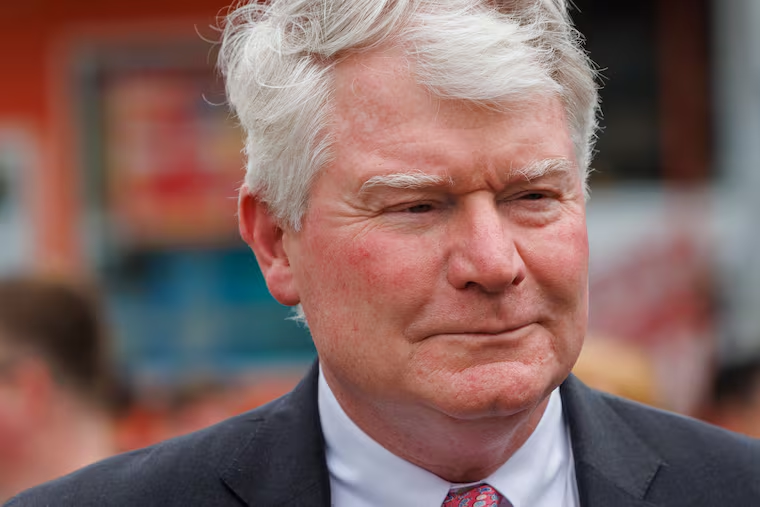
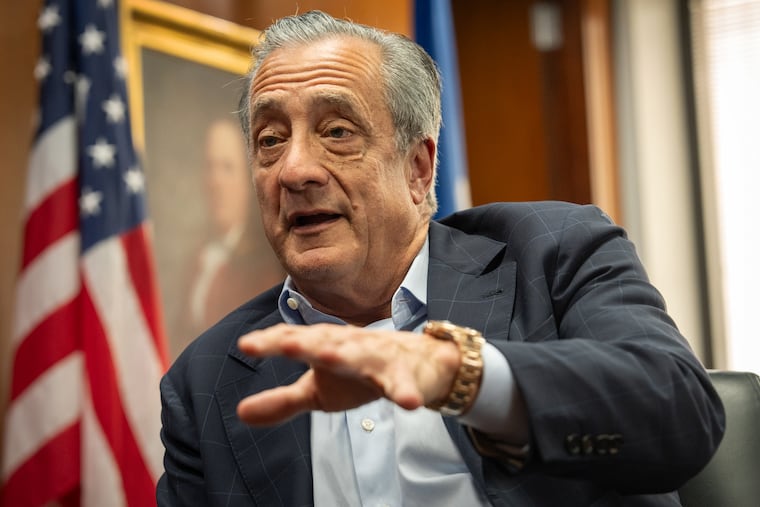
John “Johnny Doc” Dougherty, the former Philadelphia labor leader and longtime Democratic power broker whose prison sentence for a corruption conviction was commuted by President Donald Trump earlier this month, has reportedly switched political parties.
Claudia Vargas, a former journalist for NBC10 and The Inquirer, reported Friday that Dougherty changed his party registration on Sept. 11 to Republican, and that he has since moved from South Philadelphia, where he had served as a ward leader, to Center City.
The website for the Office of the Pardon Attorney in the U.S. Department of Justice shows Trump signed Dougherty’s commutation Sept. 3.
Dougherty, who served less than two years of his six-year sentence, had been seeking an early release so he could care for his gravely ill wife, Cecilia. He was released Sept. 4 from the federal penitentiary in Lewisburg, Pa., his lawyer, George Bochetto, confirmed that day.
Neither Dougherty nor Bochetto could be reached for comment on Friday.
Dougherty was found guilty of bribing former Philadelphia City Councilmember Bobby Henon in one trial, and was convicted in a second trial for his participation in an embezzlement scheme that cost his union nearly $600,000.
He had petitioned U.S. District Judge Jeffrey L. Schmehl to release him on house arrest so he could care for his wife. Schmehl repeatedly denied those efforts.
As a result of Trump’s commutation, Dougherty not only had his incarceration cut short, but also will no longer have to pay about $1.6 million in restitution to the union he was convicted of defrauding.
A representative for Local 98 of the International Brotherhood of Electrical Workers could not be reached for comment about the loss of the restitution funds.
Dougherty, whose conviction remains intact, also will not be subject to monitoring or house arrest.
On the day Dougherty was released, Bochetto called Trump’s decision “a magnificent gesture of compassion.”
Bochetto said he had been in regular communication with White House staffers about the health challenges faced by Dougherty’s wife.
A White House official said those circumstances figured into Trump’s decision, particularly because Dougherty’s father-in-law, who had been serving as the primary caretaker, died last year.
Bochetto said there was “absolutely no reason” to keep Dougherty locked up while his wife’s health was continuing to decline.
Federal prosecutors had opposed Dougherty’s early release.