GOP defections widen as House passes measure intended to halt the Iran war
The House on Tuesday passed a largely symbolic measure intended to halt the war in Iran — the latest bipartisan attempt to limit President Donald Trump’s war powers.

The House on Tuesday passed a largely symbolic measure intended to halt the war in Iran — the latest bipartisan attempt to limit President Donald Trump’s war powers.
The vote, which advanced by a margin of 220 to 204, came after similar efforts this summer. Seven Republicans joined Democrats in supporting it, the largest number of GOP lawmakers so far to publicly oppose the war.
Rep. Zach Nunn and Rep. Mariannette Miller-Meeks of Iowa and Rep. Nancy Mace of South Carolina joined four Republican lawmakers who had voted for previous measures: Reps. Tom Barrett of Michigan, Warren Davidson of Ohio, Brian Fitzpatrick of Pennsylvania and Thomas Massie of Kentucky.
The measure, led by Rep. Seth Moulton (D-Massachusetts), directs the administration to “remove United States Armed Forces from hostilities against the Islamic Republic of Iran” except for personnel needed to defend American or allied bases in the Middle East.
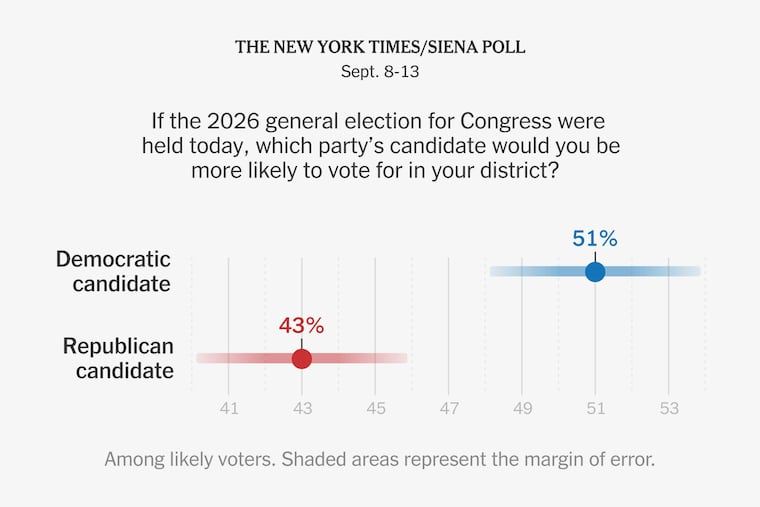
The vote relects Democrats’ months-long strategy to force votes on war powers resolutions in order to highlight Republican support for the unpopular conflict, which after seven months has roiled global energy markets and depleted the Pentagon’s stocks of precision weaponry.
The nonpartisan Congressional Budget Office released a report Tuesday estimating that the war had cost about $38 billion through July, and an additional $2 billion to $3 billion per month depending on the intensity of the fighting.
The Pentagon did not respond to the CBO’s requests for information and has previously estimated the war would cost $37.5 billion through the end of September — though that total does not account for the substantial damage to U.S. bases targeted by Iran throughout the region.
In June, the House and Senate passed a similar measure calling on Trump to end the war in Iran, though the White House has asserted that the measure is not legally binding and Democrats and Republicans disagree on whether it has the force of law. The House again voted to limit Trump in July, but a similar measure failed in the Senate.
U.S. Central Command, which oversees America’s military operations in the region, has maintained a footprint of around 50,000 troops in the Middle East and has periodically struck Iran following the collapse of a ceasefire the Trump administration reached with Tehran in June.