‘Nixonmaxers’ idolizing the 37th president should consider his policy disasters in Africa
Richard Nixon is enjoying an unlikely revival among young conservatives. His private remarks about Africa complicate the image of a misunderstood foreign-policy visionary.
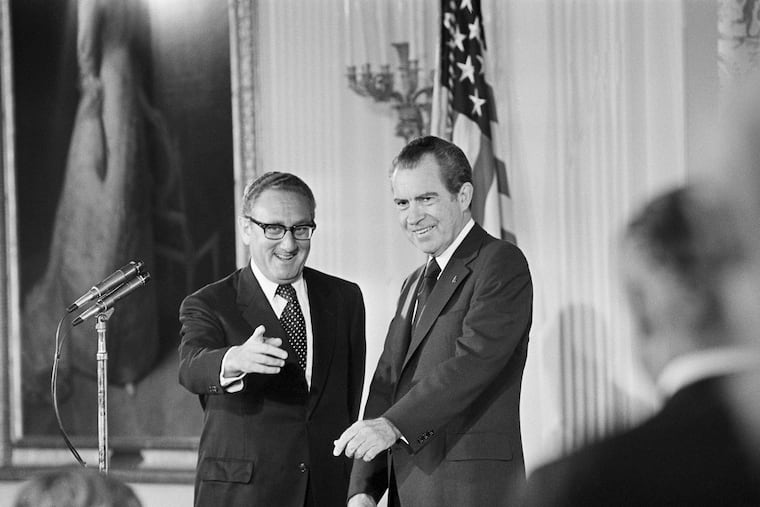
Richard Nixon is back. Or at least, that is what a growing movement of young conservatives would have us believe. Dubbed “Nixonmaxxing,” the trend has transformed America’s disgraced 37th president into an unlikely social media celebrity. Slickly edited videos celebrate his foreign-policy achievements to the tune of Drake’s “National Treasures” and Bia’s “We On Go.” The Nixon Foundation even sold out (twice) of its distinct “Nixonmaxxing” hats.
Much of this rehabilitation centers on Nixon’s reputation as a master geopolitical strategist who opened China and pursued détente with the Soviet Union. There are two assumptions underpinning Nixon’s rehabilitation. The first is that his worldview was coolly realistic and aloof from ideological illusions. The second is that his strategies worked.
But the Nixon administration’s foreign policy record in Africa challenges both. There, Nixon’s racial contempt for Africans— captured for posterity on the White House taping system—distorted his realist instincts. These prejudices led Washington to embrace white-minority governments and crumbling colonial regimes as anti-communist bulwarks and to dismiss African calls for liberation and majority rule. This strategy proved both morally bankrupt and strategically self-defeating for Washington’s Cold War interests in the region.
When Nixon took office in 1969, Africa was in the midst of a sweeping transformation. More than 40 African states had won independence. Together, they formed a powerful and vocal bloc at the United Nations. But the southern third of the continent remained under colonial and white rule. Apartheid remained entrenched in South Africa, whose white overlords illegally occupied neighboring Southwest Africa (today’s Namibia) in defiance of multiple U.N. resolutions. Rhodesia’s white minority had unilaterally declared independence from Britain in 1965 rather than accept majority rule. And Portugal, ruled by a right-wing dictatorship, battled increasingly potent liberation insurgencies in Angola, Mozambique, and Guinea-Bissau.
Washington viewed events on the continent primarily through the lens of the Cold War. CIA analysts worried about an “accelerating tempo” of Soviet efforts on the continent. Portugal was also a NATO ally. The Nixon White House worried that pressuring Portugal’s right-wing government to decolonize its African holdings would threaten America’s lease agreement for the Azores airbase, which represented a key logistical link between the continental United States and its interests in the Middle East.
In public, Nixon tried to present a balanced approach that called for controlled change in the region. The administration kept in place some Lyndon B. Johnson-era policies, such as the arms embargo against South Africa and a de-facto ban on U.S. Navy port calls to the segregated country. At the same time, however, policy quietly tilted in favor of the white regimes.
The Nixon administration’s official policy towards southern Africa, encapsulated in the classified National Security Study Memorandum (NSSM) 39, outlined this approach. It asserted that “the whites are here to stay and the only way constructive change can come about is through them.”
Privately, Nixon’s taped conversation reveal the racialized logic behind this strategy.
In October 1971, Nixon spoke with California Gov. Ronald Reagan about African delegates at the United Nations. Reagan complained about “those monkeys from those African countries,” adding that they were “still uncomfortable wearing shoes.” Nixon laughed.
This was hardly an isolated exchange.
Following a meeting with African leaders, Nixon told Henry Kissinger: “You see these poor, child-like Africans. God almighty, you think what the world, you know? We did our best.”
On another occasion, Nixon used a racial slur to refer to African people, instructing Kissinger to ”leave [them] to Bill" Rogers, then serving as Nixon’s Secretary of State, “and we’ll take care of the rest of the world.”
Even before the installation of the White House taping system, Nixon’s chief of staff recorded the president declaring that “there has never in history been an adequate black nation, and they are the only race of which this is true.”
Later, Nixon informed his ambassador to the United Nations that “the Africans just can’t run things,” describing this as a “very fundamental point in the international scene.”
Within Kissinger’s National Security Council (NSC), a casual racism emerged when discussing African affairs. For example, according to Roger Morris, who covered African affairs at the NSC during this period, then-Colonel Alexander Haig “would quietly pretend to beat drums on the table as African affairs were brought up at NSC staff meetings.”
The geopolitical assumptions which underpinned Nixon’s ostensibly “realist” strategy soon collapsed. The Caetano regime in Portugal fell in a coup in April 1974. By the end of 1975, Portugal’s African empire had disintegrated, leaving Washington to contend with newly independent governments and liberation movements whose political ambitions it had long discounted. Nixon’s accommodation of apartheid South Africa, meanwhile, offered Moscow an opportunity to present itself as a champion of African liberation. Washington’s retrograde approach led many Africans, as Nelson Mandela himself noted, to “equate Communism with freedom.”
In the realm of foreign policy, Nixonmaxxing champions the 37th president’s willingness to transcend ideology and restructure the world order to maximize America’s long-term power. By this standard, however, Nixon failed miserably in Africa. Nixon’s racism undermined his realism, blinding him to the winds of change sweeping the region. As one Nixon NSC staffer later admitted, the administration’s Africa strategy “was a disaster.”
There is nothing inherently wrong with reconsidering Nixon’s legacy. Historical reputations deserve scrutiny and his diplomatic achievements warrant serious examination. But rehabilitation requires confronting the entire record rather than selecting its most flattering excerpts.
The next time a Nixonmaxxing video celebrates the president’s geopolitical wisdom, remember that the White House tapes offer a rather different soundtrack. Perhaps the Nixonmaxxers should give it a listen.
Sam Wilkins is a Ph.D. Student in History at Yale University and an active-duty U.S. Army Special Forces officer with deployments to Somalia, Nigeria, and Afghanistan. Previously, Sam also served as an Assistant Professor of International Affairs in the Department of Social Sciences at West Point.
The views expressed are those of the author and do not reflect the official position of the Department of the Army or the Department of War.
Made by History takes readers beyond the headlines with articles written and edited by professional historians. Opinions expressed do not necessarily reflect the views of The Inquirer.