Reaching for the stars: Shapiro and Pa.’s two senators propose the state as the home of the first-ever space academy
As part of Pennsylvania's application, Shapiro's administration promised to steer up to $85 million toward construction of the new academy ordered by President Donald Trump.
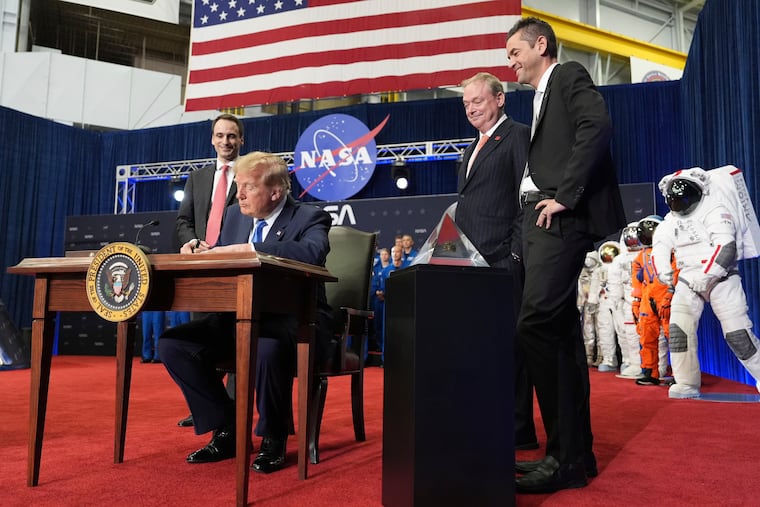
Gov. Josh Shapiro and U.S. senators are united in a bipartisan effort to make the state the home to a new U.S. Space Academy ordered by President Donald Trump.
Penn State University as well as other regional partners will also be involved in the effort to bring the academy to the Pittsburgh area, according to news releases from Shapiro and Republican Sen. Dave McCormick.
“Pennsylvania is now uniquely positioned to welcome the United States Space Academy – building off our robust space industry and world-class research universities – to launch the next generation of America’s scientists, engineers, astronauts, and service members and ensure America remains the global leader in space,” Shapiro said in a statement.
“Pennsylvania’s application provides the federal government with an opportunity to strengthen and diversify America’s space industry. My administration is all in,” he said.
The planned academy will provide training for NASA and the U.S. Space Force, the armed services branch which Trump established during his first term.
As part of its application, the Shapiro Administration outlined a commitment of up to $85 million toward construction of the academy, including $30 million for site preparation, $11 million for water infrastructure upgrades, and $45 million for regional transportation improvements.
In addition, the state’s proposal also includes what’s being described as “an independently governed private endowment”— with a $200 million initial target — to strengthen the education provided at the academy and fund scholarships and fellowships, endowed faculty chairs, mission studios, and laboratories.
If Pennsylvania’s application is selected over other states, the academy would break ground in 2027 on a campus on 300 acres of publicly owned land that sits beside the Pittsburgh International Airport, according to the state’s proposal.
While the Pittsburgh site and the Allegheny County area are the focus of the proposal, Shapiro’s statement included a brief mention of the Bellwether District in Philadelphia as an alternative site for the academy, without detail. The Bellwether District is a massive 1,300-acre campus in South Philadelphia transforming the site of the former Philadelphia Energy Solutions oil refinery into a hub for logistics, life sciences, and manufacturing.
The statements from Shapiro and McCormick said state leaders are responding to Trump’s August 2026 Executive Order, as well as a request for information from NASA, to establish an American space academy.
The school would train the “next generation of astronauts, scientists, engineers, operators, entrepreneurs, civil servants, and warfighters,” according to the order.
“Pennsylvania has the talent, technology, and industrial strength to help America win the race for space dominance,” McCormick said in a statement. “Bringing the U.S. Space Academy to Pittsburgh would build on those strengths, create new opportunities for Pennsylvanians, and train the next generation of leaders who will ensure America remains the world’s leader in space.”
The commonwealth already has a robust connection to the so-called “space economy,” according to Shapiro’s statement.
The Pittsburgh region alone is home to 126 of these businesses, spanning engineering, research and testing, software and computing, advanced machinery and equipment manufacturing, academia, spacecraft, power systems, and propulsion, the statement added.
All told, the state’s space economy has generated $8.6 billion in economic impact over the last four fiscal years and supports 556 businesses across the space supply chain, Shapiro’s statement said.
In his own statement, Democratic Sen. Fetterman said that as a member of the Senate Commerce Committee, he’s “deeply committed to investing in NASA and its workforce, our national security, and making sure Pennsylvania is part of those important conversations.”
Under the proposal, Penn State University and six other Pennsylvania research universities would help develop the academy’s curriculum.
If selected, Pennsylvania would become home to the nation’s first new federal service academy since 1955.