Trump’s economic approach draws concern from some Republicans
GOP candidates criticize some of the president's recent moves, such as imposing tariffs on Canada and lifting tariffs on foreign beef.

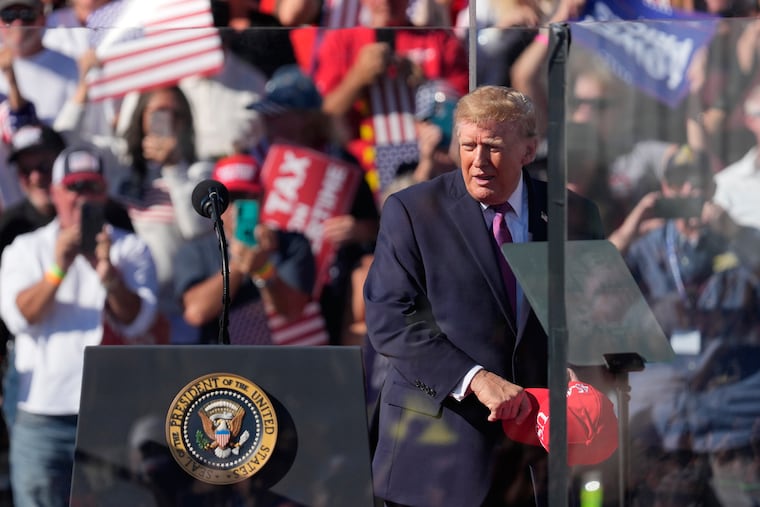
President Donald Trump’s economic policies drew a fresh round of concern from some Republicans over the weekend who criticized his trade policies, as others in the party sidestepped questions about his broader approach amid a midterm election that has put consumer prices front and center.
Rep. Ashley Hinson (R., Iowa), who is running in one of the most competitive Senate races, reiterated her opposition to Trump’s recent announcement that he would lower tariffs for up to 300,000 metric tons of imported ground beef over the next 90 days, which he claimed would push down costs.
“We need to focus on affordability, but I think this isn’t the way to do that,” Hinson told Fox News in an interview broadcast on Sunday Morning Futures, arguing it would hurt domestic cattle ranchers. The import taxes, she said, are helping U.S. cattle ranchers restore the U.S. cattle supply, which remains at a 75-year low.
On Saturday, Sen. Susan Collins of Maine, considered one of the most vulnerable Republican incumbents, implored Trump to reverse course on Canadian import taxes and “reach a fair agreement” after trade talks between the United States and Canada collapsed.
“If the Administration proceeds with these tariffs, they will increase costs for Maine families, as most businesses will have no choice but to pass on the tariffs to their customers through higher prices,” Collins wrote in a social media post, urging “both sides to return to the negotiating table.”
Texas Gov. Greg Abbott, a Republican who is running for reelection, refused to grade Trump on the economy when asked about it on ABC News’ This Week on Friday. He said that “people are not talking to me about Trump” on the campaign trail.
Pressed again, Abbott said, “We all need to have prices lowered,” adding that he thought Trump was “on a track to get us there.”
The comments from candidates in key races reflected the distance some Republicans have tried to draw from Trump at a moment when polls show that voters have major concerns about the economy and the president’s stewardship of it, including cost increases driven by an unpopular war with Iran. The remarks also revealed some of the geographic sensitivities to the administration’s economic approach that could come into play in November in battleground states such as Iowa and Maine.
The White House did not respond to a request for comment. Trump has defended his economic actions.
But some Republicans are unnerved by recent developments.
Hinson joined other Midwestern Republicans, including Sen. Chuck Grassley of Iowa and both of Nebraska’s senators, who criticized Trump’s beef import tariff cuts. Sen. Tim Sheehy (R., Mont.) said he had “advised President Trump against this course of action for a year.”
The breakdown of trade negotiations with Canada kicked the Trump administration’s 50% tariffs on a range of Canadian goods into gear and prompted Prime Minister Mark Carney of Canada to promise “dollar for dollar” counter-tariffs on American imports.
Former Vice President Mike Pence, who served in the first Trump administration before breaking with Trump, expressed concern about the trade standoff between the United States and Canada on CNN’s State of the Union on Sunday.
“The last thing we need right now, as our economy is getting back on its feet, is a trade war with Canada,” Pence, a critic of Trump’s tariffs, said, adding, “That’s how I would advise the president: Drive a hard bargain, but let’s pursue free trade with free nations, especially our partners to the north.”
On Sunday, Transportation Secretary Sean Duffy told Fox News Sunday that “Canada gets the benefit of trading with the U.S. way more than the U.S. gets the benefit of trading with Canada” and that it was “foolish” for Canada to think it could win a trade war with the United States.
Carney said the United States had made unreasonable demands of his country in trade negotiations.
John Barrasso (R., Wyo.), the Senate majority whip, who is not up for reelection this year, defended Trump’s handling of negotiations — but he also said that the United States needed to maintain its trade relationship with its northern neighbor.
Canada would “be wise” to return to the bargaining table and move forward, he said on Sunday Morning Futures, “because we need to continue trade with Canada.”
He added, “The president is very consistent: We’re going to make sure to protect our workers and bring jobs back to America.”
Democrats have sharply criticized Trump on the economy. On Sunday, Sen. Chris Van Hollen (D., Md.) said Trump had broken his campaign commitments to keep the United States out of foreign wars and to lower prices.
“He’s done the opposite,” Van Hollen told NBC’s Meet the Press. He added, “Broken promises, betrayal.”
The campaign of Troy Jackson, the Democrat challenging Collins in Maine, slammed Trump’s tariffs.
The tariffs are “a tax on Maine families and small businesses,” Dan Gottlieb, a spokesperson for Jackson’s campaign, said.
Sen. Tim Scott (R., S.C.), a staunch supporter of Trump, sought to redirect an interview when pressed on Trump’s tariffs. Asked on Meet the Press if he agreed with Collins’ comment that they would increase costs for families, Scott, who presides over the Senate Republicans’ campaign arm, pivoted to arguing that Trump had inherited economic problems from his predecessor, President Joe Biden Jr.
The interviewer, Kristen Welker, interjected to say that Trump had been in office “for two years.”
Asked if Trump had broken his campaign promise to lower costs, Scott again dodged the question, saying the election would be about differences between Democrats and Republicans.
“At the end of the day, the American people need to see the contrast,” Scott said. “And the good news is, they’re seeing the contrast.”
This article originally appeared in the New York Times.