Camden drops uniforms in high schools in favor of a dress code
A dress code for Camden's high school students allows more flexibility instead of uniforms but bans durags, bonnets, hair rollers, pajamas, and revealing clothing.
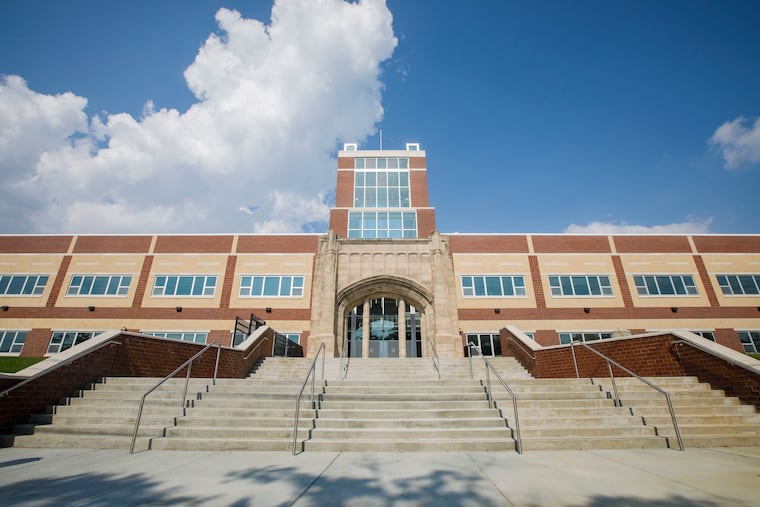
The Camden school district has dropped its longtime mandatory school uniform policy at its five high schools.
Instead of wearing uniforms that included khaki pants and a shirt based on their school colors, students returning to school on Sept. 3 will have a dress code that allows more flexibility but bans durags, bonnets, hair rollers and curlers, pajamas, and revealing clothing.
Superintendent Alfonso Q. Llano Jr. said the decision was made after feedback from students and staff in the South Jersey school system. Elementary and middle school students will continue to wear uniforms. In a social media post earlier this month, the district explained the decision as a response to students who expressed “desire for greater opportunities to express themselves through their clothing while maintaining a safe learning environment.”
High school will also start an hour earlier at 8:05 a.m. and run until 2:25 p.m. The district said the earlier time aligns with national start times and better meets the needs of students who work after school or have extracurricular activities.
The new dress code has drawn mixed reaction from students and staff. It will impact students at the district’s two traditional high schools, Camden High and Eastside High, and three magnet schools, Dr. Charles E. Brimm Medical Arts High, Creative Arts High, and the Big Picture Learning Academy.
“I think it’s a good idea. It allows students to break the mode, creates more creativity,” said Odalys Dejesus, 17, a rising senior at Eastside. “It’s a good step forward.”
Former school board member Jose E. Delgado said the uniform policy was established more than two decades ago to improve security by making it easier to identify students entering buildings, curb bullying, and stop students from wearing gang colors.
Delgado and others who served on the board that adopted the uniform policy have asked state Department of Education Commissioner Lily Laux to review whether Llano followed procedures for switching to a dress code.
“It makes no sense,” Delgado said. “The uniform policy was working.”
A state education department spokesman said the dress code policy was a local matter. Camden has been a state-operated district since 2013.
Llano has been making changes since becoming schools chief in March. He sent pink slips to the entire central office staff. He backpedaled on a plan to merge the three magnet high schools after a backlash.
Delgado believes the dress code policy is too subjective and can be interpreted differently by school leaders. He also worries about enforcement.
“The teachers are not going to enforce this,” Delgado said. “They have enough problems.”
Camden Education Association President Pam Clark said she supported the new policy for high school students only.
“I’m for the district giving the students a chance to wear their regular clothes,” Clark said. “However, the students need to know there will be consequences if they do not come to school presentable.”
The policy also bans open-toe shoes, most face coverings like ski masks, baseball hats, short shorts and mini-skirts, and baggy pants with underwear showing. Hoodies are allowed but the hood must be removed when the student enters the building.
The policy calls for progressive disciplinary action for violators, beginning with a warning, and possibly escalating to in-school suspension and a meeting with a parent or guardian for repeat offenders.
Last year, then-acting Superintendent Davida Coe-Brockington said the district would enforce a long-standing policy banning students from wearing all-black outfits at the Camden High campus.
The complex houses four separate wings, and students were assigned shirt colors based on their school. Coe-Brockington said the all-black outfits made it difficult for staff to easily identify which school a student attends.
Karen Borrelli, a veteran health and physical education teacher at Brimm, does not support the move to a dress code. She said the uniforms gave the schools identity, especially at the Camden High campuses. Some parents depended on district-issued vouchers to purchase uniforms, she said.
“They don’t have the money to get outfits and keeping up with the Jones,” Borelli said referring to possible peer pressure students may face to wear the latest fashions. “Our parents can’t afford that.”
Llano said students may still opt to wear uniforms. Borrelli expressed doubt that they would because they would stand out.
“The focus shouldn’t be on what they are wearing to school, but on academics,” Borrelli said. “It’s going to be a mess.”
Tuskegee University sparked a national debate earlier this year when president Mark Brown tackled the thorny issue of proper attire for students at the historically Black college.
» READ MORE: Tuskegee University’s ban on hair bonnets and do-rags in class? I’m here for it.
Like Camden, Tuskegee banned students from wearing hair bonnets and durags, which customarily are worn to protect Black hairstyles while people sleep.
The Philadelphia school district leaves it to schools to set a dress code policy for students “so that their appearance does not constitute a health or safety hazard.”
» READ MORE: CAPA flagged dozens of female students for dress code violations, sparking outrage about policing girls’ bodies
Last school year, an uproar flared at Philadelphia High School for the Creative and Performing Arts when female students complained they were unfairly flagged for dress code violations.
Students said they were told by administrators that the crackdown was imposed because men outside of school were following female students. The district said it would review the dress code policy.
Staff writer Kristen A. Graham contributed to this report.