A Voorhees Holocaust survivor fled his family store in Germany in 1938. As he turns 100, his hometown will honor him.
Fred Behrend, who turns 100 on Nov. 3, will be honored along with his late parents in his hometown of Lüdenscheid with memorial plaques known as Stolpersteine, or "stumbling stones."
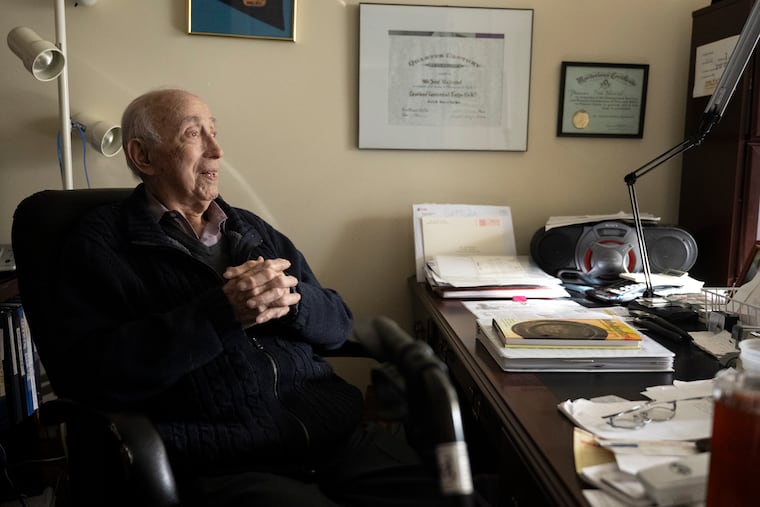
It’s been decades since Fritz Fred Behrend returned to his hometown of Lüdenscheid, Germany, where his family once owned a textile store.
The Behrends fled the city in western Germany when Fred was 12 , after Nazis torched synagogues in 1938 during Kristallnacht, an anti-Jewish attack across the Nazi regime and arrested Fred’s father. They sent him to a concentration camp, and he was released only on the condition that the Behrends leave the country immediately.
“I was 12 years old when we escaped from Germany,” Fred said from his South Jersey home. “My father came from the concentration camp, onto the boat that took us to Cuba.”
The family, expelled for being Jewish, fled to the Caribbean, then the United States.
Today, Fred, a Holocaust survivor and retired TV repairman, lives in Voorhees in Camden County. He turns 100 years old on Nov. 3.
He’s lived an adventurous life. He taught democracy to German prisoners of war at a Virginia military base at 19. He went to high school in New York with former U.S. Secretary of State Henry Kissinger. He befriended the late Ruth Westheimer, the famous German-American sex therapist. He’s given countless presentations to schoolchildren about the Holocaust and traveled much of Asia and Europe.
“We joke that he’s like the Forrest Gump of Holocaust survivors,” said Larry Hanover, who co-wrote Fred’s 2017 memoir, Rebuilt from Broken Glass.
Fred’s home city in western Germany will honor his life next week.
Three plaques will be placed in front of the Behrends’ former store building in Lüdenscheid, which is now a brunch spot called Café Moon 2. They will honor Fred, along with his mother, Else Behrend, and his father, Herman Behrend. The memorials are called Stolpersteine, “stumbling stones,” which are created by artist Gunter Demnig for victims of Adolf Hitler’s Nazi regime, whether they died, fled, or survived.
Fred’s children, Evelyn and Andrew Behrend, will fly to Germany with Hanover for the ceremony. Fred will watch on Zoom from home, seated beside relics he’s collected over the years: a 500-year-old seder plate for Passover, created by one of his forefathers before his family had recorded surnames, and a yad, a pointer for reading the Torah, extracted from the ashes of a synagogue by Fred’s father in the days before they fled Germany.
Fred held the yad as he spoke, the same tool he used during his bar mitzvah, and that Evelyn and her daughter used when they turned 13.
“My family that I trace back was an exceptional family because not many people have a background like this,” Fred said. “How did they live? How did Jews live?”
‘Still living’
Hans-Ulrich Dillmann, a retired German journalist, has long covered Holocaust survivors and their families who came from Lüdenscheid. He wrote a biography of about 280 people with ties to the city who were impacted by the Holocaust.
Fred is one of the last people in that group alive, Dillmann said.
“So when I found out that Fred Behrend was still living, I tried to make contact with him,” he said, to make sure Fred’s family could be remembered.
Herman Behrend, Fred’s father, was the last president of Israelitische Synagogengemeinde Lüdenscheid, the city’s Jewish community group, before he was sent to Sachsenhausen concentration camp, according to Dillmann, a member of Lüdenscheid’s historical society, who has researched the Behrend family.
When Herman was arrested, the store, like others held by Jewish families, had to be sold, Dillman said. Jewish Germans couldn’t access those assets to profit from the sales because German banks refused to work with Jews, Dillman said.
The Behrends’ Stolpersteine join 120,000 other stones across the world and more than 40 in Lüdenscheid informing passersby about the final voluntary locations of Holocaust victims.
The waitlist for the concrete plaques, less than 4 inches by 4 inches, can be yearslong because local authorities have to give permission to install the stones in the sidewalk. In past years, Stolpersteine have honored the family of Fred’s mother in another German town.
“I appreciate the fact that they recognize they killed 6.5 million people,” Fred said. “It’s the least they can do.”
Tracing their roots
Evelyn, Andrew, and Hanover will arrive to Germany on Saturday to see all the places where the Behrend family once frequented, in good times and bad. The trip will give them a chance to trace their roots as far back as they can, and Hanover will see everything he’s referenced in his writings about Behrend and his life story for years.
On their trip, the family will also place a plaque on the unmarked grave of Fred’s older brother, who died shortly after birth, to finally publicly name him as Hans Behrend.
“My grandparents, if you think about it, had to leave behind not only their house and their store,” Evelyn said. “They left behind the grave of their firstborn child.”
They will visit the jail where Herman was kept, the site of Fred’s former home, and a school Fred once attended in Cologne after the Nazis banned Jews from public school. Evelyn plans to walk the path her father took on the morning of Nov. 10, 1938, when synagogues in Cologne were set aflame during Kristallnacht.
When they return home, Evelyn knows they will continue to hear their father’s countless stories of the tragedies, joys, and strange encounters he’s endured in his 100 years. He can’t stop talking about them, including the terrible times, even though his busy life on the Holocaust lecture circuit ended long ago.
“I’ve seen what I’ve seen, and that was much too much,” Fred said. “And it was a very interesting life.”

Inquirer South Jersey