A vast collection of ‘scandalous’ 19th-century sex manuals has made its way into the Library Company’s stacks
Charles Rosenberg has donated more than 16,000 books to America’s first independent lending library. This latest batch covers every conceivable unmentionable, from sterility to STDs.
On a recent visit, the Library Company of Philadelphia’s curator of printed books, Rachel A. D’Agostino, gently removed the delicate 1832 edition of Charles Knowlton’s Fruits of Philosophy from a matchbox-size box within a box.
The two-and-a-half-inch-tall book’s exquisite packaging was like that of a 1.5 oz. bottle of vintage French perfume.
But unlike Chanel N°5, there were no fancy logos or recognizable typeface on the weathered encasing; just a small sticker with its title. Next to the first edition print were two additional volumes published in 1834 and 1839, respectively.
Both a tad bigger, yet small enough to fit discreetly on a chatelaine.
“Fruits of Philosophy is a 19th-century manual about birth control,” D’Agostino whispered like she was sharing a confidence, not simply using her inside-of-the-library voice.
”Everything about it is meant to be hidden, a secret. There is no name of the printer, or publisher. Knowlton’s name is not even there. Everybody knows this book is a potential problem and they are saying, ‘We think this is important and at the same time we have to keep it hidden.’”
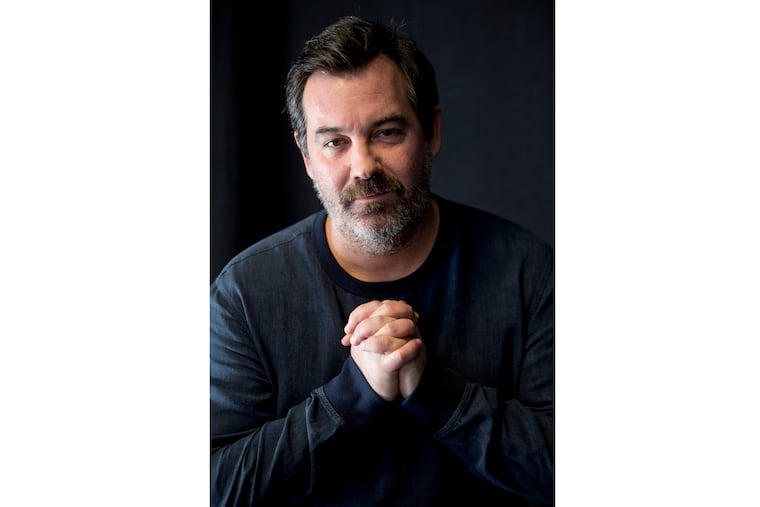
Fruits of Philosophy is one of 1,500 19th-century clandestine hardcovers that are part of the Library Company’s most recent set of acquisitions from respected medical historian, author, and avid book collector Charles E. Rosenberg. Over the last 40 years, he has donated more than 16,000 books to America’s first independent lending library.
Rosenberg’s own scholarly texts about cholera, mental health, and religion in science are widely read and referenced. However, these bound works donated by him were expected to be tucked away in secret compartments and buried in the bottom of bedroom drawers when they were first published upward of 200 years ago.
Why? Because they are all about sex. The books taught denizens of centuries past about sex and their bodies.
Not scintillating, bodice-ripping sex, but scandalous enough.
Books about every conceivable unmentionable
Americans didn’t go to the doctor for regular checkups before the mid-20th century, let alone talk to their MDs about their sexual health. Discussions about sex — even between husband and wife — were taboo.
So, an entire underground economy of books and pamphlets printed to help people navigate their sexual lives emerged. They were naughty at best, scandalous at worst, and distributed through the kinds of secret channels we think of today as the dark web. Despite their nefarious nature, people sought them out even when the tips — especially the birth control hacks in Fruits — would be considered dicey by today’s standards,
“They helped people manage their bodies,” said Rosenberg, whose collection spans from the early 18th- to the mid-20th century. “Abortion, birth control, masturbation, anything involving sexual pleasure was controversial in polite company.”
Rosenberg’s provocative collection covers every conceivable unmentionable from sterility to STDs.
Young wives learned what was expected of them in the marriage bed from sneaking reads of William H. Walling’s 1904 hardcover, Sexology. Men discovered why their virility might be waning through covert perusals of George Howard Jones’ 1881 manual The Science of Life, or, Self-Preservation, whose cover hid the book’s real title and was labeled as Know Thyself.
“Perhaps, the biblical reference on the cover hints at what the book was really about without telling you directly that it’s about sex,” D’Agostino suggested.
There are also several editions of the 18th-century masturbation treatise Onania: Or, the Heinous Sin of Sexual Pollution in the Rosenberg donation. In keeping with the mores of the times, the anonymous pamphlet damns the act but also entertains questions from anonymous readers curious about their urges.
“The conversations might have been forbidden, but people were still clearly talking,” D’Agostino said. “It really makes you wonder where these conversations started. Were people asking about themselves, or their teenage sons. … These books give us so many hints about what was important in society, what we shouldn’t talk about, but what was talked about anyway.”
Rosenberg’s favorite are the 35 copies of Aristotle’s Masterpiece. First published in 1684, Aristotle’s Masterpiece — which, by the way was not written by the Greek philosopher — is a midwifery and sexual education manual that among other things acknowledged that women do enjoy sex.
Illustrations, although rudimentary, firmly place the manual in the naughty category.
“I was very fascinated by Aristotle’s Masterpiece,” Rosenberg said. “There is just something very romantic about rare items.”
A subset of ‘popular medicine’
Rosenberg’s donated sexual health primers from yesteryear are a subset of his larger collection of hundreds of books on “popular medicine,” a term he’s lauded in academic circles for coining.
Scientific discoveries made during the Age of Enlightenment challenged the belief that any ailment — whether a stomach ache or a sprained finger — was a punishment from God. As the study of medicine found its way to the halls of universities, a new genre of reading material, blending home remedies with the popular science of the day, came on the scene. Like the wellness gurus of today.
In the 19th century, such reading material teetered between blindly obeying the will of God and understanding the needs of everyday people.
Which is why the popular science in sex subset is the most radical part of Rosenberg’s collection.
“I wasn’t interested in the high culture of medicine,” he said. “I was interested in the questions ordinary people had about their bodies as it related to their health.”
In 1962, while a lecturer at the University of Wisconsin, Rosenberg’s most famous work, The Cholera Years: The United States in 1832, 1849, and 1866, was published by the University of Chicago Press. When the first cholera outbreak hit in 1832, people thought contracting the cholera bug, which caused diarrhea and dehydration, was a punishment from God.
During the 1849 cholera epidemic, physician John Snow determined the disease spread through contaminated drinking water. When cholera reemerged in 1866, it was treated as a public health issue. Rosenberg’s book examined the societal shift’s impact on medicine and personal hygiene.
“By this time I already had a great collection of popular science books that I accumulated through my research,” Rosenberg said. “I was a nutty collector.”
Books, books, books
Rosenberg moved to Center City in 1963 to take a job as an assistant professor in the University of Pennsylvania’s history department.
Shortly after coming to Philadelphia, he befriended Edwin Wolf II, the rare book aficionado and bombastic director of the Library Company. Wolf is credited with breathing life into the struggling institution in the 1950s.
Rosenberg gave his first set of books to Wolf in the 1960s.
“I liked the notion of it being the oldest surviving colonial library that wasn’t a university,” Rosenberg, 89, said. “It was associated with Ben Franklin, the Declaration. … It was rich with American history.”
He spent the next 40 years of his life researching, collecting, writing, and giving away books about popular science.
For his 1968 book The Trial of the Assassin Guiteau. Psychiatry and the Law in the Gilded Age, he read hundreds of scientific and popular science books on insanity. He read a cadre of books on spirituality and medicine for his 1976 collection of essays No Other Gods: On Science and American Social Thought.
Each book, essay, or paper he wrote meant he amassed books on a new genre of popular science, which would eventually make their way to the Library Company — usually after a major move.
“When I moved from Center City to West Philly, I gave a bunch of stuff to the library,” Rosenberg, who became chair of the department of history and sociology at Penn in 1991, recalled. “Then I moved to Merion and gave even more books.”
In 2001, Rosenberg’s wife, Penn professor Drew Gilpin Faust, was appointed the first dean of Harvard University’s Radcliffe Institute for Advanced Study, prompting Rosenberg to donate a slew of books to the Library Company. (Faust became Harvard’s first female president in 2007 and served as its leader until 2018.)
» READ MORE: Library Company shareholders have voted for its merger with Temple University
Rosenberg kept donating books through his time on Harvard’s faculty and after his retirement in 2004. The popular sex collection donation, made in the spring of 2024, is his latest batch.
He held on to them the longest, he said, because he was toying with the idea of writing a book that looked at how sexual agency developed through the centuries and would discuss topics like abortion and masturbation.
“When I gave up on that project, I decided to part with the books,” said Rosenberg, who is now a Library Company emeritus trustee.
Sex in the stacks
The Rosenberg acquisitions are extra special, D’Agostino said, because they provide a glimpse into how people actually lived, thought about, and had sex.
“The Library Company didn’t acquire these books on their first run,” D’Agostino said. “We bought for the gentleman, the most upstanding people at the community. They would have come here looking for medical texts, but not books about managing their sex lives.”
Today, Rosenberg’s donations are nestled in the stacks on the top floors of the Locust Street building that smells of old leather.
They sit not far from the quack medicine pamphlets of the late Philadelphia-born collector William Helfand. If Rosenberg’s collection speaks to managing and understanding sexual desires, Helfand’s ephemera — a seemingly endless grouping of city directories telling where and how to cure venereal disease — is proof people were living out those desires.
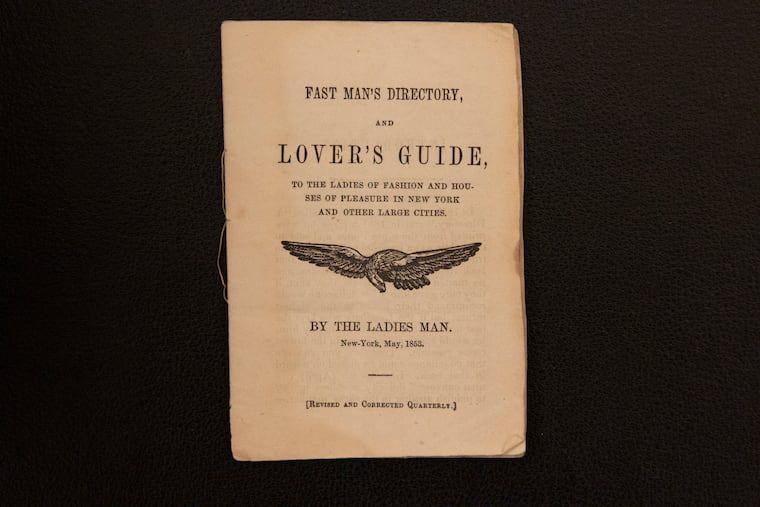
Also in the vicinity are several brothel directories including A Guide to the Stranger, or Pocket Companion for the Fancy, Containing a List of Gay Houses and Ladies of Pleasure in the City of Brotherly Love and Sisterly Affection from 1849. It reads like a Yelp review, rating things like cleanliness and performance.
“Look at how they are folded,” D’Agostino said, pointing to a centuries-old crease in one directory. “Proof that this was perhaps hidden in a man’s jacket pocket?”
Recently, D’Agostino purchased a 19th-century condom and corresponding advertising material.
People like to romanticize the 19th and early 20th centuries as a time when only people on the societal margins were having sex outside of society’s rules of decorum. And that’s just not accurate, D’Agostino said.
She still works with Rosenberg to build collections designed to help researchers illuminate stories lost to the dark shadows of disrepute but which are important to America’s story.
“A market for this work always existed and always will exist,” D’Agostino said. “It’s just finding its way into formal history now.”
Charles E. Rosenberg’s collection at the Library Company of Philadelphia is available for perusal by appointment only. It is located at 1314 Locust St.