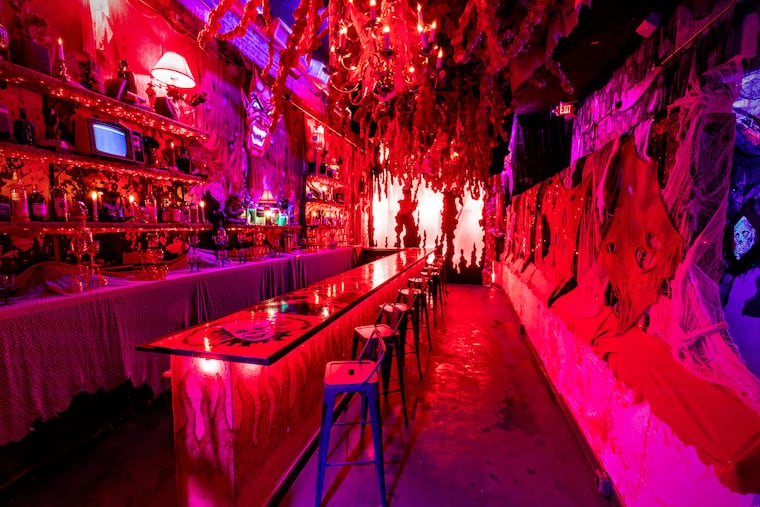
Germantown’s Colored Girls Museum transforms as vanessa german’s power figures take over
The site-specific exhibit is the artist's offering to the museum and its founder, Vashti DuBois, as the museum celebrates its 10th anniversary.
Vashti DuBois has removed all of the art from the first floor of the Colored Girls Museum. Its forest green and sunshine yellow walls now lay bare.
The living room couches, settees, dining room set, and bookcases are in storage. Hundreds of books have been boxed up and the ceramic vessels tucked away.
DuBois, TCGM’s founder and executive director, hired contractors to paint the Germantown museum’s galleries eggshell black and cover the hardwood floors with black carpet. Black curtains hang over the windows.
These changes were all made at the behest of renowned artist vanessa german. Her new show, “The House, The Oracle and the Table,” a sparkling three-piece exhibit and theatrical presentation in honor of the Colored Girls Museum’s 10th birthday, was unveiled June 20.
It is on view at TCGM and is the second act of the yearlong show “Say it loud, I’m Black and I’m proud."
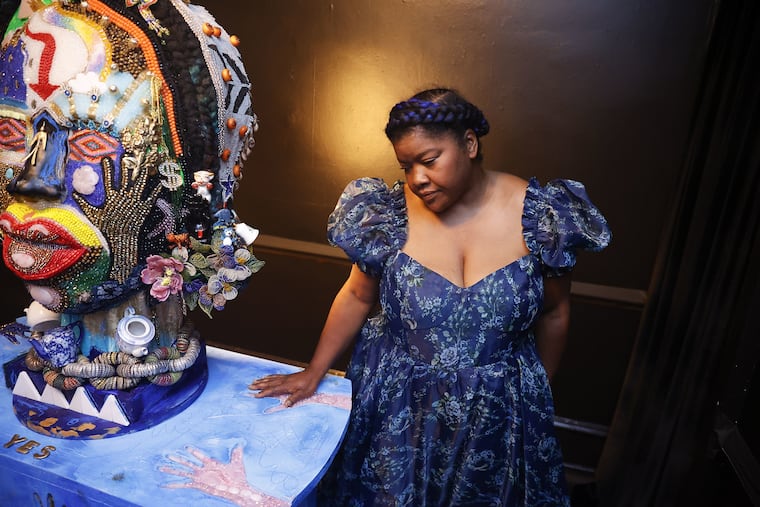
“The House, The Oracle and The Table” is comprised of three pieces. The House, a 7-foot towering talisman; The Oracle, a gem-studded bust; and The Table, an inviting drop-leaf surface with crystal-filled hand carvings. The show is german’s offering to the museum and DuBois.
“She’s one of a few artists I’d even dream of stripping the museum bare for,” DuBois said. “I released the old and I have so much more to show for it.”
‘Here the work is kinfolk’
A poet, spoken word artist, and self-taught sculptor, german is among the country’s most important contemporary artists of the moment.
Her work revels in the dynamism of the Black femme, reminding women that it’s OK to take up space with sequins — and lots of them. She’s best known for her “power figures,“ larger-than-life sculptures of Black women as sparkling, glittering, and magnificent spiritual and magical beings.
Her power figures and altars are in the permanent collections of the Museum of Contemporary Art Chicago and Pittsburgh’s Carnegie Museum of Art. In 2021, the Pennsylvania Academy of the Fine Arts acquired german’s Declaration of Independence altar. The 17-foot-long piece rejects the idea that Black women — specifically Prissy in Gone With the Wind — should be relegated to subservient roles.
German’s iconic Miracles and Glory Abound is presently on display at Doylestown’s Michener Art Museum as the centerpiece of its exhibit celebrating America’s 250th, “The Crossing: Picturing the American Revolution.” Miracles is a recreation of Emanuel Leutze’s famous 1851 oil painting Washington Crossing the Delaware. But in german’s sculpture, which features a life-size boat made from found objects, Washington and his soldiers are Black women.
“Her work allows Black women and Black queer women to take up space in a way we just can’t ignore,” said Laura Igoe, Michener’s Gerry and Marguerite Lenfest chief curator. “She’s creating a different awareness, imagining a new future, and creating a new narrative.”
It’s rare that an artist of german’s caliber creates a site-specific installation for a small community museum like TCGM, let alone makes the museum’s founder central to the show. This makes “The House, The Oracle and The Table” a big deal in local and national arts circles. TCGM is also of the community that inspires german’s art. Here, german’s work is not a spectacle or a teaching moment. It’s an understood and welcome family member.
“Here the work is kinfolk,” DuBois said.
Prayer pouches and healing monuments
The House, a 7-foot-tall, three-headed sorceress — the personification of past, present, and future — stands in the center of the living room gallery turned black-box theater, alone under a labyrinth of Edison lights. Each woman has a head of flowing locks and lips of cowrie shells. Each face — carved from plaster, epoxy resin, and wood glue and treated with a metallic finish — is slightly different from the one next to it.
They all resemble DuBois’ face.
“What’s really tender is that vanessa wasn’t afraid to see me: my past, my present, and my future,” DuBois said. “She didn’t look away. She installed the founder and executive director in this show.”
The House wears an oceanic blue dress fashioned from found objects like bottles, baby shoes, vases, and carafes. DuBois has a few items nestled in including a tea cup of her own, a carafe, and a 19th-century doll. Eventually The House will move on and when it does, it will have DuBois’ energy embedded in it.
Hundreds of quilted prayer pouches are sewn into the floor-length frock. German makes these building blocks of her assemblages by hand.
Making the pouches is monotonous work. She cuts each one out, sews it together, and fills it with beads and intention, before stitching it together. This work she said, redirects her energy from sadness, depression, and suicidal thoughts to purpose, forgiveness, and healing.
“It kept me from myself,” said german, who was born in Los Angeles, the daughter of the late quilter and fiber artist Sandra German. Her adolescence and early adulthood were filled with creative energy, but also melancholy.
The prayer pouches helped kick off her art career in the 2000s while she lived in Pittsburgh’s Homewood neighborhood. She began to build structures made of found objects and prayer bags. They grew so big she began leaving them outside, attracting neighborhood children.
ArtHouse, her community art space, was born and german began calling herself a citizen artist.
“My body went on autopilot,” said german, who now lives in Asheville, N.C. She spent a few days in June at TCGM building The House’s dress and body from pieces she’d already assembled.
“My hands would just do it and as my body repeated the task,” she said about the pouches, “I was able to make sense of things for myself. I began to heal.”
Kindred spirits
In the TCGM dining room are the exhibit’s two other pieces: The Oracle, a roughly 40-pound bust of a seer whose face is entirely made from crystals: clear quartz, turquoise, and rose quartz. Its ear, a found teapot pouring liquid gold.
Abundance.
“She is the soul of the house,” german said. “Her cup runs over.”
The Oracle sits atop The Table, whose dropped leaf features carved hand prints filled with lapis lazuli and rose quartz. The carvings represent women in the TCGM community.
DuBois has followed german’s work since ArtHouse and struck up a conversation with her on social media. But it was only three years ago that DuBois went to see german’s critically acclaimed exhibit at the Montclair Art Museum, “ … please imagine all the things I cannot say …”
She decided she wanted german’s work at TCGM.
“In that moment I knew we were kindred spirits,” DuBois said. “I didn’t ask her to do anything new. I would have been happy to have a loan from her.”
That was out of the question for german, who said she had no intention of “phoning in the project.”
“I wanted to take my time, I did not want to be frivolous with this gift … this opportunity,” german said.
‘This house is holy’
German took the energy of all the things DuBois couldn’t say and infused it in her work.
TCGM’s inception followed the unexpected death of DuBois’ husband, Al Stewart, in 2013. She opened TCGM in 2016 to celebrate the lives of ordinary Black women. Along the way, she healed.
In the last 10 years, DuBois has stewarded the museum through more than a dozen shows and won awards and major grants. A tangle with the city of Philadelphia forced her to move out of her home in order to keep the museum open. So she moved out of the place, where for over 20 years, she raised her children and lived with her late husband.
“There is exquisite pain and exquisite beauty here,” DuBois said.
Hours before the summer solstice on the third Saturday in June, german blessed “The House, The Oracle and The Table” in five separate performances, moving from gallery to gallery like a calm blue wave.
She prayed. she chanted. She sang. And many watched. Some even cried.
“This show will awaken something in people,” german said. “They will start to say things out loud they once held inside and know to be true.”
DuBois can testify to that.
“I turned myself inside out getting ready for the show,” she said. “I’ve always known that I am holy and this house is holy. Now I can say it.”
The Colored Girls Museum is located at 4613 Newhall St. “The House, The Oracle and the Table” is on view through Dec. 30.