Pa. mushroom growers are divided over cheap, grocery-store fungi
Canadians are claiming more mushroom sales as Kennett Square growers grapple with labor concerns.
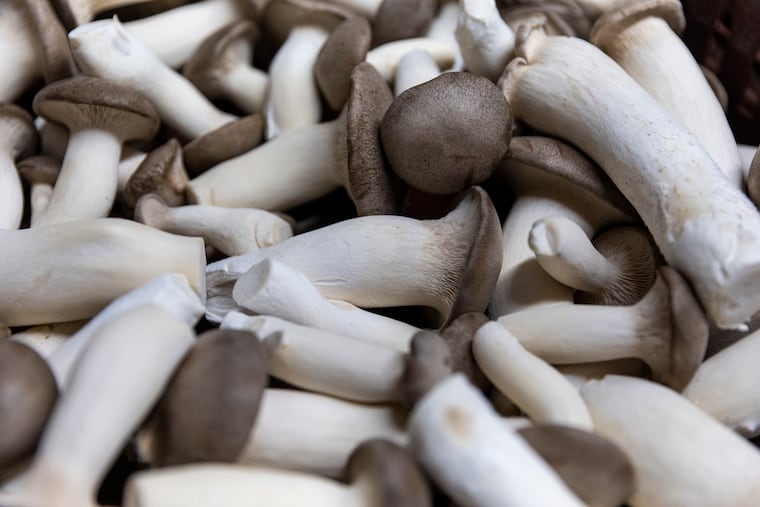
Pennsylvania mushroom growers welcomed this month’s U.S. Department of Commerce preliminary finding that Canadian farms are selling mushrooms to U.S. grocery stores at unfairly low prices.
The ruling against “dumping” threatens to make mushrooms more expensive to import, easing competitive pressure on family-owned U.S. growers in an industry also under pressure from a shortage of harvesters amid the U.S. immigration crackdown.
“This ruling supports the long-term health of our industry” in Pennsylvania, said CJ Ciarrochi, CEO and fourth-generation owner of Modern Mushroom Farms in Toughkenamon, Chester County, part of the Fresh Mushrooms Fair Trade Coalition supporting the case against the Canadians.
But one of the largest area growers called the decision a protectionist move that would enable aging U.S. farms to avoid upgrades and leave consumers with fewer choices.
“We sell our Canadian-grown mushrooms in the U.S. at a higher price than our U.S.-produced mushrooms — the polar opposite” of dumping, said Lewis Macleod, Kennett Square-based CEO of South Mill Champs mushrooms, which also has operations in Canada and Mexico.
Final decisions in September could impose penalties that boost U.S. grocery stores’ cost to buy Canadian mushrooms. The Commerce Department’s calculations suggest anti-dumping and countervailing-duties penalties, if adopted, could add 10 to 15 cents per $1 to the price of Canadian mushrooms exported by Champs, owned by Eos Partners of New York; Highline Mushrooms, owned by Japan-based Sumitomo Corp.; and Windmill Mushrooms, owned by Toronto-based Instar Asset Management.
That would ease import competition for Pennsylvania growers, who produce more than two-thirds of the U.S. mushroom crop, mostly in clusters of climate-controlled sheds in northern Berks County and southern Chester County.
The Department of Commerce’s finding “is a win for fairness, competition and the future of American mushroom farming” and for “everyone to play by the same rules,” said Mark Currie, CEO of 99-year-old Giorgio Cos.’ food division, the largest of the coalition members.
Giorgio employs over 2,300 in Berks and Chester Counties and also buys from other growers such as Modern. Its corporate parent, Giorgi Global Holdings, is an international bottle and can maker with $5 billion in yearly sales.
While Champs’ Macleod predicted the Commerce Department’s final probes would find no dumping, Currie said he expects the review of sales records would find more evidence.
“We know the private-equity playbook: ‘Let’s drive the mom-and-pops out, jack prices, and then flip our companies” to outside investors and global companies, Currie said. “We called them on it. Enough’s enough.”
Both sides agree that Canadian growers have been winning a larger share of the U.S. market.
Sales to U.S. buyers peaked at around 1 billion pounds in 2019 but have since declined, according to the Mushroom Council, a national organization that promotes the crop. Canadian farms are gaining larger sales in a smaller U.S. market.
U.S. production peaked in 2015 at 811 million pounds and has fallen each year since, to 631 million pounds in 2025.
Fresh mushroom imports, mostly from Canada, have grown steadily since 2012, more than doubling to 208 million pounds in 2025.
The trade coalition says at least 10 U.S. mushroom farms have closed since 2022, including five in Chester County and one in Berks County.
In its investigation, the Commerce Department compared the prices of premium-grade U.S. mushrooms to lesser-grade Canadian mushrooms and discounted low-priced U.S. mushrooms, Macleod said.
Canadian exports are winning U.S. customers not because Canadians are selling unfairly cheap but because Canadian farms tend to be new and efficient and grow an attractive product, he said.
Commerce began the investigation of alleged dumping and subsidies in January. The department’s latest finding follows its May “preliminary affirmative determination” that some Canadian mushroom farms were operating with an effective Canadian government subsidy of up to 5%.
South Mill Champs was set up in 2017 by Eos Private Equity, which bought a controlling stake of South Mill’s Kennett Square mushroom-growing complex from the founding Pia family and combined it with the Champs mushroom farms in British Columbia. It is based in Kennett Square.
South Mill Champs built an additional plant in 2023 in Chester County’s Elk Township, near the Maryland border, and now directly employs around 400 in the county, according to Macleod.
The company also has added mushroom production near Winnipeg, Manitoba, and is building in Mexico’s Guanajuato state. It has a processing plant in Cambridge, Md., and has diversified into mushroom-based snacks and fruit storage and distribution.
Rival Giorgio has a joint-venture plant in Saltillo, northern Mexico, which has been selling to Mexican and U.S. buyers since the 1990s.
Many of Chester County’s Mexican mushroom workers are from Guanajuato. Thousands gained legal resident status and a path to citizenship in President Ronald Reagan’s 1980s amnesty program. Many have raised families and started businesses in the county. Nearly half Kennett Square’s population is Latino, according to the U.S. Census’ 2025 estimates.
In recent years, growers have had more difficulty obtaining U.S. work permits for workers from other countries.
Miguel Morales, a Guatemalan labor contractor who served as employer of record for nearby Chester County mushroom growers from his base at an Oxford convenience store, was convicted in federal court in Philadelphia last year of hiring unauthorized workers and failing to collect and pay taxes for some of them. He was sentenced to a year in prison, plus $8 million in restitution to the IRS. The growers were not charged.
South Mill Champs’ Macleod said he and his neighbors, though they differ on trade and sanctions, all support efforts by the American Mushroom Institute to expand legal status for immigrant farm laborers.
But with government restrictions on labor growing instead of easing, he said, “we have had to limit our expansion in the U.S., owing to challenges with labor availability.”
Macleod says the key to the U.S. mushroom industry’s survival and growth is automation.
The “distraction” of the trade dispute has delayed South Mill Champs’ proposed investment in a new, fully automated mushroom farm at its Oxford facility, where there’s room to triple the size of the current facility, he said.