2026 Toyota 4Runner Hybrid: An overdue revision
The rugged SUV was definitely showing its age before last year’s redesign. So does the hybrid version make deep woods exploring more palatable in light of Trump-era oil prices?
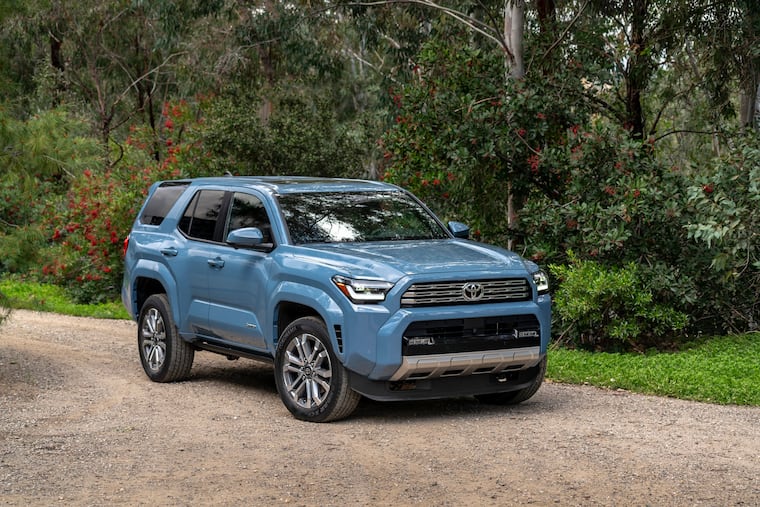
2026 Toyota 4Runner Hybrid 4WD Platinum: A wilder time off-road, now that fuel will last longer?
Price: $66,360 as tested. $200 for a tailgate LED light; one more option mentioned below.
What others are saying: “Highs: Comfortable ride on-road, massively capable off-road, electric assistance makes it peppy off the line. Lows: Hybrid battery reduces cargo space, no available third row, only moderate fuel-economy gains over the nonhybrid,” says Car and Driver.
What Toyota is saying: “4ever untamed.”
Reality: It’s a better SUV, but don’t plan on big fuel savings dividends.
What’s new: The 4Runner was moved into the marketing department’s world of all-newness for the 2025 model year, when it received a new look, upgraded technology, and the very hybrid motor and engine that give it the 4Runner Hybrid name. So we’re expecting some real fuel stretching this time around, right?
Fuel savings or not, it was definitely overdue for a remake, as noted in the 2023 4Runner review, and heck, even three years before that in a review of the 2020 model.
Competition: Here’s the shortest list we’ve seen in a while: Ford Bronco and Jeep Wrangler.
Up to speed: The 4Runner Hybrid features the usual array of drive settings, including Sport and Sport+, that might sound incongruous with a hybrid.
But the two-part power plant doesn’t slow things down, as the 2.4-liter turbo four-cylinder engine and 48-horsepower hybrid motor make a combined 326 horsepower. These launch the big SUV to 60 mph in 6.7 seconds, according to Car and Driver.
It takes the non-hybrid — the same four-cylinder turbo but lacking 48 of the hybrid motor’s horses — 7.5 seconds to cover the same ground. That’s half a second faster than the previous generation’s models with the 4.0-liter V-6.
Shifty: A normal-geared transmission paired with a hybrid is unusual, and Toyota seems to do its usual good job on the eight-speed transmission. That is, until my final test day, when I began to notice some lag now and again when downshifting, especially when turning.
On the road: The 4Runner seems like a big, ungainly vehicle in the driveway, but like its competitors, it grows on you.
The Sport and Sport+ modes tighten things up, and with a little practice I could feel where the vehicle was in the lane and how it cornered, but it never felt sporty, and definitely fell short of sport-plussy.
Driver’s Seat: I’m a fan of the Driver’s Seat. The front seats in the test vehicle were wide and supportive, quite comfortable, heated and ventilated, stitched in blue, and trimmed in leather. We’re definitely beyond the “rugged, rhinoceros hide leather seats” I described in the 2020 version, likening them to something you’d find in a firetruck.
The gauges are standard for Toyota, but the controls are plasticky with touches of matte gray and exterior-matching blue.
Friends and stuff: The rear seat is pretty nice as well; the fabric and cushioning feel soft and comfortable, and still offer good support as well.
Space is at a premium, though, as foot room and headroom are super snug, while legroom is just adequate. A large hump makes the center seat a bad place to be. And the hybrid battery pack cuts into the rear storage as well.
The big console is nice in the front but also cuts into rear legroom.
Cargo space is 42.6 or 82.6 cubic feet, depending on the seats. That’s about 10% less than the nonhybrid 4Runner, which also offers three-row versions.
Both versions of the 4Runner tow up to 6,000 pounds. The right configuration of the Wrangler can tow 5,000 pounds while the Bronco maxes out at 4,500.
Keeping warm and cool: Big dials operate the temperature and toggles work the fan and blower location.
The blower is squeezed vertically next to the giant screen and it seems either too strong or too weak, with no “just right” setting.
Play some tunes: A big dial works the volume and almost everything else is in the ginormous 14-inch touchscreen.
Sound from the 14-speaker Toyota system including JBL portable speaker is quite good, an A- heading to an A. There were points when I was hearing a little more from songs, but not consistently enough.
In and out: The automatic running boards ($1,005) are concierge-worthy in helping entry and exit for this tall beast of a vehicle. They sit nice and low, and made it possible for Mr. Driver’s Seat and his herniated disc to enter without loud groaning.
Fuel economy: I averaged just over 20 mpg with this hybrid vehicle, quite a disappointment.
The 4Runner clocked 17 mpg in 2020 and 18 three years later.
The Bronco averaged 16 mpg in Driver’s Seat testing, while the Wrangler Hemi struggled to reach 13. A 2018 Wrangler averaged 17.
Where it’s built: Tahara, Aichi, Japan
How it’s built: Consumer Reports gives the 4Runner a 5 out of 5 for predicted reliability.
In the end: If you have to have a rugged, off-road-type SUV, there’s just no better way to do it than the 4Runner. Rock-solid reliability, nice road manners, strong towing, and plenty of space help it squash the Wrangler and the Bronco like bugs on a rocky trail.