Pennsylvania AG announces bust of statewide ring allegedly selling millions in 'legal' weed
Investigators traced about $18.7 million to the alleged illegal proceeds, Attorney General Dave Sunday said.
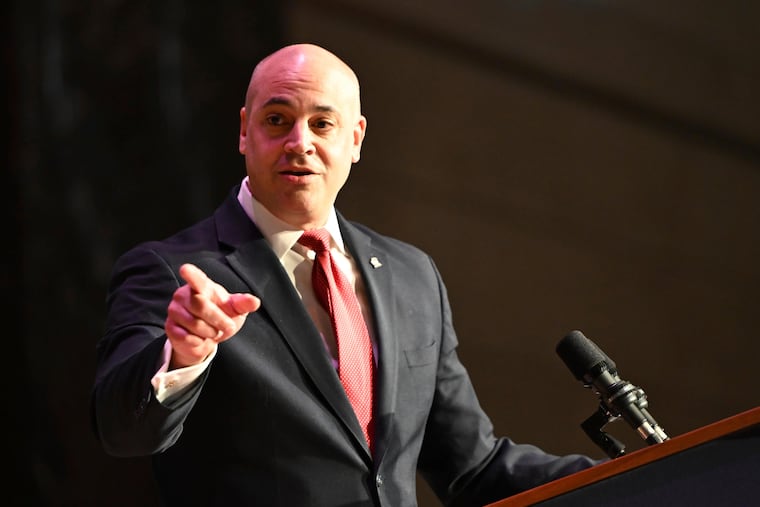
Twelve people have been charged in connection with an alleged multimillion-dollar operation to sell high-potency marijuana products in stores across Pennsylvania “under the guise that they were legal” using large distribution warehouses, including one in Bucks County, state Attorney General Dave Sunday said Monday.
Marijuana products are being been sold at vape shops, convenience stores, and gas stations because of what has been described as a loophole in federal law. This is separate from the laws passed by states, such as New Jersey, approving the sale of recreational marijuana with strict regulations.
In the Pennsylvania case, investigators traced about $18.7 million to the alleged illegal proceeds, Sunday said.
“We have closed this operation by raiding the main source warehouse locations, three of them, and by removing products from those warehouses and many convenience stores or smoke shops across Pennsylvania,” Sunday said at a news conference in Westmoreland County.
“The defendants in many cases went from being renters of homes and apartments to owners of giant warehouses and lavish residential properties,” Sunday said.
The investigation got its first “big break” in January 2025, when authorities conducted a vehicle stop in Chester County and discovered the driver was “hauling loads of THC products to these stores, illegal products, all being paid for with cash, and that was a tipping point,” Sunday said.
“So our investigation showed that this criminal organization began as a small-town, small-time operation that grew into something massive,” Sunday said.
A few months later in Westmoreland County, a related investigation was launched after authorities found that “kids at school” were consuming marijuana products sold from these stores, Sunday said.
“We know that these products can end up in the hands of children, but also adults who consume them, sometimes without knowing what they contained. The charged traffickers, however, knew what they were selling and they knew that the products were illegal,” Sunday said.
Investigators then allegedly connected the statewide operation to three main warehouses, and search warrants were executed last September in Bensalem, Pittston in Luzerne County, and Plum Borough in Allegheny County.
“These warehouses were hubs for distribution to storefronts where the products were sold, and those transactions led to consumption by kids and adults alike. From those warehouses, we seized more than 40 pallets full of illegal products,” Sunday said.
Hundreds of types of products were sold, including pre-rolled joints and candylike edibles, and investigators seized nearly 150,000 total items, Sunday said. Some were also legal products, such as snacks and sodas.
Sunday said some of the defendants owned stores where the products were sold.
“The storefronts were also scattered all throughout the commonwealth, but the pieces and the players were all working together,” Sunday said.
Search warrants also were executed at some of the stores.
The 12 individuals charged are Albina Kumar, Duttkumar Patel, Dharmeshkumar Patel, Madhav Patel, Nirav Patel, Palak Patel, Divyesh Patel, Ketankumar Patel, Niravkumar Vora, Roshniben Patel, Ankitkumar Patel, and Mitul Patel.
“Many of them are also charged with felony drug trafficking charges as well, because that is precisely what this was — a high-level drug trafficking empire disguised as legitimate businesses,” Sunday said.
Agencies that assisted the attorney general’s office in the case include the district attorney’s offices in Bucks, Chester, and Montgomery Counties. Also assisting the case were the police departments in Bensalem Township, Bristol Township, Lower Moreland Township, and other municipalities.
In the meantime, Pennsylvania lawmakers are still struggling with how to close the so-called loophole.
Under the 2018 Farm Bill, hemp became legal if it contained less than .3% Delta-9 tetrahydrocannabinol (THC) after harvest. The legislation was meant to help a struggling agricultural section.
However, entrepreneurs began extracting trace amounts of intoxicating THC variants from those legally grown hemp flowers and turning them into powerful, alternative cannabis products.