Thousands of Ukrainians face uncertainty with immigration protection set to end. Many built new lives in Philly.
“There’s a lot of confusion,” one local activist said
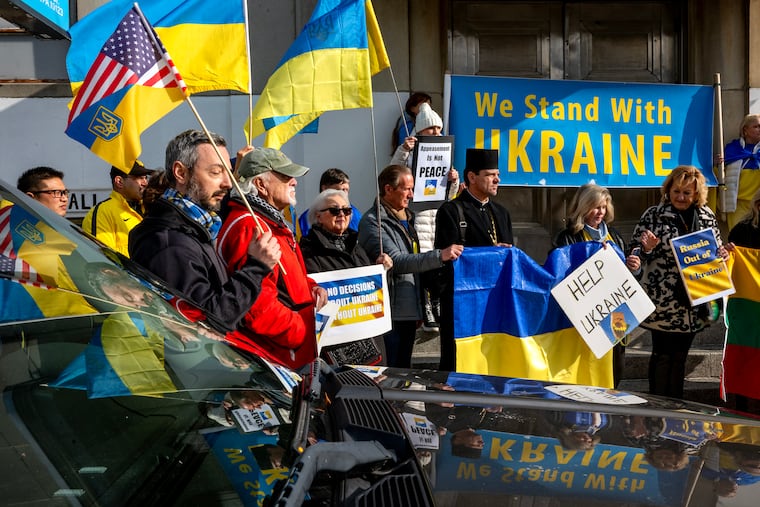
Uncertainty is sparking through Ukrainian communities in Philadelphia and elsewhere with temporary immigration protections set to expire on Monday, driving doubt about the future of 101,000 people who gained safety in this country after the 2022 Russian invasion.
Thousands could be at risk in the Philadelphia region, both those who have been granted temporary protected status (TPS) and others still hoping to get it.
Some people already have left for other lands, spurred by the unpredictability over their ability to stay here. Others have nowhere to go, their homes in Ukraine destroyed, their cities under attack, and their lives here bound to keeping their children safe and fed.
“Everyone is extremely stressed,” said Iryna Mazur, the honorary consul of Ukraine to Philadelphia, who is also an immigration attorney.
By law, she and other immigration lawyers and organizations said, the lack of prior notice from the Trump administration has automatically triggered a six-month extension of TPS. But the administration has offered no statement or clarity around that. As of Saturday, U.S. Citizenship and Immigration Services continued to list the expiration date as Oct. 19.
Last month, as protection for an estimated 170,000 people from El Salvador was set to end on Sept. 9, the administration posted a last-minute alert ― saying an announcement would be made later, and until then Salvadorans here would retain TPS.
No subsequent announcement has been made. TPS for Sudan, which protects about 1,800 people, is also due to expire on Monday.
TPS for Ukraine, Mazur said, needs to be both extended and redesignated, the latter opening the program to newer arrivals. She has been talking to elected officials about ways Ukrainians can be protected, and how at the same time local employers can count on retaining the workers they have trained and depend on.
Asked about the future of TPS for Ukraine, the Department of Homeland Security provided a statement from USCIS spokesperson Zach Kahler, who said the agency “is actively processing discretionary re-parole cases, including those for Ukrainians, on a case-by-case basis as the law intends.”
“Under this administration, all aliens are undergoing intense screening and vetting to better protect the safety and security of the American people.”
Immigration parole is different from TPS. It is a discretionary permission under which the government can allow a noncitizen to enter or temporarily stay in the United States.
The American Immigration Council says that government decisions around TPS must be published in the Federal Register at least 60 days in advance of expiration. And that if that fails to occur, as in the case of Ukraine, the designation is automatically extended for at least six months.
The government has advised people to watch for updates on the USCIS website.
“There’s a lot of confusion,” said Mary Kalyna, a Ukrainian American activist in Philadelphia.
The Philadelphia region is home to one of the nation’s larger Ukrainian communities, tens of thousands strong, and became a key point of welcome and resettlement after the Russian invasion.
“These are our neighbors, employees, parents and children,” Andre Krug, president and CEO of the KleinLife social services agency, said in a statement. “They were welcomed into this country, they followed the rules, and they became part of our community. Now they are being left to wonder whether they will be allowed to work, support their families, or remain safely in the United States.”
KleinLife, with locations in Northeast Philadelphia and elsewhere, assisted about 2,000 Ukrainians displaced by the war, providing English instruction, employment assistance, transportation, mental health services, summer camp, and after-school programming, the agency said.
It is not only Ukrainians who will be hurt by the end of TPS, Krug said. A price will be paid by area companies that depend on Ukrainians’ skills and diligence.
“Employers invested in training them and now risk losing reliable workers — not because of anything the employees or businesses did wrong,” he said, “but because the federal government has not provided a clear path forward.”
When the war started, Philadelphia and its surrounding suburban counties were already home to about 15,000 Ukrainian immigrants and 52,000 people of Ukrainian ancestry, part of an ethnic connection that stands a million strong across the United States.
The 101,000 Ukrainians who live in the U.S. under TPS were joined by 240,000 welcomed under humanitarian parole through a now-paused Biden-era program, Uniting for Ukraine.
The Ukraine Immigration Task Force, a nonprofit that helps Ukrainians fleeing the war find refuge in the United States, posted on its website that TPS had been automatically extended for another six months, to April 19, 2027.
“By operation of law,” the group said, “if the secretary of DHS does not make a final decision on whether to extend, redesignate, or terminate a country’s TPS designation at least 60 days before it expires, the designation is automatically extended. … As of now, no further action is needed by current TPS beneficiaries.”
The task force did not immediately reply to a request for comment.
Since the start of the war, Philadelphia has been a center of pro-Ukraine activism and assistance. People here have shipped everything from medicine to sleeping bags to baby bottles to Ukraine to support the war effort and the civilians there.
The Russian flag was twice stolen from the Benjamin Franklin Parkway, as Ukrainian American activists demanded it be permanently removed from the boulevard’s iconic rows of banners. Local Ukrainian Americans unsuccessfully petitioned for Philadelphia to end its sister-city relationship with a Russian town, saying the tie lent legitimacy to a murderous Moscow regime.
Many Ukrainian Americans in the Philadelphia region were staggered as President Donald Trump tilted toward Russia, blaming Ukraine for a war that prompted the largest refugee crisis since World War II.
Meanwhile, the U.S. State Department has issued a Level 4 “Do Not Travel” advisory for Ukraine, its strongest, telling Americans not to go there for any reason.
The department warns of ongoing military operations, checkpoints by Russian forces, limited medical care, and unexploded ordnance.
Yet without an extension or redesignation of TPS, says Global Refuge, a Baltimore-based resettlement agency, Ukrainians living in the United States could be forced back into those conditions.
“Ending TPS now would put families at risk and destabilize the lives they have worked hard to rebuild,” the agency said Thursday.
TPS has been a mainstay of U.S. immigration and humanitarian policy for more than three decades ― and is fast disappearing under the Trump administration.
Created by Congress in 1990, TPS enables nationals of designated countries to live and work in the U.S. while their homelands grapple with war, environmental disaster, epidemics, or other extraordinary circumstances. TPS does not include a path to citizenship or permanent residency.
Trump and his allies say, however, that TPS has become a backdoor means of continuous residency, that “temporary” means temporary and people must go.
As of early 2025, about 1.3 million people from 17 designated countries were living in the United States under TPS, according to the American Immigration Council. Since then, the Trump administration has ended or announced its intention to end TPS for more than 1 million of them, including about 330,000 Haitians.
Today only four countries retain TPS ― El Salvador, Lebanon, Ukraine, and Sudan.