Temple will for the first time require most freshmen to live on campus
The new residency requirement represents a significant change for the North Philadelphia university, long considered a commuter school before evolving in recent decades.
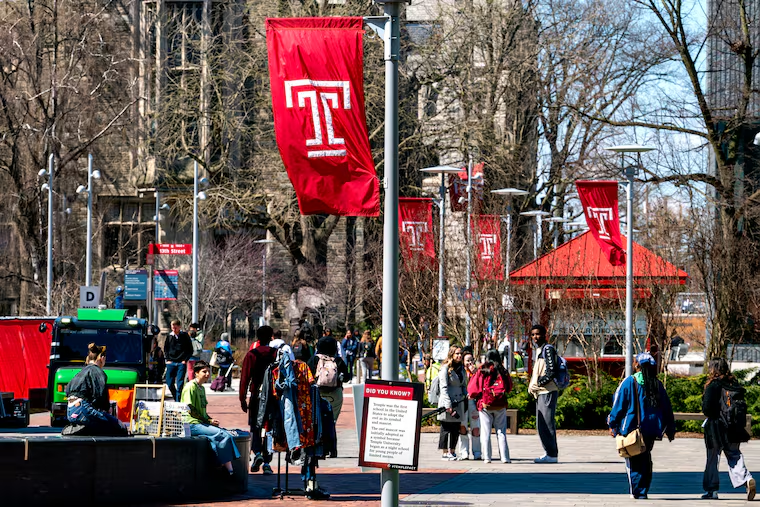
Temple University for the first time in fall 2027 will require freshmen under the age of 21 to live on campus, with certain exceptions for students living locally with parents or guardians and others facing financial hardship.
The university’s decision comes as the school makes an effort to improve the first-year experience and stem a declining retention rate.
It is a significant change for a university that for much of its history was largely a commuter school and only transitioned to a major research university with an on-campus living community in recent decades.
“The policy gives Temple an important opportunity to strengthen student success by creating a more intentional first-year experience and connecting students earlier to the people, resources and support that can help them persist and thrive,” Temple president John Fry said in a message to the campus community Wednesday.
Last fall, 63% of first-year students and 22% of all undergraduates lived on Temple’s campus, according to the university.
Many four-year colleges already require their freshmen to live on campus to better connect them to the college community, ensure they have access to support services, and improve their chances at academic success. It also brings in revenue and eases the burden of off-campus housing in surrounding communities.
The University of Pennsylvania and Drexel University require students to live on campus their first two years. Pennsylvania State University — like Temple, a state-related university — calls for freshmen to reside on its main University Park campus. Some colleges, including Dickinson in Carlisle, mandate that students live on campus all four years.
Not all schools have such a requirement, however: West Chester University, which has been tight on student housing over the years, does not, though the majority of first-year students live on campus.
“We want over time for people to think about Temple as a great residential campus that’s also very friendly to commuter students,” Fry said, “as opposed to a commuter campus that is doing some residential things.”
» READ MORE: Temple has released its plan for the next decade. See what the North Philadelphia university has in mind.
Temple will create “an intentional focus on belonging, connection, academic success, wellness, help-seeking and personal growth” during that first year, Fry said.
Peer mentorship, early intervention and academic support initiatives, mental health resources, and financial counseling for students and families are among the resources that the university will offer, the school said.
“This work will include stronger coordination across housing, advising, academic support, wellness and other student services so that students experience a more connected first year at Temple,” Fry said.
» READ MORE: Temple University lost returning students at a high rate last year. This year, first-year students will see changes.
Creating closer connections is especially important for first-generation college students and those coming to Temple from outside the area, the school said.
The university’s recently released strategic plan calls for the construction of a new 1,000-bed residence hall on Broad Street, with work beginning next year. That would increase the current 5,000-bed capacity on the main campus by 20%. Temple welcomed a record-breaking 5,379 first-year students last fall.
“We think we’re at a minimum several thousand beds short of where we need to be,” Fry said in January when the plan was released. “A stronger residential experience really does make for a much more fulfilling undergraduate experience. The more kids living on campus, the more dense campus is, I think the better we’re going to do on safety.”
The university has ramped up its safety efforts in recent years following the shooting death of a student outside his off-campus residence in 2021 and the shooting death of a Temple police officer in 2023. But challenges continue in the school’s North Philadelphia neighborhood. In April, a Temple student was chased into the lobby of the school’s Morgan Hall dormitory and attacked by a group of juveniles.
When the new residence hall opens, Temple will upgrade Johnson and Hardwick Halls, which have an additional 1,000 beds, Fry said in January.
The Annenberg Hall/Tomlinson Theater building, whose programs will relocate to a new arts and communication building in 2027, could also be converted into more residential space if needed, Fry said.
Fry expects the new first-year residency policy will lead to increases in persistence and graduation rates in future years, he said in Wednesday’s announcement.
About a decade ago, 90% of freshmen returned to Temple for their sophomore year, but by last fall, that percentage had slid to 82%, and Temple said in an internal report in April that the figure could fall below 80% this fall.
Fry said that more than 60% of all four-year residential colleges have some kind of first-year residency requirement. That includes many colleges that belong to the national University Innovation Alliance, which Temple joined in March 2025.
“Decades of research have shown that students who live on campus ultimately benefit from a more productive and rewarding college experience,” Elizabeth Wentz, Temple’s new senior vice president and provost, said in a statement.
Temple will offer several exemptions to the requirement, including those living with a parent or guardian in Philadelphia or other approved nearby zip codes. Students facing financial hardship verified through the university; those who are part-time, nontraditional, married, or have custody of one or more dependent children; and those with extenuating medical or personal circumstances that cannot be accommodated in university housing also are exempt, the school said.