Nursing shortage prompts Philly schools to offer loan repayment and accelerated programs
Philadelphia-area institutions working to expand the nursing pipeline include Gwynedd Mercy, La Salle, Thomas Jefferson University, and Penn.
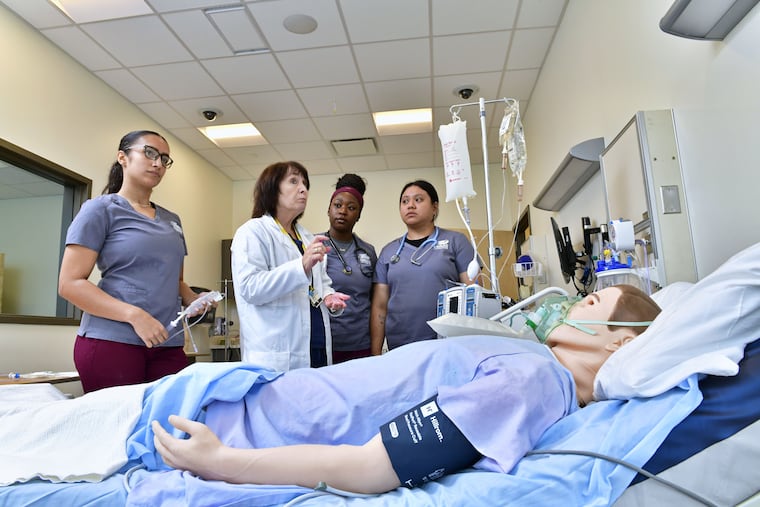
When Lansdale native Nyla Sanders received an email about Gwynedd Mercy University’s new loan repayment program, she says her heart “lit up.”
The university’s Nursing Scholars Network program offered nursing students employment after graduation at a participating health system — and their employer would repay $25,000 to $65,000 of their educational loans.
A sophomore at the time, Sanders bookmarked the email when it landed last year, intent on applying once she became eligible in her senior year.
“Wow, there’s something that can help me tackle a large sum of my loans once I graduate,” she said.
Gwynedd Mercy’s repayment program, launched in late 2024, represents one of many efforts by Philadelphia-area nursing schools to address the nursing shortage in recent years.
La Salle University, Thomas Jefferson University, and the University of Pennsylvania are among the other institutions with initiatives that range from accelerated degree tracks to educational programs for middle and high schoolers.
Two years ago, Pennsylvania was projected to have the worst nursing shortage in the country by 2026, according to a report by the consulting firm Mercer. Its aging workforce, retirement trends, issues with retention and turnover, and burnout had fueled widespread concern.
“I think we’re on a good course,” said Tom Foley, president of the Association of Independent Colleges and Universities of Pennsylvania, regarding the shortage. “The work will continue because the need will continue.”
For Sanders, Gwynedd Mercy offered a financially viable pipeline to attaining her dream of becoming a nurse. She had started college at Drexel University and transferred after her freshman year, realizing she could not afford the tuition. Full price is currently $63,078 at Drexel, compared to $41,980 at Gwynedd Mercy.
Now a senior in the bachelor’s of nursing program, she applies for a scholarship every week. Though still anxious over her loans, Gwynedd Mercy’s repayment program gives her added confidence that she can stay on the path.
“Our intention has always [been] trying to address the barriers and help to improve the workforce pipeline,” said Jane Tang, dean of nursing at Gwynedd Mercy.
A jump-start
Students in Southeastern Pennsylvania can get a jump-start on a nursing career path as early as third grade.
Jefferson partners with the Southeastern Pennsylvania Area Black Nurses Association to run the Mini Nurse Academy. Started in 2023, the program aims to improve health literacy, build interest in nursing, and diversify the profession.
“The shortage is not just about increasing the number of new hires,” said Marie Ann Marino, dean of Jefferson’s College of Nursing. “It’s about attracting people into the profession.”
» READ MORE: A ‘mini nurse academy’ for elementary school students is trying to diversify nursing
The Howley ASPIRE Nurse Scholars Program at the Hospital of the University of Pennsylvania similarly works to attract young people to nursing early.
In partnership with La Salle University, the program provides high schoolers with early exposure and mentorship. Students who go on to study nursing at La Salle also receive a guaranteed scholarship and part-time employment at HUP during college.
“The students are providing direct patient care as early as their freshman year, which is pretty unlike, I think, any other nursing student,” said Diana Rodenbaugh, nursing professional development specialist for the program.
The program aims to help Philadelphia students who may lack the financial or social supports needed to enroll in a nursing program, said Gabrielle Mariotti, who manages the program. It’s sponsored by the Howley Foundation, an Ohio-based nonprofit that supports educational opportunities to create social and economic mobility.
Goals include building a workforce that better represents the community they serve. The majority of participants are from historically underrepresented groups.
“People who are ill and hospitalized really want to be taken care of by people who look like them,” said Beth Ann Swan, dean of La Salle’s school of nursing and health sciences.
The program currently counts 43 nursing students at La Salle, with the first cohort set to graduate next May. In time, the effort could recruit a nursing workforce that is “connected and engaged with the people that they’ll be taking care of,” Swan said.
Accelerated paths
New accelerated pathways allow students to become nurses faster than the traditional four-year route.
Gwynedd Mercy offers a master’s-level nursing degree in as few as 20 months. Another part-time option, the weekend BSN program, can be completed in three years.
These target career-changers who already have a bachelor’s degree in a different field “to make nursing education more accessible to people at different stages of their lives and careers,” Tang said.
The accelerated master’s program started with 13 students in 2022 and has since grown to 59. Gwynedd Mercy has since added a second yearly admissions cycle to accommodate the popularity of the program.
Drexel University, Temple University, and Jefferson are among the other area schools that also offer accelerated pathways.
Emeritus nursing
At Jefferson Health, nurses considering retirement have the option of transitioning into a lower commitment role with fewer hours as so-called emeritus nurses.
Jefferson started the Nurse Emeritus program in November 2022 after the pandemic spurred many nurses to retire early or leave its hospitals to take travel assignments.
This program helps retain nurses nearing retirement, while bridging the gap in experience as earlier career nurses join the workforce, said Kate FitzPatrick, executive vice president and chief nurse executive officer at Jefferson Health.
About 40% of the roughly 14,000 nurses employed at Jefferson’s nearly 33 hospitals from South Jersey to Scranton have less than three years of experience.
“These really experienced nurses can dedicate time and experience to support our new and upcoming leaders,” she said.
The program’s 24 emeritus nurses work an average of six to 10 hours every two-week pay period.
Some are focused on supporting direct care: helping with admissions and discharges, patient teaching, and mentoring to nurses at the bedside. Others serve as nurse educators in clinics, or mentor frontline nurse managers.
The majority retired from Jefferson, though a few come from other health systems.
“They were not fully ready to step completely away, yet they were at a point where they knew they didn’t want to continue in a full-time capacity,” FitzPatrick said.