Repairing a King of Prussia sinkhole has taken 2 years. It’s a 500-million-year-old problem.
In a community as bustling as Upper Merion, the detour of busy Route 202 has caused headaches for business along the highway and PennDot engineers responsible for fixes.
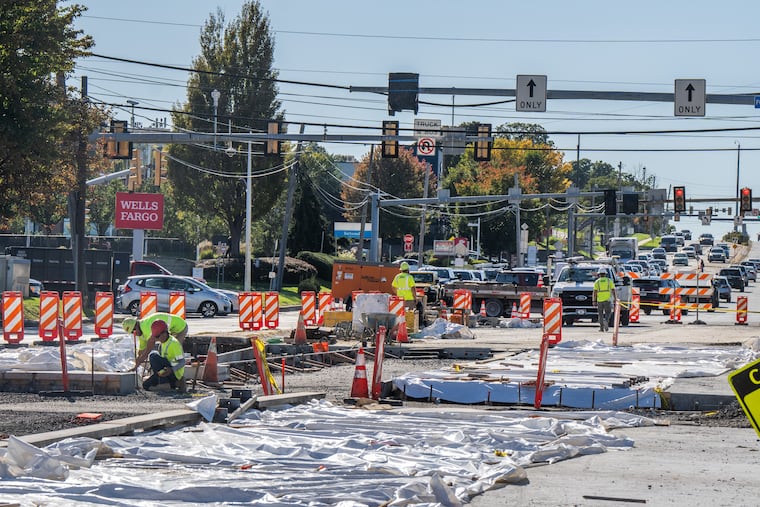
Among those who can’t wait for PennDot to withdraw its arsenal of drilling equipment and to finish repairing a troublesome patch of a bustling stretch of Route 202 in King of Prussia, Musa Jaffa might top the list.
Jaffa is manager of the Joe’s Kwik Marts and gas station fronting the southbound lanes of 202 between Henderson Road and Saulin Boulevard that have been closed while PennDot attempts to repair a sinkhole under a 120,000-square-foot surface.
To say the least, he said, business is “slow.” He estimates daily revenues have plummeted from $16,000, to about $2,000. And the traffic complications of the two-year project have had immeasurable impacts on area businesses.
“Everyone knows someone who is affected by it,” said Pattie Malone, director of Marian’s Attic, a nonprofit thrift store, on the other side of the highway.
PennDot says the $22.4 million federally funded project, which involves burrowing down more than 100 feet to apply grout, should be finished by “late fall,” as in the astronomical fall. It might not be done until mid-December, an agency spokesperson said Wednesday. Route 202, or DeKalb Pike, is a critical access road for the King of Prussia Mall and scores of other businesses.
Upper Merion Township is a commercial and commuting nexus that has experienced a remarkable economic prosperity, in large measure due to its King of Prussia core. Township population has jumped 25% since 2010. Since then the aggregate market value of real estate has more than doubled, to $8.6 billion, according to state tax data. That’s No. 2 among all the towns in Philadelphia’s neighboring Pennsylvania counties — up from No. 9 in 2010.
Yet the township continues to fight an underground war against unpredictable sinkholes — a problem that geologists point out has been 500 million years in the making, give or take a few million.
“It will never end,” Jaffa said.
What is a ‘sinkhole’?
Upper Merion happens to be in the heart of a narrow geological corridor of limestone bedrock, a “karst” formation, that extends from central Chester County across southern Montgomery County.
(The limestone alleyway bypasses Philadelphia, whose numerous sinkholes have been the result of a variety of causes.)
An ancient sea once covered the area now occupied by the likes of the mall and Joe’s Kwik Marts. About 500 million years ago, explained Geoff Hickman, Upper Merion’s public works director, shells and other sediment settled on the sea floor and over time mutated into the limestone and dolomite underlying the area today.
Rain and groundwater can dissolve the limestone and create hollow pockets below the surface. That can cause the ground to collapse, creating sinkholes, a common experience in Upper Merion.
The source of the underground water isn’t always clear, as is the case with the 202 sinkhole.
King of Prussia is a king of sinkholes
About half the land in Upper Merion is situated in “high probability” zones for sinkholes, Hickman said, and the township has a lengthy history of incidents.
In 1961, The Inquirer carried a report of “land cave-ins” in Lower and Upper Merion, “where large areas of residential property have dropped as much as 15 feet.”
A decade later, PennDot altered the route of 202 after “a series of collapses,” Hickman said. A sinkhole as wide as 75 feet opened on 202 near Mall Boulevard in 2011.
When the mall was undergoing an expansion, “the ground collapsed 35 times” between 2014 and 2016, he said.
The most problematic sinkholes are those that occur in clusters, he said. “They show that the geology and drainage conditions in those areas continue to produce sinkholes.”
The ones currently under repair, he said, “are among the most significant in township history.”
What PennDot is doing on 202 in King of Prussia
The repairs are a bit more complicated than a spackling operation.
PennDot says crews are drilling hundreds of holes, some of them through solid rock and deeper than 100 feet, and injecting pressurized grout into the subsurface.
The grout “stabilizes the ground mass beneath the roadway,” PennDot says, adding that it is a laborious and time-consuming process. It can take a minute to drill through a foot of rock.
All this effort should “help stabilize the ground beneath the pavement,” the agency said, and that will be followed by the installation of drainage piping and reconstructing the surface.
“We expect that this fix will be permanent,” the PennDot spokesperson said.
The geological future of King of Prussia, and the Philly region
Sinkholes will continue happening, but neither King of Prussia nor anyplace else around here is in danger of becoming subterranean, said Franklin Institute scientist Derrick Pitts, a geologist. Those involved in permitting are well aware of geological hazards.
“The geology of this entire region has been extensively mapped in excruciating detail for maybe a century,“ Pitts said. “They know where the trouble spots are.”
The resolution of the 202 trouble spot can’t come too soon for Jaffa and other merchants.
The road is closed for only about 0.2 miles, but getting around it requires navigating a detour of nearly a mile through often-heavy traffic.
Malone said the traffic nuisances have discouraged some people from dropping off donated items to her thrift store, operated as charity benefiting Laurel House, an anti-domestic violence advocacy group.
Her assistant manager, Lisa Cristinzio, said the construction project has become a safety hazard for some people exiting the mall where their shop is located. Numerous crashes have occurred, she said.
“It’s a mess,” she said.
Through it all, business have remained opened. On the closed southbound side of 202, makeshift lanes have provided access to the businesses that include a Japanese restaurant and an auto-service center.
But Malone is convinced the construction and traffic signage have been a customer repellent for the entire area.
“We’re doing all right,” Malone said. But, “I cannot even imagine what we would be doing if that road was open.”