Allentown energy company likely to name Union's stadium
There's a new team in town, but we're not talking about the Philadelphia Union. PPL Corp., the Allentown energy company best known for its electric utility, wants to buy the naming rights for the 18,500-seat stadium that will host the Union, Philadelphia's new Major League Soccer team.
There's a new team in town, but we're not talking about the Philadelphia Union.
PPL Corp., the Allentown energy company best known for its electric utility, wants to buy the naming rights for the 18,500-seat stadium that will host the Union, Philadelphia's new Major League Soccer team.
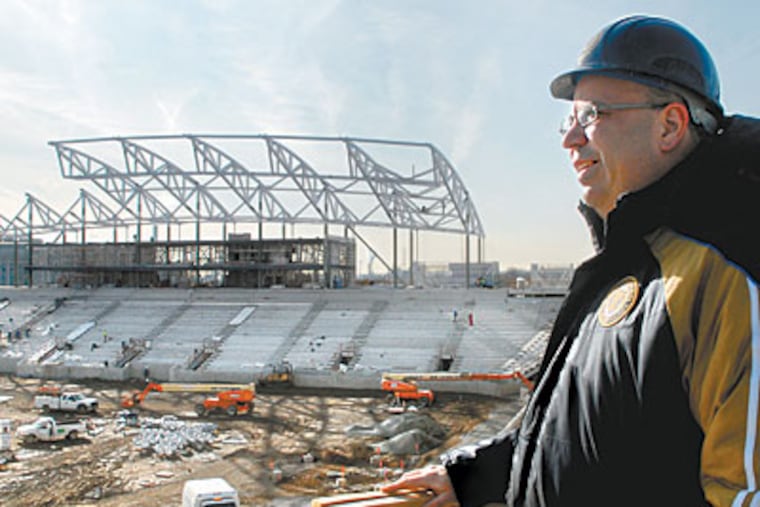
PPL is close to signing a 10-year, $20 million deal to emblazon its name on the stadium, now under construction on the Chester City waterfront. When it opens this year, the stadium would be called PPL Park.
In addition to ushering in the new professional team, PPL Park would introduce a concept even more novel to Philadelphians than big-league soccer - electric deregulation.
PPL is planting the flag in Peco Energy Co.'s service territory, where at the end of this year Peco's rate caps will be lifted, and its 1.6 million customers will be fair game for a circling legion of power suppliers.
"It's really a marketing opportunity to get our name better known in an area where we want to do business," said George Lewis, a spokesman for the Allentown company.
Though PPL is a familiar name in the 29 counties where its utility has supplied power for generations, its unregulated subsidiary, PPL Energy Plus, is poised to market its services primarily to Peco's industrial and commercial customers.
"This is the first visible sign that other companies are coming in to compete in Philadelphia," said Lewis.
The naming deal, first reported by the Philadelphia Daily News and Street & Smith's Sports Business Journal, would not be the first such partnership between an athletic club and an energy company: Reliant Stadium in Houston, Consol Energy Center in Pittsburgh, and Xcel Energy Center in Minnesota have taken their names from power suppliers seeking recognition.
"If you're a new brand, it's a good way of raising awareness," said Larry Weil, chief marketing officer for Branded Energy, a Dallas company that specializes in energy marketing.
Weil helped negotiate a four-year, $7.5 million deal in 2007 between the Houston Dynamo of the MLS and Amigo Energy, a retail power supplier in Texas. Amigo's brand is splashed across the front of the club's orange jerseys.
PPL's deal with the Union does not include its name on the team's uniforms.
Nick Sakiewicz, the Philadelphia team's CEO and operating partner, said the two sides quickly abandoned discussions about making PPL the Union's front-of-the-jersey sponsor.
"The jersey play is really a national play," he said. "They're a regional company. We discussed it, but didn't pitch it hard, because it's not a good fit."
Sakiewicz said that some details remained to be worked out, and that he expected the contract to go beyond stadium naming rights. It's likely to include investments in youth-soccer programs, business-to-business opportunities, and community events, he said.
The team's courtship of PPL began about six months ago, Sakiewicz said: "From the very first meeting, there was a lot of energy between us. We really felt like we were on the same page."
At least five other companies expressed interest, he said, but Union officials felt PPL was the best partner because they shared the same philosophies.
"They have a great, long tradition, and history - we're building one," Sakiewicz said.
The Union's $120 million stadium is rising next to the Commodore Barry Bridge, but it will not be finished in time for the first home game April 10. That has been moved to Lincoln Financial Field.
When the Chester stadium opens, it will be a billboard for a new type of electric competition unfamiliar to most retail customers here.
Under Pennsylvania's plan to introduce competition, electric utilities were broken up into separate power-generation and distribution companies. The power suppliers must compete on the open market.
PPL Corp. not only operates the traditional distribution company (PPL Electric Utilities) and a power-generation subsidiary, but it also created a marketing company that can operate in areas outside the utility's traditional service territory.
That company, PPL Energy Plus, is actually the brand name that will be associated with the soccer stadium deal. It is targeting industrial and commercial customers rather than the residential market.
PPL and other companies will likely ramp up marketing activity this summer in anticipation of the arrival of competition in Peco territory at the end of the year.
Though Peco will still act as the distributing and billing company next year, its customers will be free to choose power suppliers, which may be able to offer discounts to Peco's default rate.
The competition is likely to be intense as many companies vie for attention. Association with a sports franchise can't hurt.
Said Weil, the marketing officer for Branded Energy: "It's very hard to differentiate yourself when the thing you are selling is the ultimate commodity - electrical power."