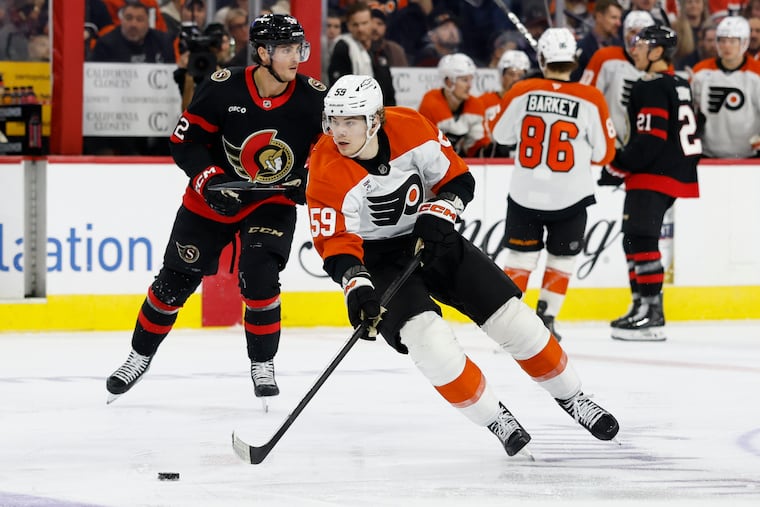
Flyers update arena rendering after fans say women were left out of the first version
Critics worried the original rendering depicted a lack of women’s representation within sports and sports fandom, too. The design firm called it an oversight.
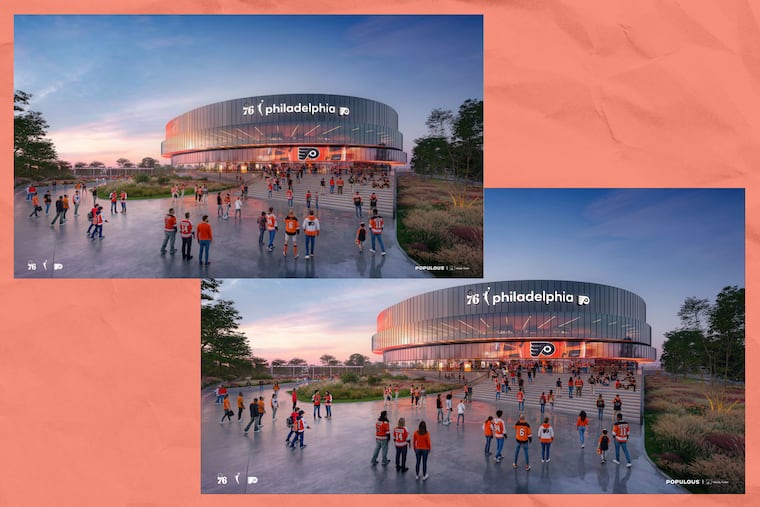
The Sixers and Flyers released the first public renderings of their new arena, which is scheduled to open in 2030, earlier this week.
Two images, which were created by Populous, the global design firm responsible for the arena’s conception, showed fans attending basketball and hockey games in the new state-of-the-art digs. But some fans say the Flyers’ rendering was missing one key detail: female fans. What ensued was a Where’s Waldo? level of analysis by people on the internet. The Flyers have since updated the rendering.
The original Sixers rendering had a handful of what appeared to be female-presenting fans, wearing crossbody purses over their jerseys, with long hairstyles and ponytails. The Flyers version was more ambiguous. There appeared to be some women sitting toward the top of the image, in clusters across the stairs, but none wearing Flyers gear.
A Populous spokesperson said the company accepted responsibility for the oversight and worked quickly to update the rendering as soon as it became aware of the issue.
“The website now reflects the updated image,” the spokesperson said.
Camille Barrière was one of the initial critics who pointed out the apparent lack of women via an X post. Barrière, who lives in Paris, studied architecture and is pursuing her master’s degree in media design at the School of Design Nantes Atlantique, with a focus on the delegitimization of women and non-male sports fans.
When the renderings came out, Barrière said online that it was “new source material” for her thesis. Her post has been viewed nearly 200,000 times on X and has since spread to other social media platforms, particularly Reddit and Instagram among women’s sports pages.
Some fans worry the lack of visibly female fans in the original rendering was more than an innocent mistake and is actually indicative of the male-centric way sports fandoms are still stereotypically viewed. Others say it’s not that serious and this much intense dialogue based off a rendering is laughable.
“As a woman, I’m hyper aware of the amount of men in public spaces, and it’s for that reason that the image struck me. I continued searching and couldn’t find a single woman in Flyers gear in that picture,” Barrière told The Inquirer.
Creating architectural renderings is not one size fits all and the process can vary considerably, but the final product can help represent the future of a space and who it belongs to, says Rashida Ng, an architecture professor at the University of Pennsylvania’s Stuart Weitzman School of Design.
“I wouldn’t presume to know how or why the particular Flyers image was produced, or suggest that the omission was intentional,” she said. “But something can be unintentional and still be meaningful. If an image of a major public venue inadvertently leaves out a substantial part of the public, I think it’s worth asking how that happened.”
The Gist and Togethxr, two popular women-founded sports media brands, called out the original renderings on Instagram. Reports show women are one of the fastest-growing audiences in sports.
“They’re buying season tickets, filling arenas, creating fan communities, and shaping sports culture across every major league. The future of sports already includes women,” the Gist wrote in its post. “The renderings should too.”
Ng says she sees the rendering debacle as a “teachable moment.”
“Design is not neutral. The spaces we create — and the images we use to imagine and communicate them — both reflect and shape ideas about who belongs, who is welcome, and whose experiences matter,” she said. “That doesn’t mean every design decision or omission is intentional, but it does mean that designers have a responsibility to think critically about the worlds their work helps to envision.”
Thursday morning, the Flyers updated the rendering on its website with a new version, one that added many new visibly female fans.
As for Barrière, she’s shocked that a non-fan’s observation from across the world sparked discussion.
“If my silly tweet that was just meant for my 40 followers can initiate a discussion on the issue, then I’m all for it,” she said. “I think inclusivity in hockey spaces, whether online or in real life, still has a long way to go, and calling out the teams directly is one of the ways we can help move the conversation forward in a positive direction.”
And thinking about those women fans is particularly pertinent for the new arena — it’s also the future home of Philadelphia’s new WNBA franchise.