An ‘economic D-Day’ that must overcome a troubled history
The original D-Day, on the shores of Normandy, did not require Chinese participation. This economic D-Day does.
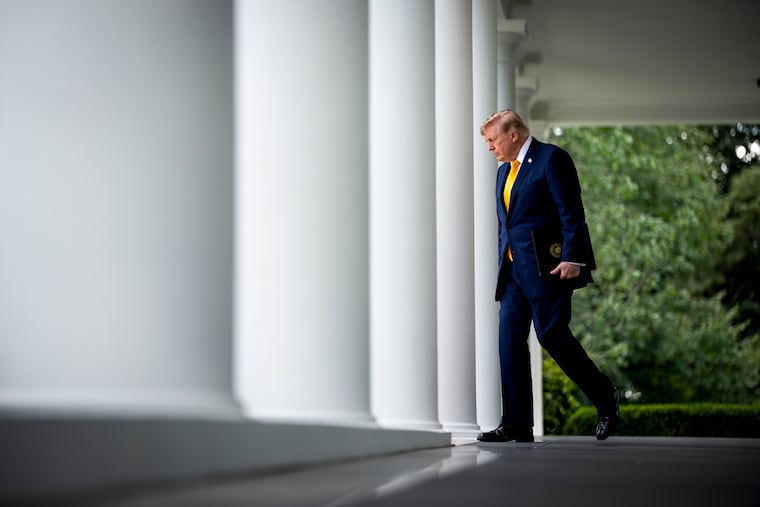
In declaring a new “economic D-Day” for Iran on Monday, President Donald Trump and Treasury Secretary Scott Bessent are reaching for yet another strategy to grope their way out of a military adventure gone wrong. Along the way they are reversing the usual approach to coercing adversaries to bend to American will.
Ordinarily, Washington approaches a problem like dismantling Iran’s nuclear program with straightforward diplomacy. If that goes nowhere, officials mix in escalating economic sanctions, adding an element of coercion. Military action is a last resort, and only if the president determines that risking American lives is worth the possible benefit.
But Trump leaped from a brief round of diplomacy straight to bombing runs, meant to force the country to give up its stockpiles of 11 tons of enriched uranium — including a batch that was nearly bomb-ready — and perhaps collapse the government. The attacks failed at both objectives, at the cost of 18 American lives, hundreds or thousands of Iranians dead, and a price tag that independent analysts put at over $100 billion, though the Pentagon’s estimates are lower.
And only now are Trump and Bessent trying one more grand experiment, named Operation Economic Outcast, that the White House described as “an unprecedented campaign to sever every remaining economic lifeline sustaining the Islamic Republic of Iran.”
The plan is not implausible. As described by Bessent, it involves choking off every last transaction that funnels money to Tehran, whether it is well-disguised digital transactions, or ship-to-ship transfers of oil, or the movement of gold around the globe. “This is a sustained operation to collapse every last option for Iran,” Bessent, who has become the public face of the effort at economic strangulation, said at a news conference at the Treasury on Monday.
But the effort raises a series of questions that the White House has not answered. First among them is why, if sanctions as airtight as these are possible, they were not employed before Trump ordered the U.S. military into battle, exposing shortages of key munitions and the limits of U.S. military power? And now that the military has, in Bessent’s words, “laid the groundwork” for success, what about China — which purchased more than 80% of Iran’s oil exports in 2025? Is the administration willing to risk another direct confrontation with Beijing, with which it is already at odds over artificial intelligence, Taiwan, a rapid nuclear expansion and a huge production overhang that threatens the global economy?
The original D-Day, on the shores of Normandy, did not require Chinese participation. This economic D-Day does, and there is no indication so far that it is forthcoming, a month before Chinese President Xi Jinping is scheduled to arrive in Washington for his first state visit in more than a decade.
“This will be tricky,” Peter Harrell, a visiting scholar at Georgetown Law School who has written extensively on the limits of economic sanctions, said on Monday.
Earlier this year, in deciding how to bring Iran to its knees, Trump “had a choice to really come down hard on the Chinese, which he didn’t want to do because of his own economic agenda with Xi, or put the naval blockade on the Iranian tankers,” Harrell noted. “It turned out it was politically easier to put the blockade on all the Iranian tanks than to tell the Chinese ‘We will sanction your big companies’ if they continued their trade with Iran.”
It is still a delicate issue.
Bessent threatened what are called “secondary sanctions” on all nations that continued to do business with Iran.
But in an opinion article for the Financial Times over the weekend and at his news conference Monday, Bessent never uttered the word “China.” He was going out of his way to avoid angering the world’s second-largest economy, and the one nation that may well determine whether this new White House strategy has a chance.
Of course, there is nothing new in trying to make Iran an economic outcast. The first serious efforts to impose sanctions on Iran for its nuclear program date back to the George W. Bush administration. When the Obama administration was trying to push Iran into negotiations in 2009, the secretary of state at the time, Hillary Clinton, promised “crippling sanctions” unless the country entered negotiations.
It took years to generate results, but many experts contend that the escalating sanctions that followed helped compel Iran to agree to the 2015 nuclear accord, sharply limiting its nuclear work in return for a lifting of financial and oil sanctions. Trump ripped up that agreement in 2018, declaring it deeply flawed.
At that time, he began reimposing sanctions, and he and his secretary of state, Mike Pompeo, predicted that the economic pressure would be too much for Iran’s leaders to take.
“The Trump administration is pursuing a ‘maximum pressure’ campaign designed to choke off revenues that the regime — and particularly the Islamic Revolutionary Guard Corps, part of Iran’s military that is directly beholden to the Supreme Leader — uses to fund violence,’’ Pompeo wrote in Foreign Affairs in late 2018. “Yet President Trump does not want another long-term U.S. military engagement in the Middle East.”
Pompeo, now estranged from Trump, sounded many of the themes repeated by Bessent on Monday. The exception is that the United States is now committed to a military presence off Iran’s coast for an indeterminate amount of time, but certainly as long as Iran threatens shipping through the Strait of Hormuz.
The record of these past sanctions is unimpressive: Iran kept shipping 2 million to 3 million barrels of oil a day despite them. Those numbers have now come down to a trickle, thanks to the naval blockade now in place.
But the nuclear material has not moved out of its rubble-covered storage sites since the United States bombed those areas in June 2025, satellite photographs indicate. And the government survives, though under different management after Ayatollah Ali Khamenei was killed in the opening strikes of the war in February. His son, considered more of a hard-liner, now holds the post, even though he has not been seen or heard from directly.
As a result, one of the more curious elements of Bessent’s speech Monday came when he returned to a promise made by Trump nearly six months ago: that he would establish the conditions for regime change.
At the time, Trump thought the military battle would last a few days or weeks, before Iran offered what the president called “unconditional surrender.” He urged the Iranian people to rise up, and take over their government, after the smoke of the U.S. bombing cleared. Trump soon abandoned that effort, acknowledging in an interview with The New York Times in June that the Iranian people simply did not have the guns or organization to make that happen.
Bessent tried a slightly different approach Monday.
“To the ordinary soldiers supporting this regime,” Bessent said, “as more and more of your paychecks stop or are supposedly just delayed, ask whether your commanders are leading your country to triumph or to ruin, and recall that the Berlin Wall fell when ordinary soldiers decided not to shoot at their own people.”
Of course, the circumstances when the wall fell were entirely different from those in Iran. There was no external, active war going on, just the accelerating pressure of the Cold War. And the Soviet Union and its satellites saw little hope in putting down the local uprisings, including the one in East Germany that led to Bessent’s historical analogy.
Yet that is Trump’s big bet right now. His decision in February to forgo the kind of sanctions announced Monday, and to move right to military force, was in some ways an acknowledgment that economic sanctions move slowly, and that history suggests they often fail to work.
Today, he is back to that plan, for absence of many other viable choices.
This article originally appeared in The New York Times.