How a ‘perfect storm’ spread fire, heat, and smoke across the Northern Hemisphere
Extreme heat and dry conditions driven by climate change stoked wildfires that one scientists calls "the new normal."
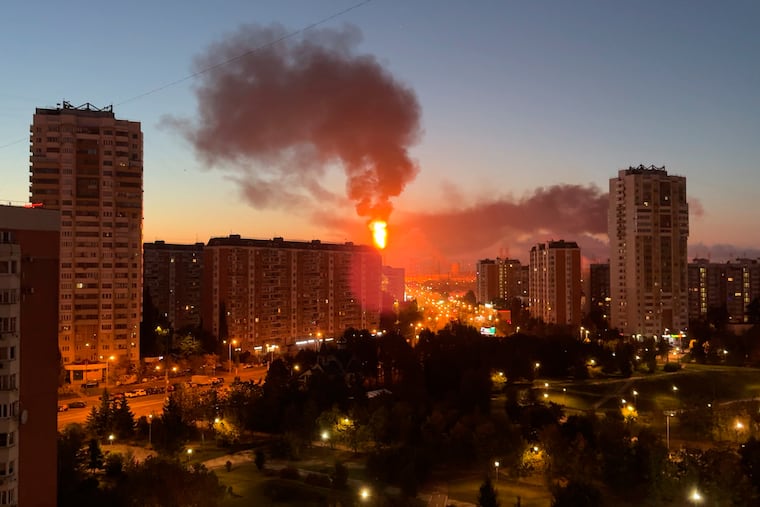
Chicago and New York choked under orange and white skies. Madrid and Bordeaux had flames licking at their doorsteps. Vast forests, rural communities, and ranchlands full of livestock in Canada and Oregon have burned — and all in the month of July alone.
Major wildfires and their massive, suffocating plumes of smoke blanketed vast swaths of North America and Europe, in some cases combining with intense heat waves that exacerbated flammable conditions and contributed to human misery.
According to a wildfire smoke analysis by the Washington Post, about 20% of Northern Hemisphere land area — covering around 7.5 million square miles — experienced moderate or greater concentrations of black carbon, the soot particles released by wildfires, at some point during July.
That included large swaths of North America — stretching into the Arctic Circle — as well as Western and Southern Europe and parts of Russia.
Against the backdrop of a changing climate, July has illuminated what it can look like when severe weather, at heightened frequency and intensity, combines to form a hellish landscape. Like 2023 and 2024, this summer is the latest chapter in the Northern Hemisphere’s fiery era, as wildfires become more frequent and intense and oppressive heat and smoke harming the health of millions become increasingly normal.
“It was like the perfect storm of very hot conditions with strong winds that fanned these fires,” said Dmitri Kalashnikov, a climate postdoctoral researcher at the University of California at Merced, referring to the flames he saw explode in Minnesota and Ontario in mid-July. Heavy smoke from those fires made its way through the Midwest and the East Coast in subsequent weeks, temporarily making cities there among the most polluted in the world.
“That direct clear linkage of big heat wave, lots of fire, then lots of smoke impacts was kind of a wow moment for me," Kalashnikov said.
In some cases, this sprawling smoke lingered over densely populated cities for days, causing poor air quality that spread toxins and increased the risks of asthma attacks, heart disease and strokes.
“There is no safe level of exposure to wildfire smoke,” said Ze’ev Gedalof, a forest ecology expert at the University of Guelph in Ontario. “We just need to expect that this is the new normal.”
Cities such as Cleveland, Denver, Detroit, Milwaukee, New York, and Philadelphia all experienced at least four days with moderate or higher smoke concentrations during July. In Baltimore, Minneapolis, and Portland, Ore., the tally was three moderately smoky days, while D.C. and Boston had two each.
In Canada, Calgary, Edmonton, Montreal, Ottawa, Toronto, and Winnipeg all experienced three to five smoky days, while Spain’s Madrid had three and France’s Bordeaux had four.
And across many of these cities, fire and smoke were not the only summer scourge.
Many of the fires occurred in areas that have recently experienced record-breaking temperatures from towering heat domes. The heat and dryness that spike as a result of these powerful areas of high pressure can drive wildfire risks. A recent study by Kalashnikov and other researchers at UC Merced found that from 2001 to 2024 more than 40% of the area torched by fires in the western United States had burned during or in the immediate aftermath of a heat wave.
“The conspicuous overlap between record-breaking warmth, dryness, and/or low snowpack and these fires is simply not a coincidence. The scientific evidence linking increasingly extreme fire weather, as well as increasingly extreme wildfires themselves, to climate warming is clear,” wrote climate scientist Daniel Swain in a series of posts on social media about the conditions across the hemisphere.
Several factors could be behind this summer’s many heat domes.
Changing jet stream wind patterns, partly linked to El Niño and a marine heat wave in the Pacific, may be playing a role, as could an unusual cold blob of water in the North Atlantic. The jet stream has been arcing up and over both the United States and Western Europe, with heat domes bubbling underneath.
But a heat dome doesn’t make a wildfire.
“There will not always be extreme wildfire outbreaks when exceptional heat and dryness occur, that is true,” Swain added in one of his posts. “But such conditions greatly raise the ceiling on what is possible in a warming world — and sometimes, as is happening now, that increased potential will be realized.”
In recent days, firefighters have made progress in containing blazes across the two countries; in the region around Bordeaux, authorities have now allowed nearly 150,000 people back to their homes, Reuters reported, to begin a recovery.
“Considering the damage to the ecosystems and the livelihoods, communities affected are going to need support from authorities for a very long time,” said Maria Alcazar Castilla, the deputy regional director for the Red Cross in Europe. “There’s people that need to build their homes, to recover livelihoods, etc. All that, in economic terms, is extremely expensive.”
Some parts of the world have always been vulnerable to fire. Canada has enormous ranges of dense boreal forest — roughly the size of the United States west of the Rocky Mountains — with few roads and scant human population. That kind of forest has evolved to burn in order to rejuvenate, said Jen Beverly, a wildfire researcher at the University of Alberta — but now has grown susceptible to more extreme fires.
“The forest don’t change quick enough to be able to reflect in the data like that. That means it’s climate change,” Beverly said.
Around 14,500 square miles of Canada have burned through July 31 this season — already above the 10-year average, although not on pace to match the extreme fire seasons of 2023 and 2025.
The intense conditions generated by July’s wildfires include the fire in Bordeaux that created its own thunderstorm. The phenomenon, known as a pyrocumulonimbus cloud, occurs when the intense heat of a wildfire sends a column of hot air and smoke high up into the atmosphere, where it cools and condenses into a cloud. The resulting thunderstorm, with high winds and lightning strikes, can further fan the flames.
“It might last for one to three to four hours, and all the while it’s connected to that fire source. And at the same time, the fire is being altered and energized by that storm that it generated,” said Mike Fromm, a meteorologist at the U.S. Naval Research Laboratory. “So it’s a feedback loop.”
Now, the American West is bracing for more of the same.
A fast-moving wildfire driven by strong winds and high temperatures swept across northwest Spokane on Saturday before jumping the Spokane River and prompting the evacuation of thousands of people.
In California, Arizona, and Nevada, a new heat dome that settled over the region this weekend was expected to send temperatures up to 115 degrees Fahrenheit in cities like Phoenix, and another bout of extreme heat could expand across the country in the days to come.