The plan to turn a contaminated industrial site in Kennett Square into housing takes another step forward despite residents’ pushback
The borough will advertise a change that could allow for housing and business at the former National Vulcanized Fiber site — once it passes muster for environmental cleanup.
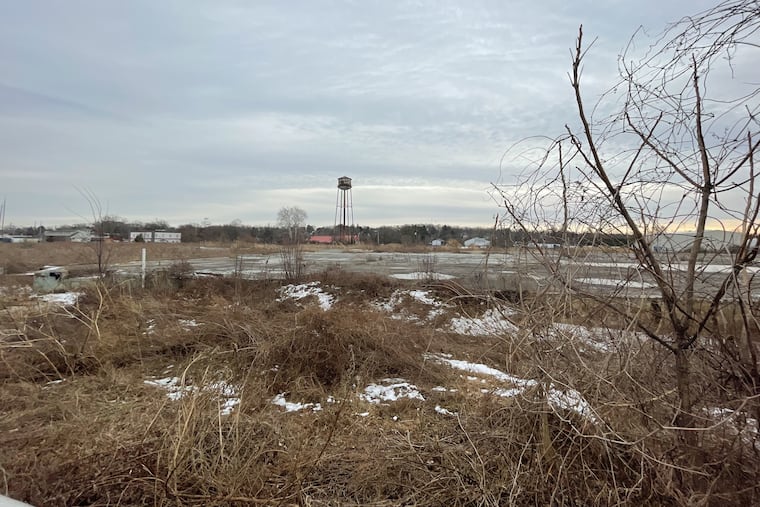
Ambitions to turn a former industrial site in Kennett Square into a residential development inched closer to reality Monday — but residents still have concerns about the land’s safety after decades of contamination.
Council voted 5-2 to advertise a change that would allow for housing and business development at the former National Vulcanized Fiber site, a long-vacant 22-acre industrial plant that ultimately contaminated the land with polychlorinated biphenyls (PCBs).
Initial attempts to allow for redevelopment of the site stalled earlier this year, when a vote to advertise the amendment failed to garner enough support due to a vacancy and an absence on the council.
But a revised ordinance received enough positive votes this week to be posted publicly ahead of a hearing on changing the zoning. It is an early step to possibly develop one of the last untouched pieces of Kennett Square into a mix of townhomes, apartments, and single-family attached dwellings. Under the ordinance, 15% of the units must qualify as affordable housing — with compliance restrictions, financial guarantees, and penalties if the developer does not comply — coming at a time when growth has soared in the borough but housing has become harder to come by.
That vision, however, has been staunchly opposed by some residents, who argue that the site is unsafe for housing and have raised concerns repeatedly about contamination cleanup and whether construction could harm the health of the surrounding neighborhoods. Federal and state agencies still need to OK the cleanup before construction could begin.
“It’s pretty clear repeatedly that the community … doesn’t want this big development to come in there,” resident Holly Peters said. “I guess what I don’t understand, and I would like an answer to, is why this continues to move forward. Like, what is the urgency to push this ordinance through? I mean, why don’t we just wait?”
How did we get here?
The site has been the subject of ongoing cleanup for roughly 40 years. NVF folded in 2007, and the property was acquired by developer Rockhopper LLC two years later, with the ambitions of turning it into housing. Officials have said that there had not been a great deal of other interest in redevelopment.
In April, the borough planning commission had recommended an ordinance amendment that would have allowed for a mixture of affordable and market-rate residential development on the site. The ordinance set parameters around multifamily use, density standards, and affordable housing stock.
In recent months, NVF has once more become a topic at council meetings, with the planning commission seeking guidance on how to move forward after the stalled recommendation.
A straw poll in June showed that a majority of the board — which consists mostly of new members — favored redevelopment of the site as residential or mixed commercial use.
In July, council members asked the planning commission to consider adding mixed-use development in the amended ordinance, which would allow retail, restaurants without drive-throughs, business offices, medical clinics, day spas and salons, and personal services.
That got a tepid reception from Austin Coleman, a representative from the developer, in July, who told the council “we do feel strongly that it’s a residential site, and it’s a great opportunity to provide affordable housing, as well as attainable housing.”
Ultimately, the planning commission included the commercial element in the revised ordinance. Allowing for such development does not mandate that it happen, however.
Borough officials have seen this as an opportunity to add affordable housing stock for residents, in an increasingly expensive county and municipality. Kennett Square has seen an explosion of growth recently, with its population rising 16% in the last five years. But with it has come a squeeze, as people are getting increasingly priced out of what limited housing is available.
What comes next?
These are still early days. The borough will now advertise adding housing and business use alongside the industrial designation. It will then go to county leadership; after that review, it returns to the council for a public hearing. If the proposed ordinance is later approved, with the additional uses for the site, it would eventually open the door for the developer to submit an application to redevelop the parcel into housing. The process could take 18 to 36 months, officials have said.
But before the developer could think of breaking ground, the cleanup efforts on the site must pass muster from the U.S. Environmental Protection Agency and the Pennsylvania Department of Environmental Protection.
For decades, the site has undergone remediation and cleanup efforts, overseen by the EPA. The agency is currently accepting public comments until Aug. 28 on its intention to approve a final cleanup application for the site.
Residents have long held concerns that the land is unsuitable for housing, and have worried that the cleanup has not gone far enough.
“I think you’re signing a death certificate for people. Unless you get the EPA to come in and strongly suggest that the property’s OK to build on, nothing should be touched,” resident Mark Thompson said.
Council member Michael Bertrando, who has said he would like to keep the site industrial, cast one of the dissenting votes, alongside council member Juan Tafolla.
“Not one resident who got up at that microphone has said that they are for this project,” Bertrando said. “I mean, yes, this is an advertisement, but why are we doing this before we have any proof that the site is cleaned, it’s remediated, and the EPA hasn’t given us their report yet?”
But for other council members, allowing for development of the long-languishing site would ensure it was actually cleaned up.
“I’m not looking to build something that’s going to create more problems or have issues or people getting sick,” council member Amy Reigel said. “I do want that property to be developed because it’s dirty. Like if we don’t clean it up, if we don’t keep moving forward, it’s going to stay there because we don’t own the property.”

Want to get Inquirer Chester County straight to your inbox every week? Sign up here for our guide to the news, stories, and events shaping life in your community.
This suburban content is produced with support from the Leslie Miller and Richard Worley Foundation and The Lenfest Institute for Journalism. Editorial content is created independently of the project donors. Gifts to support The Inquirer’s high-impact journalism can be made at inquirer.com/donate. A list of Lenfest Institute donors can be found at lenfestinstitute.org/supporters.