India’s Cockroach Party leader carries Gen Z’s many demands
On Saturday, thousands of protesters were detained at mass demonstrations, including Cockroaches co-founder Abhijeet Dipke.
MUMBAI, India — He uncorked a generation’s anger at a broken college entrance exam system.
Now the Gen Z movement that Abhijeet Dipke birthed five months ago and called the Cockroach Janta Party has become a formidable finger in the eye of the Indian government.
The cockroaches’ latest aim is the resignation of the country’s chief election commissioner, over what they say is a politically motivated purge of 130 million voters from the election rolls.
Saturday, in perhaps their biggest challenge to Prime Minister Narendra Modi’s administration, they called on supporters to defy a police ban and stage a mass protest in New Delhi.
“For the nation, its democracy, and our future, let’s all come together,” Dipke, 31, said on social media Thursday, appealing to Indians of all generations and ideologies. “Irrespective of your political inclinations, march with the youth.”
In fact, India’s youth have many more grievances: failing schools, insufficient jobs, violence against women, a lack of government accountability. Their frustrations have been boiling for years. There are so many of them — 367 million people between ages 15 and 29, the world’s largest Gen Z cohort.
Dipke said he feels intense pressure.
“It’s like someone has dropped a baby at my doorstep,” Dipke said on a recent road trip to highlight the problem with public schools in the countryside. “It actually scares me, to be very honest.
On Saturday, an extraordinary show of force by Indian authorities met an equally extraordinary display of defiance by the country’s young.
Throughout the day, thousands of people, mostly in their 20s and 30s, tried to gather. Security forces hauled them away, sometimes grabbing them by their arms and legs, and stuffed them, often forcefully, into buses and vans.
By early evening, more than 2,000 people had been detained, according to a lawyers’ group providing legal aid to the detainees, though an exact number was impossible to ascertain.
The leaders of the Generation Z movement that called for the protest, the Cockroach Janta Party, said they, too, had been detained, including Dipke.
He shared a video of their encounter with police officers on Instagram. They were landing in Delhi on a flight from Mumbai after attending rallies in other cities earlier in the week, when police officers boarded the plane.
“You can see where the nation is heading. This is dictatorship,” he said. By Saturday evening, it was not known where they were being detained.
The Delhi police appeared to confirm that Dipke was in their custody. In a post on social media, they said they had offered “assistance” to help him travel home “on humanitarian grounds” after his grandmother’s death on Saturday.
For Dipke — and the cockroaches — the risks are enormously high.
The cockroaches’ four leaders are all younger than 32, with no political experience. Signs of friction have appeared with the main opposition party, the Indian National Congress. Its leader, Rahul Gandhi, held another rally across the country, in Chennai, on Saturday.
The cockroaches already have one win under their belt: the rare ouster of a government minister in connection to the entrance exams. They seem to have emboldened many more Indians to speak out against the government. Over the last week, a range of groups, from left-wing student activists to conservative regional politicians, have rallied in several cities.
“We are just frustrated by everything. Everything,” said Aayushi Gaikwad, 18, who traveled three hours by train to attend a cockroach protest in Mumbai last Friday.
It was her first time at a protest. Around her, thousands of people waved Indian flags. As evening fell, Dipke led the crowd in singing the national anthem.
Ram Guha, a historian and an outspoken critic of Modi, credited the cockroach leaders for puncturing the “invincibility of the Modi government.”
“They clearly have a raw courage,” he said.
A campaign to fix schools
Not long after they forced the resignation of the education minister in July, the cockroaches turned to India’s rural schools. A range of Instagram-worthy horrors awaited them at government schools. Clogged toilets. Broken water taps. Overheated tin sheds for classrooms. Rotten onions in a school kitchen. Children wading through floodwaters to reach school.
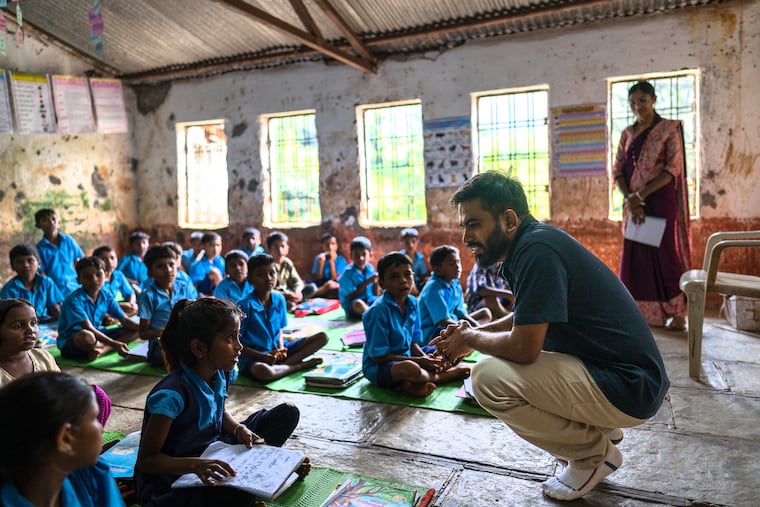
We joined Dipke as he visited a remote district in western Maharashtra state, called Nandurbar, where he had spent the first five years of his childhood before his family moved to a city.
For Dipke, fixing schools is personal.
He was born to a Dalit family, seen as low on the Hindu caste ladder. He attended private schools. But his cousins, whose parents were not as educated as his, attended rural government schools, and the contrast was obvious to him, even as a child. He sat at a desk; they sat on the floor. He drank filtered water; they sometimes had no water. He went on to Boston University for a master’s degree; they repaired cars or worked construction.
“That has been one of the most neglected things since independence. Government schools have never been given the attention they need,” he said.
At a residential girls’ school in a village called Sari, he learned there was no running water in the fourth-floor bathrooms. The girls hauled buckets of water up four flights of stairs.
At a primary school, he met the one teacher who taught a class of first through fourth graders. There was no electricity, and the girls had to fetch water for their bathroom from across a field. The boys had no toilet at all.
Vishwas Thakarey, the teacher, said he, like many teachers, had been diverted from the classroom because he had been told to work on the voter roll revision. (Teachers are often pulled away on other government duties.)
At another residential school an hour’s drive away, Dipke found a dormitory for girls made of tin walls and a tin roof. There were no beds, only thin cotton mattresses to lay out every night. Dipke compared it to “an animal shed.”
“If there are no basic facilities, how can we expect a quality education?” Dipke said.
The schools in the area serve mostly Indigenous children, among India’s most neglected.
Some education advocates say that the cockroaches’ focus on school infrastructure is neither new nor especially useful to improving educational outcomes. The latest Annual Survey of Education Results, an independent assessment, found roughly 30% of eighth graders in rural schools struggle with second grade-level texts, and around half with basic arithmetic.
In a measure of his naivete, and his awareness of it, Dipke said he had not yet read the ASER reports. He said he would.
Education experts said they hoped the cockroaches would continue their schools campaign to shine a light on an issue politicians had long ignored.
“The kind of attention they’ve been able to bring to schools, no one I can think of has been able to do that for 20 years,” said Reetika Khera, an economist at the Indian Institute of Technology Delhi who has researched rural schools for decades.
‘Not scared’
Last May, Dipke saw that India’s top judge had referred to young Indians as “cockroaches.” On a lark, he came up with the idea of the Cockroach Janta Party. Its website welcomed the “lazy” and the “unemployed.”
The idea caught fire, thrusting him into the public eye after anger boiled over at the leaked exams. “We didn’t plan or strategize this movement at all,” he said.
He admits to being no expert, on education or anything else. He said he is not a veteran activist nor a skilled orator. His sister reminds him that he was so camera-shy that he refused to take selfies with her. Now everyone wants a selfie with him.
In Mumbai last week, he went, as hundreds of fans do daily, to gawk at the home of Shah Rukh Khan, a Bollywood actor who played a character Dipke has long admired — only to be stopped for a selfie by one of his own fans. More people were looking at Dipke today, the fan said, than at the actor’s house.
Dipke smiled sheepishly, looked at the house and said, “Oh, ho. I’m still a big fan of yours.” He promptly shared the video with his 5.9 million followers on Instagram.
The next day, he stood on a makeshift stage with his fellow cockroach leaders, speaking to a crowd of thousands with a copy of the Indian Constitution in his hand.
“Finally, someone’s asking for accountability. Finally not being scared,” said Madhur Manohar, 26, who joined the protest.
“For the longest, everybody’s had frustrations,” her friend, Surabhi Apte, 30, said. “They didn’t know how to channel it. It was only dinner conversations, where your parents were like, ‘Ignore it.’”
“This is finally us doing something,” Manohar added.
This article originally appeared in the New York Times.