Oxford may soon disband its police department. The community is worried about losing its homegrown force.
The borough council is expected to vote later this month to join a regional police department.
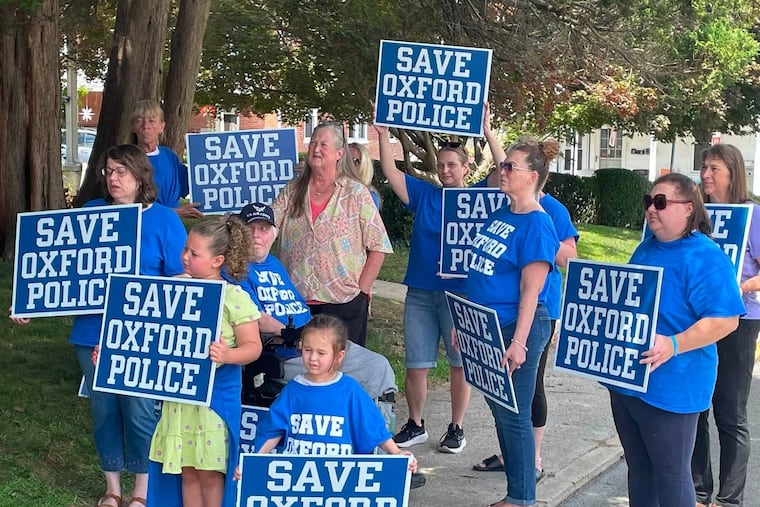
Oxford officials are inching closer to disbanding the borough’s century-old police department and joining a regional law enforcement agency, as increasing costs of maintaining the local force have outpaced revenue. But the plan has prompted worries from some residents.
The seven-member borough council will review final agreements to join the Southern Chester County Regional Police Department at its Aug. 17 meeting, where officials are poised to cast their final vote to move ahead with regionalization.
First responders represent some of the most expensive parts of a municipality’s budget, between salaries, health insurance, and pensions, as well as facilities and equipment costs. Oxford will join a smattering of other area municipalities that have moved to regionalization as a way to save money.
But the prospect has sparked concerns in the community of roughly 5,800 people. Some fear that dissolving the borough’s department will increase emergency response times and potentially leave the municipality unprotected. And they worry about losing the officers who have grown up alongside them and understand their community. Some residents have called on the township to try to save the department by cutting costs in other ways.
“These are people that literally would pull my kid over, give him a ticket, and ask how his dad is when he had cancer,” Oxford resident MaryAnn Riess said. “This is personal. This is a small town. These guys, all 11 of them, mean something to us. We buy them coffee. We buy them doughnuts. They are part of our extended family. This matters to us, and how they’re being treated matters to us.”
Mayor Phil Harris does not disagree. But he says it is becoming impossible to maintain the department at its current level — let alone increase salaries or staffing.
“We all want the same thing. I want our officers in a different uniform in our town doing the same job, with more equipment and more access to the tools they need to continue to perform at a very high level,” he said. “That’s the goal.”
Years of deliberation
When Oxford’s council casts its vote later this month, it will be after more than three years of studies and evaluations, the township said.
In 2023, leadership found its police department — which consists of a police chief, 10 full-time officers, and several part-time officers — was the borough’s largest operating expense. It accounts for about half of the borough’s expenditures, with more than $2 million budgeted in 2026 for police.
Meanwhile, the borough’s revenues were not keeping pace. Officials began exploring how they could sustainably provide public safety services long-term.
Original fiscal forecasts were quite “bearish,” Harris said. But even when the borough performed better than earlier projections, the writing was still on the wall, he said.
Its higher revenue was in part thanks to an influx of new homes with higher-than-expected earned income tax. But the largest indicator of why revenue rose was a 21% tax increase during the same period.
“We’re seeing the operational and the structural imbalances continue within the police department,” he said. “We’re struggling on the operational side to be able to maintain what we currently have.”
A July analysis from Keystone Municipal Solutions found that though Oxford’s financial status had improved, it levied the second-highest millage rate in the county, increasing by 21% since 2023, compared with the average of 12% across the county. Additional raises were seen as “counterproductive to the growth necessary for long-term fiscal stability.”
The analysis evaluated five possible service alternatives: keeping the borough’s department, restructuring the existing department, reducing staffing and supplementing coverage with Pennsylvania State Police, relying entirely on the state police, and merging with the Southern Chester County Regional Department.
At its July 29 meeting, the borough council voted 6-1 to authorize the council president, borough manager, mayor, and solicitor to negotiate with the regional department. They will present those agreements to the full council in August.
If the council votes in the affirmative, the borough will join New Garden, West Grove, and Avondale in the regional department. Formed in 2017, the department employs 21 full-time officers.
It is projected the regional department would add 12 more officers with the inclusion of Oxford. Oxford would receive 24-7 police services, with at least two officers on patrol at all times, like the current structure.
Harris said the goal is for every officer who wants to go to the regional department to do so. But there are protections and a path for those who do not.
Oxford is a ways further west from its partners; the borough is up to 16 miles away from them.
To keep response times low, the borough would have a substation — though likely not in Oxford’s existing police building — with cars in the borough. Officers would start and end the clock within Oxford’s boundaries, so there would be no shift-change gaps. They hope to retain the administrative assistant and have a lieutenant stationed on duty at the substation, Monday to Friday.
Officers would get new uniforms, the cars would be relabeled, and Oxford’s assets would become part of the regional department’s assets.
According to the report, after an increase in costs associated with up-front transition costs in 2027, annual savings would range from $300,000 to $320,000 “before declining slightly toward the end of the projection period.” The report estimates cumulative savings through the projection period at approximately $1.4 million.
“What you get by regionalizing is the economy of scale,” Harris said. “You get stability across those lines, and it’s predictability — and you can spread things out, and you can plan.”
More regionalization
The Southern Chester County Regional Department is part of a broader swell across the state of municipalities utilizing regionalized services to slash expenses, said John Brenner, executive director of the Pennsylvania Municipal League.
You would be “hard pressed” to find a community that spends less than 50% of its budget on public safety, he said. And those costs continue to rise.
“That puts pressure on local officials again to say, ‘OK, what is more efficient here? Is there a better way to do this?’ And I think a number of local officials throughout the state have said, ‘You know what? Regionalization might make a lot of sense,’” he said.
It is not a perfect solution: Across the state, municipalities have joined and then withdrawn from regional services due to increasing costs under the agreement, according to the analysis by Keystone. Similarly, Kennett Square pulled out of the regional fire and emergency services commission that it had helped start after costs soared too high. It rejoined the commission earlier this year, having not found a cheaper alternative.
In Chester County, some municipalities contract out with their neighbors’ forces. Oxford tried to embrace such a model, but its closest neighbors have relied entirely on the Pennsylvania State Police for public safety, at zero cost. Contracting Oxford’s force was an expense those communities could not take on.
Across Chester County, more than 20 municipalities rely on the state police for full coverage. Around a dozen others use partial coverage.
But that was not a direction Oxford wanted to go. While the state police do a “great job,” they are “not a community-based police department,” Harris said.
“We were desirous of having a community-based police department that operates in a different model, that knows the neighbors, that knows the streets, that goes out to the festivals, that shakes the hands and goes to the schools and the nonprofits,” he said. “We felt like the [regional department] brings that model and it maintains that standard.”
Residents are concerned
Danny Graham grew up running around town with the men who would go on to become police officers in Oxford. There is a distinct “hometown” feeling to the force, he said. It feels like the officers know what to do, how to calm people down. And they respond almost immediately, he said, recalling an incident outside his home when they were there within 2.5 minutes.
Oxford police responded to 4,406 calls for service in 2023, according to the most recent data in the Keystone report. A majority were for property and house checks, followed by traffic stops, medical emergencies, and more.
Serious crime — such as larceny or violent crime — was “not prevalent,” according to the report.
But residents worry about what regionalization will do to that community culture and speed of response.
In response, Graham created Save Oxford Police, a Facebook group that amassed nearly 1,000 members in recent weeks. A Change.org petition calling for saving the department has accrued hundreds of signatures.
He said he did not understand how the borough could have enough cash flow for other expenses, but would not invest in the department.
“Something stinks in Oxford, and we’re trying to find that smell,” he said.
He hopes that, if enough people come to the Aug. 17 meeting, they can shut the regionalization effort down by postponing the vote, with the hope something could come up in the interim to save the department.
But, if not that, “it’s no longer Save Oxford Police. It’s Save Oxford Police Officers, because now that means more than the department itself,” he said.
Riess, who believes the Oxford police force is a greater extended family for the borough, said that sitting out on the patio at a restaurant recently, her group watched an officer test each business door, making sure they were locked.
“Do you really think that’s going to happen [with regional]?” she said.
“I’ve never seen regional do that, but I haven’t seen any officers really do that. Except Oxford,” Graham said.
This suburban content is produced with support from the Leslie Miller and Richard Worley Foundation and The Lenfest Institute for Journalism. Editorial content is created independently of the project donors. Gifts to support The Inquirer’s high-impact journalism can be made at inquirer.com/donate. A list of Lenfest Institute donors can be found at lenfestinstitute.org/supporters.

Want to get Inquirer Chester County straight to your inbox every week? Sign up here for our guide to the news, stories, and events shaping life in your community.