Closing a 200-year-old institution will wound both the city and science
The oldest museum of its kind in the nation, it has inspired generations of science enthusiasts. Drexel must find a way to preserve it.
When I committed to attending Drexel University at 17, I was excited for many reasons.
Drexel is a fantastic school for science and engineering. It’s in a vibrant and central part of the city. It was near enough to my parents that I could take SEPTA to visit them on the weekends. And at that time, in 2014, it had recently become affiliated with the Academy of Natural Sciences.
That meant, as a Drexel student, I could flash my blue-and-yellow ID and be granted instant free access to the Academy museum, one of the coolest places I’d ever been.
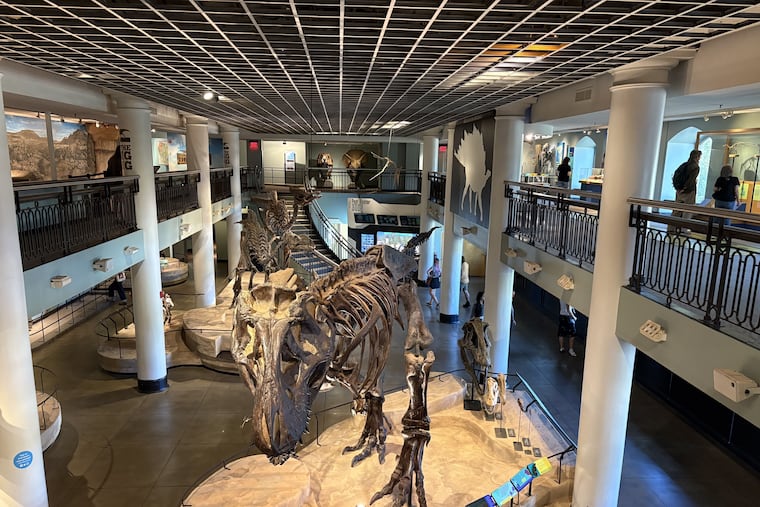
As a kid, I dug around in the mock archeology site where replica bones were buried under sediment; I learned to gingerly dust them off to avoid damaging fossils. I marveled at the Tyrannosaurus rex at the entrance with bones bigger than my whole body. I felt the humidity rush over my skin as I walked into the butterfly exhibit, where I learned how caterpillars build cocoons, how they must struggle to emerge unaided from their chrysalises so they properly develop their wings, and how wonderful it feels to see a butterfly with wings the size of soft pretzels land right at your feet or — if you were lucky — on your raised arm, goosebumps and all.
When you expose a child to science, you open a door to a new universe. In almost 200 years in the city, the Academy museum achieved something extraordinary and rare: It got kids (and adults of all ages) excited about dinosaurs and insects and animals from faraway places. It taught thousands of visitors about their connection to the natural world. It inspired generations of science-curious people to don lab coats and hiking boots and advance our understanding of what surrounds us.
If we lose the Academy, we lose a way to introduce Philadelphia’s kids to science. We lose future ecologists and conservationists and people working to save a warming world.
I’m no exception. My work now as a science journalist consists, in large part, of helping other people understand the wonders of science. I credit the Academy with helping me understand those wonders first — back when I was just a kid with a magnifying glass, an insatiable curiosity, and a terrific natural history museum accessible to my family by the regional train.
Like many others, I felt my stomach sink to see the news that the museum would close at the end of this month.
If we lose the Academy museum, we don’t just lose the fossil-digging pit and the grand hall of dinosaurs. We lose one more way to introduce Philadelphia’s kids to science. We lose future ecologists and conservationists and people working to save a warming world. We shut one more door to that magnificent universe.
I’m thankful Drexel is committed to the stewardship of the Academy’s collections, even if the museum closes. Recent reporting indicates that Drexel may have a chance to help preserve or reestablish the museum in some way.
When I was a student, I loved that my university supported an institution like the Academy — the oldest natural history museum in the United States. I can think of no better thing to do for the city and for future Drexel students than for the university to help find a way to preserve this incredibly special museum in Philadelphia.
If they do that, they won’t just have my gratitude. They’ll have the thanks of current and future science enthusiasts throughout the city, and along the tracks of the regional trains.
Gina Vitale is a journalist and writer who grew up in Greater Philadelphia.