Renaming Wissinoming Park after Margaret Tartaglione is a travesty | Shackamaxon
Plus: Mayor Cherelle L. Parker’s tax proposals are denied, and SEPTA prepares for the World Cup crush.
This week’s column covers Mayor Cherelle L. Parker’s big setback, SEPTA’s World Cup plans, and an extraordinarily dubious honor.
Budget chaos
Under its previous two mayors, Philadelphia experienced a subtle shift in power. While the city’s Home Rule Charter explicitly created a “strong mayor” form of local government, disagreements with Mayor Michael Nutter and disengagement by Mayor Jim Kenney led to more and more authority shifting to City Council.
Initially, it seemed like Parker would reverse this phenomenon. She got her first budget passed without significant fanfare, secured most of Council’s support for the proposed (and canceled) Market Street Sixers arena, and implemented her housing initiative without major changes.
How quickly things change.
Council is now in full revolt over several of the mayor’s ideas. On Thursday, it passed an initial budget that did not include a slew of Parker’s proposed tax increases.
In many ways, the mayor has only herself to blame for this. Despite her own years of service in the legislature, including a stint in leadership, she seems to have forgotten the way things work on the fourth floor.
She also seems to prefer negotiating directly with Council President Kenyatta Johnson over engaging with members individually. This leads to the kind of routine standoffs that used to categorize the relationship at the federal level during the 2010s between President Barack Obama and House Speaker John Boehner.
Like Johnson, Boehner could simply tell the administration, “I can’t get this through with my members” — a move that strengthened his bargaining position while removing his responsibility for the impasse.
Parker also deviated from a standard practice in these cases in an important way. Officials typically levy dedicated taxes when there is a logical connection to the program being funded, such as using revenue from fuel taxes to pay for road repairs and other types of infrastructure that are impacted by the use of motor vehicles.
Parker took a risk by attempting to impose taxes where the revenue source (her proposal on rideshare trips, for example) did not have an intuitive link to the city service that would benefit from the fee (public education). Tying the rideshare tax plan to transit funding could help solve that problem.
But the worst development for the mayor may be the rejection of her proposed tax increases by the state legislature. Parker’s prowess at securing additional money and authority for Philadelphia from Harrisburg was a key part of her appeal. From the cigarette tax to the additional sales tax, then-State Rep. Parker was an effective advocate for the city’s needs. Now she faces what looks like a hard no from both Council and the General Assembly.
That said, don’t be surprised if some of these ideas end up being implemented later, much like the soda tax.
World Cup crush
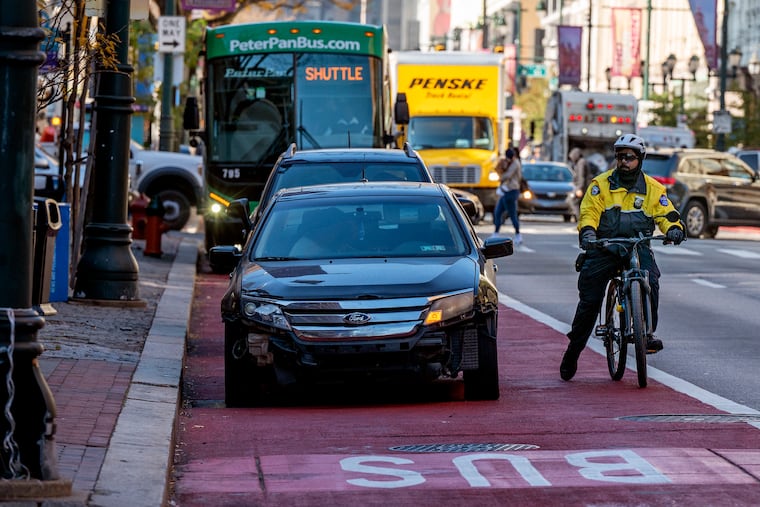
When the Eagles play at Lincoln Financial Field, their spectators arrive from all over the region. When the World Cup comes to town, a larger-than-usual chunk of attendees will be coming from hotels in and around Center City. This means the Broad Street Line is going to be tasked with transporting more people than usual for games.
The transit agency is warning that this could take hours.
Each train can hold at most 1,000 people. SEPTA spokesperson Andrew Busch told me that its current signal system allows for a departure every four to five minutes. The agency also has just 19 train sets, which also limits its ability to scale up. That caps the number of people that can be transported at around 15,000 to 20,000 per hour. Meanwhile, there could be 40,000 people all trying to get back at once.
I suggested that SEPTA do something it’s long been reluctant to pursue: opening the lower platform at NRG Station. Agency staffers and transit nerds have offered everything from Americans with Disabilities Act (ADA) access to inadequate width as a reason to forgo utilizing this extra capacity. Busch reiterated the width concerns, while noting that the idea has not been ruled out.
It may be time to rule it in. If SEPTA can have four whole trains available when the matches end, it could transport 4,000 people in one go. Crowding concerns can be alleviated by having staff control access to the lower platforms and closing off the entrances when they get too full. While ADA access is essential (a fact underlined every time I navigate the system with a stroller), the lack of elevators to the lower platform would not remove the existing accessible options at the station.
Another way to avoid forcing people to endure long waits is to give them something to do after the game. Perhaps the postgame show could be broadcast to the stands, or tents could be set up for rival teams to celebrate their wins, commiserate a loss, or analyze a tie.
Dismal honor
Wissinoming Park, a place where I spent much of my own childhood, will now bear the name of former City Commissioner Margaret “Marge” Tartaglione, who died in 2019. While city officials frequently honor people who are less than deserving, this particular renaming is galling.
When I first joined the Philadelphia City Commissioners in 2014 as an entry-level data and community outreach coordinator, the office tasked with overseeing elections was working to fix the years of mismanagement and outright misconduct that had characterized the department under Tartaglione’s watch.
To give a sense of the environment, some employees had set up a “marijuana lounge” to smoke and watch TV during the down season for election workers. Tartaglione hired her daughter, Renee, as a deputy.
Renee Tartaglione was forced to resign after nine violations of city ethics rules and was later convicted of 53 counts of conspiracy, theft, fraud, and tax evasion. Despite the hefty charge sheet, it took jurors just four hours to come to a conclusion.
The older Tartaglione herself would do things like threaten to punch reporters and compare federal election monitors to Adolf Hitler.
The voter registration building had what I would describe as a shrine to Frank Rizzo, a mayor known for brutalizing the city’s Black and gay residents. There was no formal leave policy, and some employees hadn’t been seen in weeks or months. Pay was miserably low, so employees were given leave to work overtime without significant oversight. Fixing all of this took time and negotiations.
The worst part of Tartaglione’s tenure was the allegations that she used her office to electioneer. In 1994, her tactics led to a federal judge invalidating an election, opting to remove Democrat William Stinson from the state Senate in favor of Republican Bruce Marks.
Republicans alleged that local Democrats forged absentee ballots and went door-to-door to solicit them, in violation of the law. Tartaglione testified that she was aware of these efforts, and she actively tried to conceal them. Stinson was later acquitted of voter fraud charges.
This was not Tartaglione’s first rodeo, however. All the way back in 1978, she was accused of sending faulty voting machines into Black neighborhoods to help then-Mayor Rizzo, who was seeking to modify the City Charter so he could run for a third consecutive term.
Changing the name of a beloved local park in order to honor one of the city’s most notorious civil servants should be shocking, but in Philadelphia, it is par for the course.