Letters to the Editor | Oct. 26, 2026
Inquirer readers on the Cornell University sexual assault case and concerns that Donald Trump would misuse presidential emergency powers if the GOP suffers significant losses in next month’s election.
Tech threats
In raising the possibility of a Donald Trump-led coup if Democrats gain control of one or both chambers of Congress, Inquirer columnist Will Bunch asks whether Americans would come together to stop such an unthinkable act.
I wonder if we could, given how much we’ve come to depend on digital technology for both information and communication.
Meta’s deactivation of the No Kings Coalition’s Instagram account on Oct. 17 should scare anyone who wants to protect democracy and the free flow of information. Regardless of whether this incident was a mistake, as Meta maintains, it shows what Big Tech can do if it allows itself to become one of the Trump regime’s most useful tools.
Of course, I also worry about the harm Congress would continue to rubber-stamp if it remains in GOP hands. And I long for the days when elections were routine matters, not something to fear regardless of the outcome.
Lisa Von Ahn, Pottsville
…
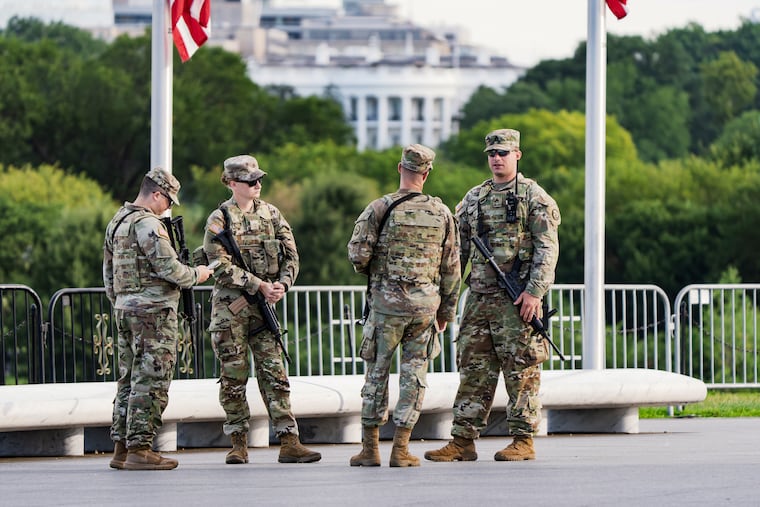
Will Bunch’s column informed us that there are Presidential Emergency Action Documents that give the president power to void the Constitution. They were designed in the event of a destructive nuclear war. Additionally, a 2025 law may be used against people the administration defines as enemies — no war or insurrection needed. What happens if Donald Trump and the GOP decide to vacate the results of next month’s elections? Is there any doubt that he would abuse these powers? He already has National Guard in Washington, U.S. Immigration and Customs Enforcement, regular military, reservists, and more National Guard throughout the country. How would we act? My son-in-law, a Marine who participated in the first invasion of Iraq, told me, “I was in favor of the Second Amendment in case we were invaded. In Iraq, I saw what our military could do and realized those small arms were useless” against a military force. As a Vietnam vet, I agree. In the 20th century, military or violent revolutions only led to dictator or totalitarian governments. The only thing is to peacefully take to the streets. If that fails, we will need to organize underground, as in The Handmaid’s Tale.
John “Jack” Marquess, Haddon Heights
…
Will Bunch’s column in Tuesday’s paper adds to other frightening warnings about the possibility of upheaval in our country’s democracy. His piece draws a line from President Donald Trump’s actions — undermining our voting system, attacking the judiciary and the press, weaponizing the Justice Department, etc. — to the potential creation of a totalitarian state. Then there are Trump’s imperialistic ambitions, which we see in his attack on Venezuela to seize the country’s oil, the decrease in our critical support for Ukraine, the inhumane strangulation of Cuba, the ongoing conflict with Canada, and the quest to control Greenland. Added to these ominous signs is the fact that those around Trump are involved in initiating, participating in, or approving these actions, including the GOP-controlled Congress. It brings to mind a goal of an attempt to divide up the world among dictators: Russia gets Europe, China gets Asia, and the U.S. gets North, Latin, and South America. Horror of all horrors. We Americans must recognize that the threats to our democracy and the world order are obvious. The coming elections will be critical. We desperately need leaders who will break the growing misdirection of our country.
Luis W. Morales, Paoli
…
How is it that Will Bunch’s column — “Are the secrets to a postelection coup locked in a White House safe?” — is not on the front page of The Inquirer? The emergency powers that a rogue president can invoke as well as the Presidential Emergency Action Documents are startling. How come we’ve never heard of this?
Donald Trump is a thug, and we’ve already seen how Congress, the Department of Justice, Supreme Court, and all his Republican cronies are in his pocket.
If the Democrats do win control of either chamber of Congress next month, that optimism will be deflated shortly; Trump is a dictator and dictators don’t relinquish power easily. Trump almost always finds a way to get what he wants, and he will not go down without a fight by claiming the election was rigged.
Wake up America, Nov. 3 will be déjà vu — Jan. 6, 2021 all over again.
Cynthia Davis, Lansdale
Real and surreal
I suspect the benefits of artificial intelligence may have to follow the same paved highway littered with the same skepticism that today’s ubiquitous personal computers once traveled before they became an integral part of our daily lives.
The past can offer valuable lessons as we attempt to anticipate and prepare for the future. But history also reminds us that even the most influential figures can be spectacularly wrong when predicting the course of technological progress.
Thomas J. Watson Sr., the longtime chair of IBM, is often credited with predicting that the worldwide market for computers would amount to only five machines — a quotation whose authenticity remains uncertain.
Then there was Ken Olsen, founder and president of Digital Equipment Corporation (DEC), who was widely reported to have said in 1977, “There is no reason anyone would want a computer in their home.”
Both remarks are enduring examples of how even prominent technology leaders can underestimate the potential of an emerging technology. IBM went on to become a giant of the computer industry, while DEC helped pioneer smaller computers that brought computing power beyond the realm of massive mainframes.
The lesson is not that every modern technology deserves uncritical enthusiasm. Rather, it is that skepticism about an innovation’s usefulness should not be confused with an accurate prediction of its future. The personal computer transformed how we work, communicate, learn, and live.
Whether artificial intelligence will prove equally transformative — or something more consequential — remains to be seen. But history urges humility before we confidently declare what people will or will not want, need, or benefit from in the future.
Steve Wenick, Voorhees
Breaking silence
As a fellow Philadelphian and a woman who has had experiences similar to Jane Doe’s, I think it’s extremely important to recognize the importance of supporting survivors of sexual assault and holding the perpetrators accountable. I’ve personally seen a disgusting amount of backlash against and harassment of Jane Doe on social media, including sickening remarks from even my own peers at school. And it’s especially upsetting that, despite Jane Doe’s allegations, criminal charges were not initially pursued against the men. When one case isn’t taken seriously, it discourages other victims from speaking out because they fear they won’t be taken seriously either. I think the protesters’ decision to share their own experiences was powerful because it shows others that sexual violence is not an isolated issue or something that we should keep to ourselves. In my own life, the publicity surrounding this case has made me less afraid to speak about my experiences and has encouraged me to use them to help others. As a society, we should continue creating spaces where survivors can speak about sexual assault and support one another, while pushing for meaningful action and accountability rather than allowing these issues to be ignored.
Annie Goldrick, Philadelphia
Join the conversation: Send letters to letters@inquirer.com. Limit length to 150 words and include home address and day and evening phone number. Letters run in The Inquirer six days a week on the editorial pages and online.
About letters to the editor
Letters feature a reader’s written opinion and are submitted in response to an article in The Inquirer or another topical issue. Submissions should be sent to letters@inquirer.com. Limit length to 150 words and include the writer’s home address and day and evening phone number. Letters are published in the Inquirer six days a week on the print opinion pages and online.