PhillyDeals: Were bailouts the right thing to do?
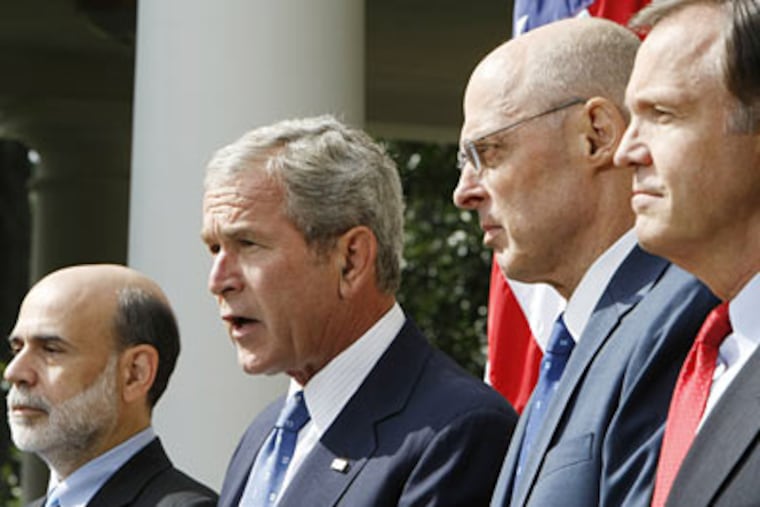
They don't want you to call it a bailout. "We expect that this money will eventually be paid back," President Bush said.
They don't want you to call it a bailout.
"We expect that this money will eventually be paid back," President Bush said.
He means the taxpayer-backed arrangements to keep Fannie Mae, Freddie Mac, American International Group Inc., big banks, money market mutual funds, and over-their-heads homeowners from painful losses on the bad subprime loans or loan-based bonds they were holding when the home-price inflation machine got jammed in reverse.
Bush is right that refinance schemes such as bank deposit insurance and the Resolution Trust Corp. that took over busted loans from failed 1980s savings banks are designed to pay back taxpayers, though not as well as if the money had been sensibly invested, said Drexel Law School professor Karl S. Okamoto.
Leaders in Congress, financial companies, and regulators mostly support this rescue package, though they were still working on details - like who's in charge - when last we checked.
The resistance included back-bench Republicans, hedge funds, traders, business scholars, and some off-Wall Street citizens, who said it was better to brace for pain, let bad investments fail, and allow inflated home and securities prices collapse to natural levels so business can grow again soon.
Grow again soon? Nobody knows, and that's why the Washington-Wall Street axis wants a government cushion against the specter of more business slowdown, mass unemployment, fear.
"There's been plenty of notice this was coming. But our government only functions quickly when there's a crisis," says Robin Weissman, Pennsylvania's state treasurer and a former Goldman Sachs Group Inc. investment banker.
"The idea that we could put blinders on and tough it out is totally, totally unrealistic, in terms of the real world."
West Chester investor Richard Gates, cofounder and portfolio manager at $450 million-asset TFS Capital L.L.C., doesn't blame the government for acting. "The situation is very dire," he said. "Paulson and Bernanke are doing what's in the best interest of the country."
But look who's getting saved. "It's ironic that Goldman Sachs and Morgan Stanley are getting the benefit of this unprecedented intervention." The investment banks borrowed heavily on overpriced loans and securities. "They should be punished. The market was punishing them."
Instead, "to help the man on the street, they are subsidizing the millionaires who have come out of Goldman Sachs and Morgan Stanley the last few years. It's disgusting. It shouldn't sit well with anyone. But it's probably in the best interest of the world."
Drexel's Okamoto said the RTC was a good model for the bad-loan and bad-bond buyer the feds want to set up: It turned the loans over to private-sector firms that had an incentive to resell them at the best possible price. Good for themselves, and taxpayers.
"They absolutely have to do it, to set up an RFC," said Vanguard Group Inc. founder John C. Bogle, referring to the Depression-era Reconstruction Finance Corp. "That helps human beings who need help badly. But I don't think we should bail out money market mutual funds or tell hedge fund managers how to trade. Let the market clear."
"Markets are going to find their level whether you artificially step in front of them or not," said Kenneth Kamen, president of $250-million-asset Mercadien Asset Management L.L.C. in Princeton.
Okamoto also questioned company intervention. "They should feel the pain," he said. "I was very happy when they let Lehman go down. I was disappointed when they saved AIG."
Recovery would be quicker if the companies were allowed to fail, Okamoto said. "There's so much liquidity in the world. The Middle East, China, India."
If U.S. assets start trading again at new, lower prices, more foreign money would be invested here, and new (or newly reorganized) banks would quickly replace the old ones, Okamoto said.
"But I don't know how Americans would react to that."
Wall Street might howl at its loss of power. But "would Main Street - or Chestnut Street - really notice the difference?"
.