Can brain training improve memory?
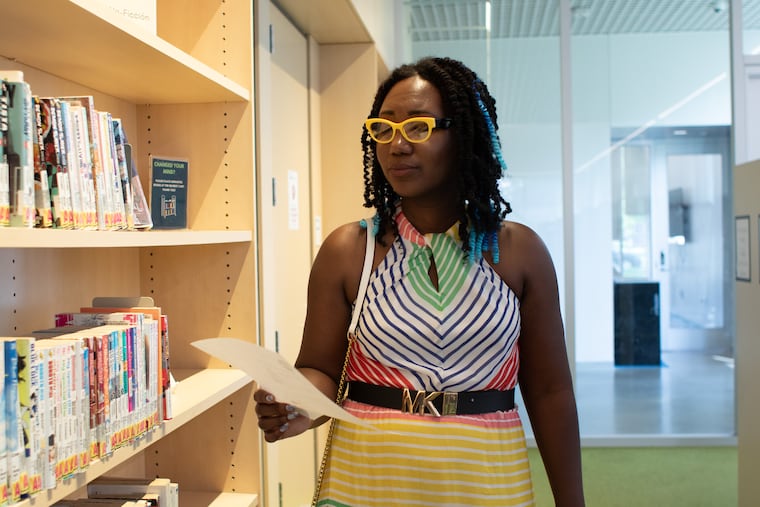
Seventeen-year-old Imani Gordon thinks a good memory will help her be a better veterinarian someday. So the West Philadelphia student was intrigued when she saw a poster on the train for a Temple University memory study. She had already signed up for Lumosity, an online brain-training program. The study might help too, she thought. Plus, it paid $120.
Seventeen-year-old Imani Gordon thinks a good memory will help her be a better veterinarian someday.
So the West Philadelphia student was intrigued when she saw a poster on the train for a Temple University memory study. She had already signed up for Lumosity, an online brain-training program. The study might help too, she thought. Plus, it paid $120.
"I just want to improve my memory," she said after finishing preliminary testing at psychologist Jason Chein's neurocognition laboratory last month. She had agreed to do twenty 40-minute sessions of computer work over four weeks. Chein's team would then see whether her working memory had improved. Working memory is what lets you keep several thoughts in your head and work with them even while distracted. It's what helps you write a report while keeping up with e-mail.
Chein's team would also look at whether Gordon's judgment, a quality that is especially vulnerable to social factors in adolescence, had improved. The theory is that better working memory, which depends on the ability to control mental focus, could lead to more deliberative decisions about risk.
Chein is among a growing group of researchers worldwide studying working memory, which is tied to lots of other things that matter. People with good working memories do better in school. They read and write better and have better language comprehension skills. They're better at multitasking and following directions.
"If it's cognitive," Chein said, "working memory predicts performance."
Because working memory is so strongly associated with achievement, many researchers want to improve it in children and young adults. It peaks in early adulthood and often becomes problematic in old age, so scientists would also like to bolster abilities at the other end of the life span.
"It definitely is a very hot area," said Sharon Thompson-Schill, a cognitive neuroscientist at the University of Pennsylvania.
Research that has found improving working memory changes other types of thinking or makes people smarter has been highly controversial. Critics say some studies used the wrong kinds of tests or control groups.
"The field is replete with really, really bad science, in my opinion," said Randall Engle, a research psychologist who has studied working memory for decades at Georgia Tech. He is particularly critical of a study that found working-memory training raised intelligence, but said he also had concerns about Chein's work.
Thompson-Schill, who edits the journal Experimental Psychology, said the evidence for "transfer" - the idea that training in working memory can make people better at something else - was decidedly mixed.
"For every study where someone claims to find an effective transfer," she said, "you can probably find a study where someone has done something very similar and has failed to do so."
"My position is that the jury is still out," Chein said of the effect of working-memory training. He thinks Engle is "a little too skeptical" and that "some people have been pretty good scientists about this."
The evidence for improvement, he said, is better in young than in old people.
This kind of research is challenging. The goal of any cognitive training is to make people better at something important in the real world, not just at the training itself. Measuring success is difficult, and definitions of working memory vary. Because post-training performance might be affected by subjects' belief that they've improved, it's also important to have an "active" control group that thinks it's doing something useful but actually isn't. That's not easy to do, either.
Chein's latest project combines two lines of his work. He's previously shown that young people make riskier decisions when peers are watching. He also found that college students who got working-memory training had more improvement in reading comprehension than a control group that did nothing. And they did better on a test that measures cognitive control - the ability to focus on a particular task or goal amid distraction or to inhibit a response.
Before training, participants ages 13 to 17 take tests that measure working memory, fluid intelligence (used to solve new problems), risk-taking, and sensitivity to rewards.
There's an active control group this time that answers questions about general knowledge.
Those getting the working-memory training answer questions involving verbal and spatial skills, memory, and the ability to withstand distraction.
The verbal test uses the "n-back." It presents the teenagers with a list of letters on their computers. Periodically, they're asked whether the letter they see is the same one they saw "n" letters back. Let's say you've seen J, K, and P and your "n" is two, you'd have to remember that J was the letter two steps before P. "N" gets bigger as people get better at the test.
The goal of the spatial task is to remember the location of darkened boxes in series of grids. For distraction, the students sometimes are shown two pictures of objects rotated differently in space. They have to decide whether the objects are the same.
Chein is still recruiting teens, so it will be awhile before the results are made public.
Would it be so bad if people who got working-memory training just got better at working memory? Some of us would love to be able to hold on to a few more thoughts, even if it didn't make us smarter or less likely to text while driving.
Chein said even the question of whether working-memory training can improve working-memory capacity - the number of ideas we can juggle - was still unanswered. It may be that attention is the skill more amenable to change. That still could improve real-life functioning.
Nelson Cowan, a memory researcher at the University of Missouri, said working-memory practice might be more helpful for people who don't use this ability much. Many of us already have mentally demanding lives. "In my opinion," he said, "there are a lot of people that are exercising their full working-memory capabilities in everyday life."
He and Engle think trying to change our mental capacities may not be as important as understanding them and compensating for limits.
Children who have trouble in school often have problems with working memory, Cowan said, and scientists know working memory develops throughout childhood. Teachers should give children information in a way that doesn't exceed their capacity. Writers can also communicate in a less mentally taxing way.
Engle said he'd seen no evidence that fluid intelligence can improve. He thinks people may be able to learn to better control their attention and to slow down to avoid mistakes.
"Does that increase your intelligence? My answer is an unqualified no," he said. "But it does allow me to behave in a more intelligent way."
Gordon said she enjoyed being part of Chein's study, and thought she learned a lot. She took quizzes on everything from SpongeBob to ancient literature and then read up on the questions she missed.
She questioned whether the work she did improved her memory. "No," she said. "It wasn't really like memory."
Temple's Jason Chein says we don't yet know for sure how to improve working memory, but here are some suggestions:
 Engage in regular physical exercise.
Find mental tasks like Boggle that challenge working memory.
Try mindfulness meditation, which isn't just relaxation, but focusing internal attention.
Avoid continuous periods of high mental workload just before important tasks, as they can deplete working memory.
Give your mind some actual downtime. Don't pull out the smartphone every time you have a break.