How Milton Street jury reached verdict
T. Milton Street Sr., brother of former Mayor John F. Street, will be sentenced in September for failing to file income-tax returns for three years. He faces 27 to 33 months in prison. At his trial in February, he was acquitted of mail- and wire-fraud offenses in an alleged scheme to sell an airport-maintenance contract he did not control. Below is the story of how his jury reached its decision.
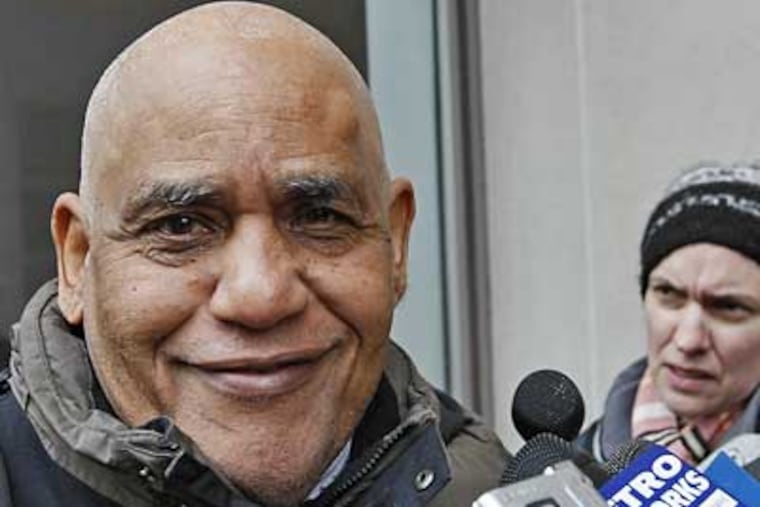
T. Milton Street Sr., brother of former Mayor John F. Street, will be sentenced in September for failing to file income-tax returns for three years. He faces 27 to 33 months in prison. At his trial in February, he was acquitted of mail- and wire-fraud offenses in an alleged scheme to sell an airport-maintenance contract he did not control. Below is the story of how his jury reached its decision.
About 3:15 p.m. on Tuesday, Feb. 19, 12 jurors were led from a spacious sixth-floor courtroom at the U.S. Courthouse in Center City to a small, windowless room to begin deliberating United States of America v. T. Milton Street Sr.
Street, the former sidewalk food vendor, onetime state legislator, and community activist, rabble-rouser, scofflaw, and political wild card, was charged with fraud and evading taxes on more than $2 million in unreported income. The evidence seemed daunting: By his own admission, he had failed to file income-tax returns for several years. Others accused him of defrauding a Vietnamese businessman by selling him rights to a contract Street no longer controlled.
Three days later, after almost 20 hours of stressful, sometimes heated talks, the jury acquitted Street of four fraud charges, deadlocked on two tax counts, and found him guilty of three counts of failing to file tax returns.
"No corruption, no fraud. No corruption, no fraud," Street crowed to reporters as he left the courthouse.
If he had heard what jurors said privately, he might not have been so exuberant.
"We were disgusted by the whole thing," one juror said, referring to Street's consulting business with Philadelphia International Airport contractors and other companies looking for city contracts. "We felt everyone we heard from was guilty of something.
"We would have convicted Street of influence-peddling and never producing a single thing for his clients - if such a charge existed. But the government did not make its case."
Juror Anthony Sama, 38, a self-employed computer programmer from South Philadelphia, described the process as a "journey to the truth."
"Most of us started out in very different places from where we ended up. I know I did, and I'm very happy with what we decided," Sama said.
Not that the journey was easy. Said Sama's fellow juror: "It was very interesting, but not one minute was fun."
'Very stressful'
Through five days of testimony, the conference room alongside Courtroom 6A had been the jury's lounge, the place to gather in the morning and during breaks in the trial.
But once the case had been presented and jurors got inside, a transformation took place: The door was closed, and a uniformed court security officer sat outside.
"It was very stressful," one juror said. "We were all acutely aware that he could wind up spending time in jail, and we took that very seriously."
After days of being ordered by U.S. District Judge Legrome D. Davis not to discuss the case among themselves, the jurors were now free to do just that.
Their first job was to elect a foreman or forewoman, who would be their only link to Davis - and only by written notes.
That person was Kathy Nosia, 49, a Phoenixville insurance worker.
Sama recalled that some jurors had asked Nosia if she would be interested because she had been the first juror selected.
Nosia agreed. Days later, when the jury seemed deadlocked, she jokingly asked the judge in court: "Can I change my mind?"
With the hour late, Sama said, the jurors decided to "go around the table" and state their views.
There was no formal vote and no consensus, he said.
Fraud, tax-evasion cases
Wednesday, Feb. 20, was the jury's first full day of deliberations in what was basically two trials: a fraud case and a tax-evasion case.
The indictment alleged that Street had failed to pay federal income taxes on $2 million in consulting fees between 2000 and 2004. He was accused of not even filing a return in 2002, 2003 and 2004.
The fraud charges involved what prosecutors called a scheme in 2003 to cheat an immigrant Vietnamese businessman named Thanh Nguyen out of $80,000 by selling him rights to a $3.2 million airport maintenance subcontract - rights Street allegedly knew he did not possess.
It was soon apparent there were no strong advocates for finding Street guilty of fraud.
As for the tax case, one juror recalled that the panel was split, with nine for conviction and three for acquittal.
Street had testified that he depended on his accountant, Fred Johnson, to file his tax returns and pay what he owed. But when explaining why he did not file a tax return for three years, Street said he had studied the legislative history of the federal tax and was convinced the tax code was unconstitutional.
Sama said most jurors had considered Street's claim "unbelievable."
Still, a few wondered if the defense had any validity. So about 90 minutes after they began the day, the jurors were back in court.
Nosia asked Davis whether Street's stated belief in the tax code's unconstitutionality justified not filing returns.
The other players in the trial - defense and government lawyers - seemed surprised. The tax counts came after fraud on the verdict form. Did that mean the jurors - less than two hours into their review - had already disposed of the fraud case?
They hadn't. In fact, jurors recalled more of a free-flowing parliamentary debate than the stereotype of 12 people systematically taking secret ballots until unanimous. By the end, that scattershot approach would wear out the patience of some jurors.
"There was a lot of debate," one juror said. "I was very impressed with how most people were pretty open-minded and willing to listen to other jurors' arguments."
Sama recalled that more than a few wound up reversing their original beliefs.
But in the courtroom, the jury would not be heard from for the rest of that first day.
String of questions
Over the next two days, the jury kept lawyers and spectators mulling the meaning of a string of questions.
The handicapping culminated in the announcement after lunch on Thursday, Feb. 21, that the jury had reached verdicts on two counts but was deadlocked on seven others.
In the jury room, tempers seemed on the rise. In court, loud voices could be heard coming from the back room.
Jurors interviewed were unwilling to discuss the dispute in detail, but apparently the freewheeling talks had finally worn down one juror. As another continued dissenting, the juror yelled, "Will you shut up?"
"It took a few minutes for some of us just to get the others calmed down," one juror said.
The dispute was loud enough, recalled the juror, that the security officer outside later looked in to make sure everyone was OK.
In court, the dispute was not mentioned. But the relationship among some jurors had changed, and several seemed upset as they took their seats in the jury box.
Davis said the jurors should continue deliberating but suggested leaving early and starting afresh on Friday.
"Can I just make a statement?" interjected one male juror, his voice edgy.
The judge cut him off.
Friday would become judgment day.
By that point, Sama said, the fraud case had lost any adherents.
It came down to the credibility of the government's two key witnesses: Nguyen and a former airport contractor's employee assigned to help Street, who had pleaded guilty to fraud. Both developed major problems on the stand when asked about questionable business or financial dealings.
"We found most of the major players in this pretty sleazy, but the [fraud] evidence just wasn't there," one juror said.
"Every one the government brought forward, they were guilty of stuff themselves. It just wasn't believable," said juror Mary M. Briggs, 62, a retired hairstylist from Southwest Philadelphia.
What did not seem to bother jurors was Street's reputation or his oddly comic turn on the stand.
"We went by the law," Briggs said. "I found that most seemed [like] they could separate him from his public persona."
Street's conversion to tax resister was another matter: It was hard to accept not even filing a tax return.
"Some believed it at first, but in the end everyone came around to the belief that his epiphany occurred the day before" he testified, one juror said.
Yet the jury deadlocked on the two counts of assisting in the filing of false tax returns, showing how juries parse their way to a verdict.
The jurors said they had believed Street when he testified that he trusted his accountant, Johnson, to handle his taxes in 2000 and 2001.
Johnson testified that he had pleaded guilty to bankruptcy fraud, mail fraud and underreporting income, charges not related to the Street prosecution.
"We gave Milton Street the benefit of a doubt," Sama said. "The accountant seemed incompetent."
The vote on the two tax counts was 9-3, and Sama said the three not-guilty votes could not be moved.
Briggs called the Street trial "emotionally exhausting."
It was her fifth time as a juror - she was on two criminal and two civil trials in Common Pleas Court - and she said she hoped it was her last.
"If it wasn't for me already taking the oath," she said, "I'd never have made it."